


Introduction: When Existing Custody Arrangements No Longer Serve a Child’s Welfare Custody arrangements can require revision when a child’s circumstances materially change after an earlier order. Indian family courts examine such requests primarily through the welfare of the minor. The Guardians and Wards Act, 1890 provides the principal statutory framework for guardianship and custody proceedings. Section 17 requires courts to consider factors connected with the child and proposed guardian. Section 25 addresses circumstances involving custody and return of a ward.
Therefore, custody modification requires evidence rather than allegations alone. A parent may seek changes to physical custody, visitation, access, schooling arrangements, or communication schedules. However, the requested arrangement must remain connected with the child’s welfare. Family Courts can exercise jurisdiction over guardianship, custody, and access disputes. Chennai families may therefore require coordinated legal assistance across custody, divorce, maintenance, protection, and enforcement proceedings. Legacy Family Court Law Firm: Chennai Divorce Experts can assist with pleadings, evidence preparation, interim relief strategy, and court representation.
Legal Framework Governing Custody Modification
Understanding the Guardians and Wards Act Framework
Why the Guardians and Wards Act Remains Central to Custody Modification The Guardians and Wards Act, 1890 governs important aspects of guardianship and custody litigation. Courts examine guardianship questions through the statutory welfare principle. Section 17 directs attention toward the minor’s welfare and several relevant circumstances. These circumstances can include age, characteristics, relationships, and the child’s intelligent preference. Courts can therefore examine present conditions rather than mechanically preserve an earlier arrangement. Section 25 also concerns custody where a ward leaves or remains outside appropriate guardianship custody. Consequently, lawyers must identify the precise relief required before drafting the petition. A custody modification request can seek physical custody, access, visitation, or structured parenting arrangements. Moreover, evidence should demonstrate why existing arrangements no longer adequately protect the child’s interests. A strong petition should connect each requested change with specific facts and supporting documents.
Changed Circumstances Supporting a Modification Request
Material Changes Can Justify Revisiting Earlier Custody Arrangements A custody order does not necessarily prevent later judicial consideration of changed circumstances. Children grow, educational requirements change, and family circumstances can develop substantially. Therefore, a parent should identify concrete developments occurring after the earlier arrangement. Relevant changes may involve relocation, schooling, health requirements, employment schedules, safety concerns, or household conditions.
However, dissatisfaction with the previous order alone may not establish sufficient grounds. Courts generally require facts demonstrating why modification would better protect the child’s welfare. Lawyers can organise those facts chronologically and connect them with admissible evidence. For example, school attendance records may demonstrate disruption under an existing arrangement. Similarly, medical records can establish changing healthcare requirements. Police complaints may become relevant when alleged conduct creates a genuine safety concern. Consequently, custody modification litigation should focus upon measurable developments instead of personal accusations. This approach also helps the court understand the practical effect of the proposed arrangement.
Child Welfare as the Paramount Legal Consideration
Welfare Requires a Child-Centred Assessment of the Proposed Arrangement Custody litigation should present the child’s welfare through specific and verifiable circumstances. The court may consider emotional stability, education, health, safety, continuity, and meaningful parental relationships. Section 17 also permits consideration of an intelligent preference expressed by an appropriately mature child. However, the child’s preference does not automatically determine the outcome. Courts can assess whether external pressure influences the child’s stated preference. Therefore, parents should avoid coaching children before interviews or judicial interactions. A lawyer can instead prepare the parent to respond calmly to welfare-related questions. Evidence should demonstrate practical parenting capacity rather than simply financial strength. Stable housing, schooling involvement, healthcare participation, and consistent caregiving can become relevant facts. Furthermore, a proposed visitation schedule should respect school routines and developmental needs. The legal objective remains a workable arrangement that protects the child while preserving appropriate parental relationships.
Parental Fitness, Conduct, and Caregiving Capacity
Courts May Examine Conduct That Directly Affects the Child’s Welfare Custody disputes can involve allegations concerning neglect, violence, substance misuse, abandonment, unsafe environments, or repeated interference. Such allegations require careful pleading because unsupported accusations can distract from welfare issues. A lawyer should distinguish relevant conduct from ordinary matrimonial disagreements. For instance, repeated conduct affecting a child’s safety can carry greater significance than marital hostility. Likewise, deliberate obstruction of court-ordered access may require separate enforcement remedies. Evidence can include school communications, medical records, messages, photographs, complaint records, and witness testimony. Where criminal allegations arise, the relevant criminal process operates separately from custody adjudication. The Bharatiya Nyaya Sanhita, 2023 now forms part of India’s current substantive criminal law framework. Therefore, counsel should identify whether alleged conduct requires a police complaint or another protective proceeding. Custody courts can then assess the welfare consequences without treating every matrimonial disagreement as a custody issue.
Modification of Visitation, Access, and Parenting Time
Access Orders Can Be Modified When Practical Circumstances Change Custody modification does not always require transferring primary physical custody. A parent may instead seek additional visitation, overnight access, holiday contact, video communication, or supervised visitation. These arrangements can address changing school schedules and geographical circumstances. For example, a child may begin attending a school with different weekend commitments. Similarly, parental relocation can make an earlier weekday schedule impractical. Therefore, lawyers should propose precise alternatives instead of requesting unlimited access. Courts can evaluate whether the proposed schedule supports stability and meaningful parental contact. A parenting plan should identify collection points, timings, holidays, communication methods, and emergency arrangements. It should also address missed visits and advance notice requirements. Consequently, detailed drafting can reduce future disputes and enforcement difficulties. The application should explain the changed circumstance and show how the requested access arrangement responds proportionately.
Interim Custody and Urgent Protection During Proceedings
Interim Relief Can Address Immediate Custody Problems Before Final Adjudication Custody proceedings may require temporary orders when waiting for final determination creates practical risks. Lawyers can examine whether interim custody, temporary access, visitation, or protective directions require urgent consideration. The Guardians and Wards Act contains mechanisms allowing courts to address temporary arrangements concerning minors. Evidence should therefore explain the immediate problem and the precise interim relief required. Courts need practical information about schooling, residence, healthcare, travel, and safety.
Moreover, emergency circumstances may require coordination with police authorities where an offence or immediate danger exists. Such police involvement does not replace the Family Court’s custody jurisdiction. Instead, criminal or protective processes can operate alongside family proceedings where legally appropriate. Lawyers should therefore avoid presenting every urgent family dispute as a criminal matter. A focused interim application can explain the urgency, evidence, and proposed safeguards clearly. That strategy helps the court consider temporary protection without prejudging the final custody dispute.
When Supervised Visitation May Become Relevant
Supervised Contact Can Provide a Structured Alternative Where Direct Access Raises Concerns Supervised visitation may arise when evidence indicates that unrestricted contact could create welfare concerns. The objective involves maintaining appropriate contact while introducing protective safeguards. Courts can consider factors such as alleged violence, serious conflict, inappropriate conduct, or concerns involving the child’s safety. However, supervision should not become an automatic consequence of ordinary matrimonial disagreement. Lawyers should therefore present specific evidence supporting the requested level of supervision. A proposed arrangement can identify the supervisor, location, duration, communication rules, and review mechanism. Moreover, the application can request gradual expansion when circumstances improve. This creates a structured pathway rather than an indefinite restriction. Courts can assess whether supervision remains necessary as circumstances develop. Consequently, legal advice should address both immediate safety and longer-term parenting relationships. A carefully drafted request can preserve meaningful contact while responding proportionately to documented welfare concerns.
Relocation and Change of Residence Issues
Relocation Can Affect Schooling, Visitation, and the Child’s Relationship With Both Parents A proposed relocation can substantially alter an existing custody arrangement. The court may therefore need information about the proposed residence, education, travel arrangements, and parental access. Parents should explain the reason for relocation with supporting documents where available. Employment transfers, educational opportunities, family support, or safety considerations can create different factual circumstances. However, the legal focus remains the child’s welfare rather than the parent’s convenience alone.
Lawyers can develop alternative contact schedules when distance prevents ordinary visitation. Video communication, holiday access, transportation sharing, and scheduled physical contact can form part of such proposals. A relocation application should also address emergency communication and healthcare access. Furthermore, international relocation may raise additional passport, immigration, and enforcement concerns. Early legal advice becomes especially important when relocation could conflict with an existing custody order. Courts can then evaluate the proposed change through evidence rather than assumptions.
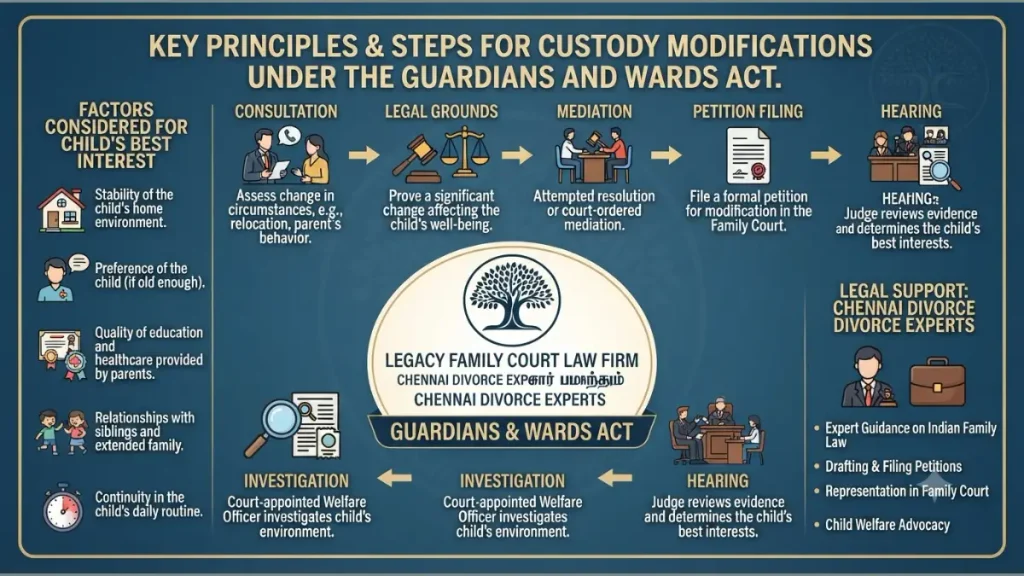
Family Court Jurisdiction and Chennai Proceedings
Family Courts Have Express Jurisdiction Over Custody and Access Disputes Section 7 of the Family Courts Act, 1984 expressly covers guardianship, custody, and access proceedings involving minors. Family Courts exercise jurisdiction comparable to relevant district or subordinate civil courts. Where a Family Court has jurisdiction, the statutory scheme can exclude ordinary subordinate civil court jurisdiction for covered proceedings. A Chennai custody dispute therefore requires careful identification of the competent Family Court and territorial jurisdiction.
Lawyers should examine the child’s residence, parental residence, existing proceedings, and earlier orders. Jurisdiction questions can become significant when parents live in different districts or states. They become more complex when one parent lives outside India. Consequently, filing strategy should precede substantive pleading. The advocate should also identify connected divorce, maintenance, domestic violence, or criminal proceedings. Proper coordination can prevent inconsistent applications before different forums. Chennai family litigation also requires attention to the Madras High Court appellate and supervisory jurisdiction.
Chennai Family Court and Madras High Court Remedies
Different Courts May Become Relevant Depending on the Relief and Procedural Stage The Family Court generally handles covered custody, guardianship, and access proceedings within its jurisdiction. The Madras High Court may become relevant through appropriate appellate, revisional, supervisory, or constitutional proceedings. The correct route depends on the nature of the order and governing procedural law. Lawyers should therefore identify the statutory remedy before selecting a High Court proceeding. A party should preserve certified copies of orders, pleadings, evidence, and relevant procedural records. Furthermore, urgent interim issues may require prompt judicial attention through the legally available procedure. The Code of Civil Procedure, 1908 also contains Order XXXII-A provisions concerning family proceedings, including custody and guardianship matters. Family litigation can also involve confidentiality considerations, including in-camera proceedings where applicable. Consequently, legal support should address both substantive custody law and procedural requirements. This integrated approach helps avoid defective filings and unnecessary jurisdictional objections.
Territorial Jurisdiction and Child’s Ordinary Residence
Residence Facts Can Influence Where a Custody Petition Should Be Presented Jurisdiction requires careful analysis when parents and children reside in different locations. The Guardians and Wards Act contains provisions concerning the court competent to entertain guardianship proceedings. Lawyers should therefore examine the child’s ordinary residence and the factual basis for territorial jurisdiction. Temporary travel does not necessarily produce the same legal consequences as established residence. Similarly, school admission and household records can help establish factual residence patterns. Existing custody orders can further affect where subsequent applications should proceed.
Therefore, parties should provide previous case numbers and certified orders during legal consultation. Where proceedings already exist, filing another application elsewhere may create procedural complications. Counsel can assess whether a modification should be filed before the existing court. Such analysis becomes particularly important when parents move between Chennai, other Tamil Nadu districts, or different states. Early jurisdiction review can reduce delays and avoid avoidable objections.
Role of Police Stations in Safety-Related Custody Disputes
Police Assistance Can Become Relevant When Custody Disputes Include Cognizable Offences Police authorities do not ordinarily decide final civil custody rights between parents. However, police intervention can become relevant where allegations disclose a cognizable criminal offence. Examples may include assault, unlawful confinement, kidnapping allegations, threats, or offences affecting a child. The Bharatiya Nagarik Suraksha Sanhita, 2023 governs current criminal procedure following the replacement of the earlier criminal procedure framework. A parent should therefore distinguish an enforcement dispute from an alleged criminal offence. Lawyers can advise whether approaching the jurisdictional police station is legally appropriate. Where immediate danger exists, urgent protective measures should be considered without delaying necessary safety action. At the same time, police complaints should contain accurate facts and supporting material. False or exaggerated allegations can create additional legal complications. Consequently, custody counsel should coordinate family litigation and criminal-law advice whenever both proceedings genuinely overlap.
Child Protection and Coordination With Government Authorities
Government Agencies Can Become Relevant When Child Protection Concerns Extend Beyond Custody Some custody disputes involve issues requiring attention from child protection authorities. Depending on the facts, relevant institutions can include the Child Welfare Committee, District Child Protection Unit, police authorities, education authorities, or healthcare institutions. These bodies perform functions different from those of the Family Court. Therefore, lawyers should identify the correct institution instead of approaching every department simultaneously. Where a child faces an immediate protection concern, statutory child-protection mechanisms may become significant. Documentation should establish the nature of the concern and the requested protective response. Moreover, coordination with the Family Court can prevent conflicting narratives and duplicated proceedings. A custody modification petition should disclose material related proceedings when legally required. This promotes procedural transparency and allows the court to understand the complete factual background. Appropriate government intervention should remain evidence-based and connected with the child’s actual welfare needs.
Evidence, Procedure, Remedies, and Legal Strategy
Building Evidence for a Custody Modification Petition
Documentary and Digital Evidence in Custody Proceedings
Strong Evidence Connects the Changed Circumstance With the Requested Custody Relief Custody litigation often depends upon documentary evidence showing the child’s present circumstances. Relevant records can include school attendance, report cards, medical records, counselling records, travel documents, residence proof, and communication records. Digital communications may also become relevant when they directly establish access obstruction or welfare concerns. The Bharatiya Sakshya Adhiniyam, 2023 recognises electronic and digital records subject to statutory requirements. Sections 61 to 63 address electronic records and their admissibility requirements. Therefore, parties should preserve original devices, source files, metadata, and relevant communications where appropriate. Screenshots alone may require careful evidentiary treatment. Lawyers should also avoid unlawfully obtained material and irrelevant private information. A well-organised evidence index can help the court understand the chronology quickly. Consequently, evidence preparation should begin before filing rather than after contested hearings commence.
School, Medical, and Psychological Records
Child-Centred Records Can Provide Objective Information About Changing Circumstances School records can show attendance, academic continuity, disciplinary concerns, participation, and communication with parents. Medical records can establish treatment requirements, appointments, medication schedules, or specialist recommendations. Where appropriate, professional counselling records may also assist the court in understanding welfare concerns. However, sensitive records require careful handling and lawful production. Lawyers should avoid presenting private material merely to embarrass the opposing parent. Instead, evidence should demonstrate a direct connection with the requested custody arrangement. For example, a school schedule may support a revised visitation timetable. A medical treatment schedule may require one parent to assume specific caregiving responsibilities. Therefore, documentary evidence should support practical proposals rather than merely strengthen accusations. Courts can then compare existing arrangements with proposed arrangements using concrete information. This evidence-focused approach can make custody modification applications clearer and more structured.
Communication Records and Alleged Access Interference
Communication Records Can Help Establish Patterns of Access Compliance or Interference Parents frequently communicate through messaging applications, email, telephone calls, or shared parenting platforms. These records can document requests for visitation, cancellations, missed handovers, or disputes over schedules. However, isolated messages may not establish a continuing pattern. Lawyers should therefore organise communications chronologically and identify significant recurring events. Electronic evidence should also satisfy the applicable requirements under the Bharatiya Sakshya Adhiniyam. Parents should preserve complete conversations rather than selectively presenting individual statements. Context can materially affect the interpretation of a message. Therefore, evidence preparation should avoid edited screenshots that conceal surrounding communications. A chronology can identify dates, requests, responses, missed access, and supporting documents. This approach allows counsel to distinguish ordinary parental disagreement from persistent interference. Ultimately, the requested remedy should correspond to the proven pattern and its effect upon the child.
Procedure for Seeking Custody Modification
Preparing and Filing the Modification Petition
A Carefully Drafted Petition Should Explain the Existing Order and Subsequent Developments The petition should identify the existing custody arrangement and the order governing parental rights. It should then explain the circumstances that changed after that arrangement. Each important allegation should have corresponding documentary or testimonial support wherever possible. The requested relief should remain specific and workable. For example, the parent may request primary custody, expanded visitation, holiday access, video calls, or supervised contact.
Lawyers should also identify connected proceedings involving divorce, maintenance, domestic violence, or criminal allegations. Procedural documents should comply with applicable Family Court requirements and local filing practices. The petition should avoid unnecessary personal attacks because they rarely clarify the child’s welfare. Instead, the pleading should establish chronology, evidence, welfare impact, and proposed solution. Courts can then evaluate whether modification serves the minor’s interests. A structured petition also helps the opposing party understand the exact relief under consideration.
Interim Applications and Temporary Parenting Arrangements
Temporary Applications Can Address Immediate Problems While the Main Petition Continues Custody cases may take time because courts must examine pleadings, evidence, and competing welfare concerns. Interim applications can therefore address urgent access or safety issues during the proceedings. A parent may request temporary visitation, video calls, holiday access, handover arrangements, or supervised meetings. The application should explain why immediate intervention is necessary.
Supporting documents should directly establish the urgency rather than repeat general matrimonial allegations. Furthermore, the proposed temporary arrangement should remain practical for the child’s daily routine. Courts can then assess whether the interim arrangement protects continuity while the main dispute remains pending. Lawyers should also monitor compliance with every interim order. Missed access or repeated violations should receive timely legal attention. Consequently, interim relief requires both careful drafting and consistent follow-up. A temporary arrangement should support the child’s stability while preserving the court’s ability to decide the final application.
Settlement, Mediation, and Parenting Agreements
Negotiated Parenting Arrangements Can Reduce Repeated Litigation Where Both Parents Can Cooperate Family disputes sometimes become manageable when parents establish clear parenting responsibilities through mediation. A settlement can address physical custody, visitation, holidays, education, healthcare, travel, communication, and expense sharing. However, parents should ensure that any agreement remains consistent with the child’s welfare. Lawyers can identify ambiguous terms before the parties sign a settlement. For example, phrases such as reasonable access may create future disagreements without defined schedules. A parenting agreement can instead specify dates, timings, locations, notice periods, and communication channels. Mediation can also help parents address recurring disputes without repeated urgent applications. Nevertheless, settlement should remain voluntary and informed. Neither parent should accept an arrangement because of improper pressure or incomplete legal advice. Therefore, legal review remains important even when both parties appear broadly agreeable. A properly structured agreement can provide predictability while reducing unnecessary courtroom conflict.
Enforcement of Existing Custody and Access Orders
Enforcement May Become Necessary When a Parent Repeatedly Disregards a Custody Order A custody modification petition differs from an enforcement application. Modification asks the court to change an arrangement because circumstances justify a different outcome. Enforcement addresses non-compliance with an existing direction. Parents should therefore preserve evidence showing missed handovers, denied access, or other violations. A court may consider the history of compliance when deciding subsequent custody applications. However, enforcement mechanisms depend upon the wording and legal character of the existing order. Lawyers should review whether the order contains specific dates, conditions, or procedural directions. Vague arrangements can create greater enforcement difficulty. Therefore, future orders should contain precise terms whenever possible. Where serious allegations accompany non-compliance, separate police or criminal remedies may require consideration. The Bharatiya Nagarik Suraksha Sanhita now governs criminal procedure, subject to its statutory scope. Legal advice should distinguish civil enforcement from criminal investigation.
Available Legal Remedies and Related Proceedings
Custody Modification Can Involve Several Complementary Legal Remedies Depending on the facts, parents may require more than one form of legal relief. The principal remedies can include the following:
- Modification of physical custody.
- Expanded or structured visitation.
- Supervised access arrangements.
- Interim custody or temporary access.
- Child relocation directions.
- Enforcement of existing custody orders.
- Protective injunctions where legally maintainable.
- Maintenance proceedings for eligible children.
- Police assistance where criminal conduct is alleged.
- Appropriate appellate or High Court remedies.
These remedies do not automatically apply to every custody dispute. Lawyers must match each remedy with the facts and governing statute. Family Courts Act jurisdiction expressly includes custody and access proceedings. Maintenance issues can involve separate statutory proceedings, including provisions under the current criminal procedure framework. Criminal allegations require independent analysis under the Bharatiya Nyaya Sanhita and Bharatiya Nagarik Suraksha Sanhita. Therefore, combining unrelated remedies without legal justification can weaken procedural clarity. A coordinated litigation strategy should identify the main custody relief first. Additional proceedings should then address genuinely separate legal rights or urgent protection needs.
Maintenance and Educational Expense Issues
Custody and Financial Support Are Distinct Yet Closely Connected Family Law Issues A custody dispute may reveal concerns about education expenses, healthcare costs, transportation, or daily child support. However, physical custody does not automatically determine every financial responsibility. Parents may have separate statutory obligations concerning maintenance and support. The Family Courts Act includes maintenance within Family Court jurisdiction. Current criminal procedure also contains provisions concerning maintenance of children and other eligible dependants. Lawyers should therefore identify whether a separate maintenance application remains necessary. Educational expenses should be supported by school invoices, fee schedules, medical bills, and other relevant records. Moreover, financial evidence should remain accurate and proportionate. The parent seeking support should disclose relevant income information where legally required. The responding parent can present evidence concerning existing payments and financial obligations. Consequently, custody litigation should not obscure the child’s legitimate financial requirements.
Domestic Violence, Abuse, and Protective Relief
Safety Allegations May Require Separate Protective Proceedings Alongside Custody Litigation Some custody disputes include allegations of domestic violence, child abuse, intimidation, or threats. Such allegations require immediate factual assessment and appropriate legal advice. A custody court can consider welfare-related evidence, while separate statutory remedies may address domestic violence or criminal conduct. Lawyers should identify whether an emergency protection order, police complaint, medical documentation, or other relief is appropriate. The Bharatiya Nyaya Sanhita provides the current substantive criminal framework for offences after its commencement. The Bharatiya Nagarik Suraksha Sanhita governs criminal procedure and related investigative processes. Evidence should therefore preserve dates, locations, medical records, complaint details, and relevant communications. Parents should prioritise immediate safety whenever credible danger exists. At the same time, custody pleadings should distinguish proven facts from allegations awaiting investigation. This separation helps each legal forum address the issue within its proper jurisdiction.
Appeals and High Court Legal Remedies
Adverse Custody Orders May Require Appellate or High Court Review Depending on Their Legal Character A parent dissatisfied with a custody order should first identify the exact statutory source of the order. The available challenge mechanism depends upon whether the order is interim, final, procedural, or otherwise appealable. Lawyers should therefore review the order, pleadings, evidence, and applicable procedural provisions before filing. The Madras High Court may become relevant in appropriate appellate or supervisory proceedings.
However, parties should not assume that every custody disagreement creates an immediate appeal. Procedural routes can differ according to the order and governing statute. Limitation periods can also affect the availability of certain remedies. Therefore, prompt legal review becomes important after receiving an adverse order. Certified copies and complete case records should be obtained without unnecessary delay. Counsel can then assess the appropriate legal remedy and grounds. A focused challenge should identify legal or factual errors rather than merely repeat the original custody case.
Role of a Chennai Family Law Advocate
Specialised Legal Support Can Coordinate Custody, Divorce, Evidence, and Procedural Requirements Custody modification disputes often involve several overlapping family and procedural issues. A Chennai family law advocate can review the earlier custody order and identify legally relevant changed circumstances. Counsel can then prepare pleadings, interim applications, evidence schedules, affidavits, and supporting documents. Representation may also involve Family Court hearings, mediation sessions, evidence stages, and enforcement applications. Where criminal allegations arise, coordination with criminal counsel can prevent inconsistent legal positions.
Similarly, maintenance disputes may require separate financial evidence and statutory applications. Digital evidence requires additional attention because electronic records must satisfy applicable evidentiary requirements. Lawyers can also assess jurisdiction before filing and identify related proceedings. Therefore, legal support should extend beyond drafting a petition. Effective representation requires case assessment, evidence management, negotiation, courtroom advocacy, and post-order compliance monitoring. Legacy Family Court Law Firm can provide structured assistance for families seeking custody modification in Chennai and related jurisdictions.
Custody Modification Preparation Checklist
Parents Can Prepare Essential Information Before Consulting a Custody Modification Lawyer A well-prepared consultation allows counsel to identify the strongest procedural and evidentiary route. Parents should organise the following information before the first detailed legal conference:
- Existing custody and visitation orders.
- Details of the child’s current residence.
- School and healthcare information.
- Chronology of material changes.
- Relevant communication records.
- Police complaints or protection proceedings.
- Evidence concerning alleged access interference.
- Travel or relocation documents.
- Details of connected divorce or maintenance cases.
- The exact custody arrangement requested.
They should also avoid coaching children or creating artificial evidence. Lawyers can then separate relevant facts from emotional disagreements. Furthermore, the proposed parenting arrangement should remain realistic and child-focused. Courts require practical information before changing existing custody arrangements. Therefore, preparation can materially improve the clarity of the legal case. The final application should connect each fact with a specific legal remedy. This structure helps the court understand why modification is necessary and how the proposed arrangement protects the child. Proper preparation also assists counsel during mediation, interim hearings, evidence, and final arguments.
Key Legal Issues to Discuss During Consultation
A Comprehensive Consultation Should Identify Every Connected Legal Issue Before Filing Parents should explain the complete custody history instead of presenting only recent disagreements. Counsel should review earlier orders, pending proceedings, and existing parenting arrangements. The consultation should also identify whether the child has changed residence or educational institutions. Safety concerns, medical requirements, relocation plans, and communication problems should receive separate consideration. Lawyers should determine whether interim relief is necessary before the main petition progresses.
They should also examine whether enforcement proceedings remain available for an existing order. Where criminal allegations exist, counsel should assess police and criminal-law implications independently. Digital communications should be preserved because they may become relevant evidence. The legal team should also identify maintenance and educational expense issues. Finally, counsel should define a practical parenting arrangement rather than pursue an undefined change. This preparation creates a coherent case theory based on welfare, changed circumstances, evidence, jurisdiction, and proportionate relief.
Legal Support for NRI and Inter-State Custody Disputes
Cross-Border and Inter-State Custody Disputes Require Additional Procedural Planning Custody disputes become more complicated when one parent lives outside Chennai or outside India. Distance can affect jurisdiction, service, evidence, travel, schooling, and visitation arrangements. International relocation can also create concerns involving passports, travel consent, foreign proceedings, and enforcement. Inter-state disputes similarly require careful examination of territorial jurisdiction and existing orders. Lawyers should identify every relevant proceeding before proposing litigation. A parent living abroad may need representation arrangements that reduce unnecessary travel. Video conferencing or authorised procedural mechanisms may assist where legally available. However, the exact procedure depends upon the court’s directions and applicable law. Counsel should also examine whether foreign orders or proceedings require recognition or other legal treatment in India. Therefore, international custody matters require specialised advice rather than a standard domestic custody petition. A carefully coordinated strategy can address jurisdiction, evidence, travel, communication, and enforceability concerns together.
Why Evidence-Based Parenting Proposals Matter
A Practical Parenting Proposal Can Help the Court Evaluate the Requested Modification Courts need workable arrangements that protect children after an order changes. A parent should therefore present a detailed proposal covering ordinary weekdays, weekends, holidays, examinations, birthdays, healthcare, and emergencies. The proposal should consider school distance, transportation, parental working hours, and the child’s existing routine. It should also provide communication arrangements when the child stays with either parent. Where safety concerns exist, the proposal can incorporate supervised handovers or contact.
However, restrictions should remain connected to documented welfare concerns. Parents should avoid proposals designed primarily to punish the other parent. Instead, the arrangement should preserve stability and appropriate parental involvement. Evidence can demonstrate why each proposed term serves the child’s interests. Consequently, a practical parenting plan can transform a broad custody dispute into identifiable legal questions. This approach also helps during mediation because both parents can negotiate specific terms rather than general accusations.
Final Legal Strategy for Custody Modification in Chennai
A Structured Custody Strategy Should Combine Welfare Analysis, Evidence, Jurisdiction, and Appropriate Remedies Custody modification requires more than proving that one parent disagrees with an earlier arrangement. The applicant should establish meaningful changes affecting the child’s welfare. The Guardians and Wards Act provides the central statutory framework for guardianship and custody analysis. Family Court jurisdiction expressly includes custody and access proceedings involving minors. The Code of Civil Procedure also contains family-proceeding provisions relevant to custody and guardianship matters.
Current criminal laws may become relevant when separate offences or safety concerns arise. Electronic evidence must satisfy the Bharatiya Sakshya Adhiniyam requirements. Therefore, parents should obtain legal advice before changing arrangements unilaterally. Legacy Family Court Law Firm: Chennai Divorce Experts can assist with custody modification petitions, interim applications, visitation disputes, evidence preparation, enforcement, mediation, and related family proceedings. Each case requires fact-specific legal assessment because the child’s welfare remains central to judicial consideration.
Frequently Asked Question:
Can Custody Be Modified After a Court Order?
Answer: Yes. A parent can seek modification when circumstances materially change. The court examines the child’s welfare, supporting evidence, and the practicality of the proposed arrangement.
Which Court Handles Child Custody Modification in Chennai?
Answer: Family Courts have jurisdiction over guardianship, custody, and access matters within their territorial jurisdiction. The Madras High Court may hear appropriate appellate or supervisory proceedings.
What Evidence Supports a Custody Modification Petition?
Answer: Useful evidence can include school records, medical documents, residence proof, communications, prior orders, travel records, and evidence showing changed circumstances affecting the child.
Can Visitation Rights Also Be Modified?
Answer: Yes. Parents can seek revised visitation, holiday access, video communication, overnight access, or supervised contact when circumstances justify a different arrangement.
Can Police Become Involved in a Custody Dispute?
Answer: Police may become involved when facts disclose a criminal offence or immediate safety concern. Police action does not replace the Family Court’s custody jurisdiction.
Can Digital Messages Be Used as Custody Evidence?
Answer: Electronic records can be legally relevant. Their admissibility depends on statutory requirements under the Bharatiya Sakshya Adhiniyam, including applicable electronic-record conditions.
Legal Disclaimer: This article provides general legal information and does not constitute case-specific legal advice. Custody outcomes depend on facts, evidence, applicable personal law, procedural history, and judicial assessment. Professional advice should be obtained before filing or changing a custody arrangement.