

Introduction: Building Secure Christian Marriage Rights Through Indian Law
Christian marriage in India carries religious, personal, social, and legal significance for spouses and families. The Indian Christian Marriage Act, 1872 regulates important aspects of Christian marriage solemnization. It establishes requirements concerning authorized persons, ceremonies, notices, certificates, witnesses, and registration. However, marriage rights do not end with the wedding ceremony or marriage certificate. Spouses may later face disputes involving cruelty, desertion, maintenance, custody, matrimonial property, nullity, divorce, or domestic violence. Therefore, understanding the applicable legal framework helps protect individual rights during changing family circumstances. The Divorce Act, 1869 separately governs several matrimonial remedies for Christians. Family Courts also handle many disputes involving marriage, maintenance, custody, and related family matters. Furthermore, current procedural and evidentiary laws can affect matrimonial litigation. The BNS, BNSS, and BSA replaced several earlier criminal-law frameworks from July 2024. Consequently, Chennai spouses should obtain timely legal advice before taking formal action. A structured approach can preserve evidence, clarify jurisdiction, and reduce avoidable procedural complications.
Legal Foundation: Christian Marriage Rights and Statutory Protection
Understanding the Indian Christian Marriage Act, 1872
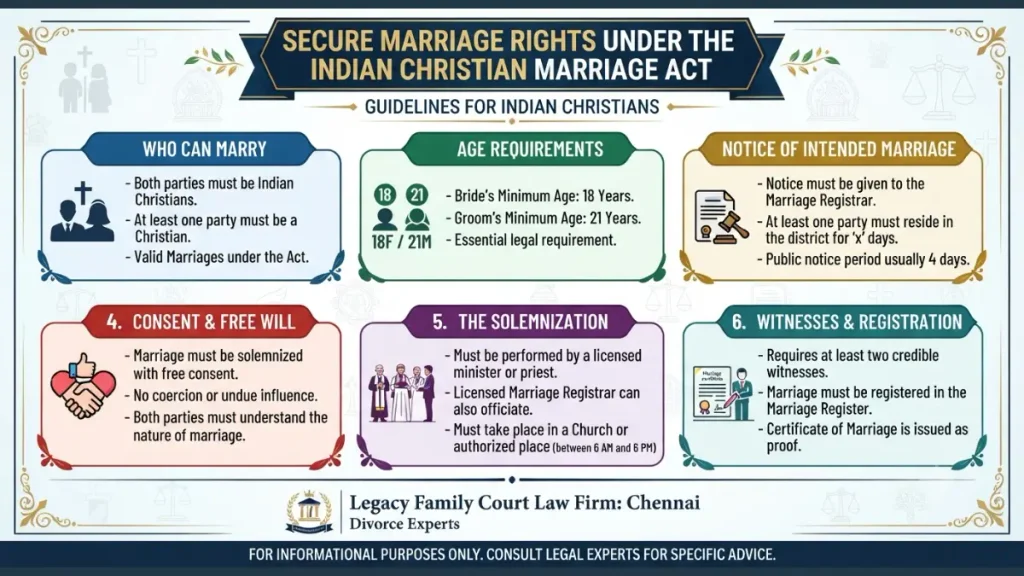
The Indian Christian Marriage Act, 1872 primarily regulates the solemnization of Christian marriages in India. Section 4 requires marriages involving Christians to follow the statutory framework prescribed by the Act. Section 5 identifies persons who may solemnize marriages under specified circumstances. These provisions make the authority of the officiating person legally important. Therefore, couples should verify the credentials of the minister, registrar, or licensed person. The Act also contains provisions concerning notices, certificates, declarations, witnesses, and marriage registers. Section 25 requires at least two witnesses besides the minister for specified solemnizations. Additionally, section 60 establishes conditions for certification of marriages between Indian Christians. Those conditions include minimum statutory ages and the absence of a living spouse. A valid marriage certificate can become important evidence during future matrimonial proceedings. Accordingly, couples should preserve certificates, registration entries, photographs, and relevant ceremony records. Proper documentation can assist with divorce, maintenance, inheritance, immigration, and child-related proceedings.
Marriage Eligibility and Capacity Requirements
Marriage capacity requires careful attention before solemnization because statutory defects can create future disputes. Section 60 addresses certification requirements for marriages between Indian Christians. It specifies that the man must not be below twenty-one years. It also specifies that the woman must not be below eighteen years. Neither intending spouse should have a living husband or wife. The required declaration must occur before an authorized person and credible witnesses. Consequently, parties should verify previous marital status before completing matrimonial formalities. A prior marriage can create serious questions concerning validity and subsequent matrimonial rights. Similarly, inaccurate identity information can complicate registration and later court proceedings. Therefore, couples should maintain accurate birth records, identity documents, and previous marriage records. The relevant documents should also reflect consistent names and dates wherever possible. Legal review becomes especially useful when previous marriages, foreign divorces, adoption records, or name changes exist. Early verification can prevent avoidable challenges after marriage.
Age, Consent, and Free Choice
Free consent remains central to a legally secure marriage because coercion can create serious legal consequences. Christian marriage procedures also require declarations concerning the parties’ intention to marry. A person should understand the nature and consequences of those declarations. Section 18 requires specified declarations before certificates issued under the relevant procedure. Furthermore, the Act contains special provisions involving minors and required parental consent. Modern matrimonial advice should also consider constitutional principles concerning personal liberty and individual choice. Therefore, families should not treat religious approval as a substitute for legal consent. Any allegation involving coercion, confinement, threats, or forced marriage requires immediate legal assessment. Depending on circumstances, criminal remedies and protective measures may become relevant. The BNSS now governs criminal procedure for offences under the current criminal-law framework. Meanwhile, the BNS contains substantive criminal offences applicable to qualifying conduct. Accordingly, victims should preserve messages, recordings, medical documents, and witness details. Prompt documentation can strengthen later proceedings.
Marriage Ceremony, Witnesses, and Certificates
A marriage ceremony should satisfy the statutory requirements applicable to the selected method of solemnization. Section 25 recognizes solemnization in the presence of at least two witnesses. The Act also regulates certificates and marriage registers under different statutory procedures. Therefore, couples should not rely solely on photographs or church records when formal registration remains available. A properly issued certificate can provide important documentary evidence regarding the marriage. Section 61 also addresses certificates for qualifying marriages under the relevant statutory procedure. The certificate may become important during matrimonial litigation and administrative applications. For example, spouses may require marriage evidence for passports, visas, inheritance claims, insurance matters, or court petitions. Consequently, parties should obtain certified copies whenever originals may become unavailable. They should also preserve the registrar’s details and relevant registration information. If discrepancies appear, legal advice should be obtained before attempting corrections. Proper record preservation strengthens the evidentiary foundation for future family-law proceedings.
Registration, Records, and Documentary Security
Marriage registration creates an important documentary trail for spouses and their children. Registration records can assist courts when parties dispute the existence or date of marriage. They can also support applications involving passports, succession, insurance, employment benefits, and immigration. Therefore, spouses should maintain both physical and digital copies of essential marriage documents. The Indian Christian Marriage Act contains specific registration provisions for different categories of Christian marriages. Moreover, applicable state procedures can affect the handling of marriage records and certificates. In Tamil Nadu, couples should confirm the competent registration authority for their particular marriage. They should also verify whether additional state registration requirements apply to their circumstances. A lawyer can review the certificate, church records, registrar entries, and identity documents together. This approach helps identify inconsistencies before litigation begins. Additionally, certified copies can become useful when original documents are lost. Proper documentation can reduce disputes over matrimonial status and jurisdiction.
Interfaith Marriage and Legal Classification
Interfaith relationships require careful classification because different statutory frameworks can potentially apply. The Indian Christian Marriage Act covers marriages involving Christians within its statutory scope. However, the precise legal route depends on the parties’ religions and chosen marriage procedure. Therefore, couples should not assume that every interfaith marriage automatically follows one statute. The Special Marriage Act, 1954 may become relevant in particular circumstances. Personal-law consequences can also differ depending on the parties and the legal route followed. Consequently, a lawyer should examine the marriage certificate and solemnization documents before advising on remedies. Questions may arise concerning divorce, succession, maintenance, child status, and jurisdiction. Furthermore, foreign marriages can involve additional recognition and documentation issues. Parties should identify the governing matrimonial statute before filing a petition. Selecting the wrong statutory route can create unnecessary procedural objections. A focused legal opinion can clarify applicable law before substantial litigation expenses arise.
Matrimonial Rights: Divorce, Maintenance, Children, and Protection
Christian Divorce Rights Under the Divorce Act
Christian matrimonial disputes often involve the Divorce Act, 1869 rather than the Christian Marriage Act alone. The Divorce Act contains provisions concerning dissolution, mutual consent, nullity, judicial separation, and other matrimonial reliefs. Section 10 addresses grounds for dissolution of marriage. Section 10A addresses dissolution by mutual consent under statutory conditions. Therefore, spouses considering separation should identify the appropriate matrimonial remedy first. A divorce petition requires facts supporting the statutory ground relied upon by the petitioner. Evidence should correspond closely with the allegations pleaded before the court. Courts may also consider procedural requirements, jurisdiction, and settlement proposals. Furthermore, Family Courts can deal with connected issues involving maintenance, custody, and family disputes. Consequently, spouses should evaluate the entire dispute rather than treating divorce as an isolated issue. Proper pleadings can help prevent inconsistent positions across different proceedings. A Chennai family lawyer can coordinate matrimonial, financial, child-related, and protective remedies.
Grounds, Nullity, and Judicial Separation
Matrimonial law provides different remedies because every marital dispute does not require immediate dissolution. Nullity proceedings question the legal validity of a marriage under recognized statutory grounds. Judicial separation permits spouses to obtain a formal separation without immediately dissolving the marriage. Divorce proceedings seek dissolution when statutory grounds or mutual consent requirements are satisfied. Therefore, the choice of remedy should reflect the parties’ objectives and legal circumstances. Issues can include alleged adultery, cruelty, desertion, conversion, unsoundness, or other statutory grounds. However, the precise ground must match the applicable provisions and judicial interpretation. Evidence should support the specific allegation rather than relying upon general marital dissatisfaction. Courts may also examine admissions, communications, financial records, and witness testimony. Consequently, spouses should organize evidence chronologically before filing a petition. A lawyer can identify gaps and distinguish relevant facts from emotionally significant but legally weaker allegations. This preparation can improve clarity during matrimonial litigation.
Cruelty, Desertion, and Matrimonial Misconduct
Cruelty allegations require careful factual presentation because matrimonial conflict alone does not automatically establish every legal ground. Relevant conduct may involve physical abuse, serious harassment, threats, sustained humiliation, or other legally significant behavior. Desertion similarly requires attention to statutory requirements and the surrounding circumstances. Therefore, petitioners should document dates, incidents, communications, medical treatment, complaints, and witness information. Digital evidence can become relevant when allegations involve messages, emails, recordings, or social-media communications. The Bharatiya Sakshya Adhiniyam, 2023 recognizes electronic records subject to statutory admissibility requirements. Section 63 contains specific requirements for admitting qualifying electronic records. Consequently, parties should preserve original devices and relevant digital information where appropriate. Screenshots alone may not always establish every evidentiary requirement. Lawyers should therefore advise clients about preservation and certification issues before filing. Furthermore, parties should avoid editing, deleting, or manipulating potentially relevant communications. Evidence integrity can become critical when allegations are strongly contested.
Mutual Consent and Settlement Planning
Mutual consent divorce can provide a structured route when both spouses genuinely agree to dissolve their marriage. Section 10A of the Divorce Act addresses dissolution by mutual consent. However, statutory conditions and court procedures must still be satisfied. A settlement should address financial claims, maintenance, child custody, visitation, education, and property issues. Therefore, spouses should not sign broad settlement documents without understanding their legal consequences. The agreement should identify payment schedules, responsibilities, deadlines, and documentary requirements clearly. It should also address pending criminal, civil, or matrimonial proceedings where legally appropriate. Furthermore, parties should consider enforcement consequences if agreed obligations remain unpaid. Family Courts have a statutory duty to encourage settlement where circumstances permit. Section 9 of the Family Courts Act emphasizes settlement efforts in appropriate proceedings. Consequently, structured negotiation can sometimes reduce prolonged litigation. However, settlement should remain voluntary and legally informed. Independent legal advice can help each spouse understand the consequences of proposed terms.
Maintenance and Financial Security
Financial security can become a central issue when spouses separate or initiate matrimonial proceedings. The applicable remedy depends upon the parties, proceeding, statutory provisions, and factual circumstances. The BNSS now contains maintenance provisions for wives, children, and parents under its statutory framework. Section 144 addresses maintenance and interim maintenance in qualifying cases. Section 145 also contains procedural jurisdiction provisions for maintenance proceedings. Therefore, applicants should prepare reliable information about income, expenses, assets, liabilities, and dependants. Bank statements, salary records, tax documents, employment information, and expenditure records may assist the court. Courts may examine the financial circumstances of both parties according to the applicable law. Consequently, parties should avoid hiding income or creating artificial financial records. A complete financial disclosure can also support realistic settlement discussions. Lawyers can evaluate matrimonial maintenance alongside other statutory remedies. This coordinated approach can help protect immediate financial needs during litigation.
Child Custody, Access, and Welfare
Children often remain the most important consideration in Christian matrimonial disputes. Family Courts exercise jurisdiction over custody, guardianship, and access matters within their statutory framework. Section 7 of the Family Courts Act includes proceedings concerning custody and access to minors. Courts generally examine the child’s welfare within the governing legal framework. Therefore, parents should focus submissions on stability, safety, education, healthcare, and emotional wellbeing. A parent should avoid using the child as a messenger between separated spouses. Similarly, parents should preserve school records, medical information, and relevant communication evidence. Interim arrangements can address residence, visitation, schooling, travel, and communication. Consequently, early parenting plans may reduce conflict during pending proceedings. Courts can consider evidence concerning caregiving arrangements and the child’s circumstances. A lawyer can help frame custody applications around legally relevant welfare factors. Child-focused preparation can also reduce unnecessary confrontation during family litigation.
Domestic Violence and Protective Legal Remedies
Domestic violence concerns can arise alongside Christian matrimonial disputes and require separate legal consideration. Affected persons may seek remedies under the Protection of Women from Domestic Violence Act, 2005. Depending on facts, reliefs can include protection, residence, monetary relief, custody, and compensation. Criminal allegations may also arise where conduct satisfies offences under the BNS. The BNSS governs procedural aspects of criminal proceedings under the current framework. Therefore, victims should assess civil, family, and criminal remedies together. Chennai also has police mechanisms addressing complaints involving women and family disputes. Tamil Nadu Police records describe All Women Police Stations as handling complaints involving women and marital disputes. In an emergency, the nearest police station can receive information requiring immediate intervention. Victims should preserve medical records, photographs, messages, complaint acknowledgments, and witness details. Legal counsel can help determine whether protection, maintenance, criminal, or matrimonial proceedings should proceed simultaneously.
Evidence, Digital Records, and Courtroom Preparation
Modern matrimonial disputes frequently involve electronic evidence from phones, computers, email accounts, and social platforms. The Bharatiya Sakshya Adhiniyam, 2023 provides a current framework for electronic and digital records. Sections 61 to 63 address electronic records and their admissibility requirements. Therefore, clients should preserve relevant evidence without altering the underlying material. Useful records can include emails, messages, call information, photographs, bank transactions, medical documents, and location-related records. However, relevance remains as important as volume because courts require legally relevant evidence. Parties should avoid forwarding sensitive material unnecessarily to third parties. They should also protect passwords and account access while preserving relevant information lawfully. Consequently, evidence collection should follow a documented and proportionate process. Lawyers can identify which records require certification or supporting testimony. This approach can reduce evidentiary objections during trial. Proper digital preservation also helps lawyers prepare accurate pleadings and cross-examination strategies.
Chennai Jurisdiction, Courts, Police Stations, and Legal Forums
Family Court Jurisdiction in Chennai
The Family Courts Act, 1984 was enacted to promote conciliation and speedy settlement of marriage and family disputes. Its jurisdiction includes matrimonial disputes, maintenance, custody, and several connected family matters. Chennai matrimonial cases therefore require careful examination of territorial jurisdiction before filing. Residence, marriage location, respondent location, and other statutory factors may influence jurisdiction. The exact jurisdiction depends upon the nature of the proceeding and applicable matrimonial statute. Therefore, lawyers should verify the correct court before drafting and presenting a petition. A filing in the wrong forum can create delay and additional expense. Family Courts may also encourage settlement before contested adjudication. Consequently, parties should prepare both litigation and settlement strategies from the beginning. Where a Family Court has jurisdiction, other courts may have restricted jurisdiction over specified family proceedings. Section 8 addresses exclusion of jurisdiction in areas where Family Courts operate.
Choosing the Correct Chennai Forum
Selecting the correct forum requires more than identifying the nearest court geographically. Matrimonial jurisdiction depends upon statutory provisions, residence, marriage location, and the relief requested. Family Courts may hear specified matrimonial, maintenance, custody, and related disputes. Magistrate jurisdiction may also arise in proceedings under relevant protective or criminal statutes. Therefore, lawyers should map each proposed remedy before filing. The legal map can include Family Court proceedings, Magistrate applications, police complaints, civil proceedings, and appellate remedies. Relevant government offices may also include Marriage Registrars and registration authorities. For evidence or document certification, other competent authorities may become relevant. Consequently, a single matrimonial dispute can involve multiple legal forums. Lawyers should coordinate filings to prevent contradictory statements and overlapping reliefs. This is particularly important when criminal allegations accompany divorce proceedings. A forum-specific strategy helps preserve procedural rights while reducing unnecessary duplication.
Nearby Police Support and Emergency Assistance
Police intervention may become necessary when matrimonial disputes involve threats, assault, unlawful confinement, stalking, or other cognizable offences. Chennai residents can approach the police station having appropriate territorial jurisdiction. Women facing domestic or matrimonial violence may also approach an All Women Police Station. Tamil Nadu Police documentation confirms that All Women Police Stations address complaints concerning women and marital disputes. However, a police station does not replace a Family Court for divorce adjudication. Police authorities investigate qualifying criminal allegations rather than granting matrimonial dissolution. Therefore, clients should distinguish criminal complaints from matrimonial petitions. In urgent situations, immediate safety should take priority over procedural planning. Afterward, legal counsel can coordinate protective and matrimonial remedies. Chennai District maintains official administrative information for various local jurisdictions and authorities. The appropriate police station depends upon the incident location and current jurisdictional arrangements. Clients should verify the relevant station before submitting non-emergency complaints.
Government Departments and Registration Authorities
Christian marriage disputes can involve several government authorities beyond the courts. Marriage registration authorities maintain statutory records concerning qualifying marriages. District administration offices may also provide information concerning local administrative jurisdictions. Chennai District publishes official information about its administrative structure and government departments. Therefore, clients should identify the correct authority before requesting certificates or certified records. Relevant documents can include marriage certificates, registration extracts, identity records, and supporting affidavits. Lawyers can also help clients identify whether records require attestation or certified copies. In cross-border cases, additional authentication or apostille requirements may arise. Consequently, documentary planning becomes particularly important for NRIs and spouses living overseas. A properly documented matrimonial record can simplify later court and immigration procedures. Clients should retain acknowledgment receipts for applications submitted to government offices. This creates a reliable administrative trail when records are delayed or disputed.
Legal Remedies and Practical Protection Strategies
Civil, Matrimonial, and Criminal Remedies
Christian spouses may require several remedies depending on the nature of their dispute. Matrimonial remedies can include divorce, mutual consent dissolution, judicial separation, and nullity. Financial remedies can include maintenance and interim financial relief under applicable laws. Child-related remedies can include custody, visitation, guardianship, and educational arrangements. Protective remedies can arise under domestic violence legislation. Criminal remedies may apply where conduct satisfies offences under the BNS. Civil remedies may also become relevant for property or contractual disputes between spouses. Therefore, legal advice should identify the complete dispute rather than one isolated allegation. The Code of Civil Procedure, 1908 continues to provide general civil procedure where applicable. Meanwhile, the BNSS governs criminal procedure under the current framework. Consequently, lawyers must select remedies according to jurisdiction and statutory authority. A coordinated strategy can reduce conflicting pleadings and procedural complications.
Notice, Negotiation, Mediation, and Settlement
Many family disputes benefit from structured negotiation before extensive contested litigation begins. However, negotiation should never compromise safety or statutory rights. Lawyers can issue appropriate notices explaining the dispute and proposed resolution. Mediation may address communication, maintenance, custody, property, and procedural arrangements. The Family Courts Act specifically emphasizes efforts toward settlement in appropriate proceedings. Therefore, parties should consider settlement where meaningful agreement remains possible. A settlement should clearly record financial obligations and child-related arrangements. It should also identify timelines for withdrawals, payments, document transfers, or other agreed actions. Furthermore, parties should understand whether settlement terms require court approval. Legal counsel can review enforceability before signatures are exchanged. Mediation becomes unsuitable when serious coercion or safety concerns prevent meaningful participation. Consequently, lawyers should assess suitability rather than treating mediation as automatic. Properly managed negotiation can preserve dignity while protecting enforceable legal interests.
Appeals, Enforcement, and Continuing Rights
Obtaining an order does not always end a matrimonial dispute because enforcement may become necessary. A party may also have statutory appeal or revision rights depending upon the order. The available remedy depends upon the statute, court, nature of order, and applicable procedural provisions. Therefore, litigants should obtain a complete copy of every judgment and interim order. Lawyers should calculate limitation periods immediately after receiving an adverse or important order. Delayed action can create procedural complications even when substantive rights remain available. Enforcement may involve execution mechanisms, compliance applications, or further court directions. Maintenance orders may also require enforcement when payments remain outstanding. The BNSS contains procedures concerning maintenance orders and recovery of unpaid amounts. Consequently, successful litigation requires continuing attention after judgment. Clients should maintain payment records, correspondence, and compliance evidence. A structured post-order strategy can protect the practical value of court relief.
Professional Legal Support for Christian Families
A Christian matrimonial dispute can involve overlapping religious, personal, financial, child-related, and criminal issues. Therefore, professional legal support should begin with a complete factual assessment. A lawyer should review the marriage certificate, ceremony documents, identity records, and previous matrimonial proceedings. The lawyer should then identify applicable statutes and competent forums. Evidence should be organized chronologically before drafting pleadings or complaints. Financial documents should also be collected where maintenance or property issues exist. Child-related evidence should focus on welfare, stability, schooling, healthcare, and caregiving. Safety concerns should receive immediate attention where allegations involve violence or threats. Furthermore, clients should receive clear advice about negotiation and litigation options. The objective should remain lawful protection of rights rather than unnecessary escalation. Legacy Family Court Law Firm can assist Chennai families with matrimonial documentation and court proceedings. Early advice can help clients understand available remedies and avoid preventable procedural errors.
Current Legal Framework for Christian Matrimonial Disputes
CPC, BNS, BNSS, and BSA in Family Litigation
The legal framework for matrimonial disputes now operates alongside India’s updated criminal and evidence legislation. These three laws were enacted in December 2023 and came into force from July 2024. The Code of Civil Procedure, 1908 continues as the general civil procedural framework. Consequently, matrimonial lawyers must distinguish civil procedure from criminal procedure and evidence rules. Digital communications require particular attention under the current evidence framework. Criminal allegations require analysis under the BNS and procedure under the BNSS. Therefore, legal drafting should use current statutory terminology and provisions.
How BNS Can Affect Matrimonial Disputes
Matrimonial conflict can sometimes involve conduct that independently attracts criminal liability. Such allegations require examination under the BNS rather than automatically treating them as matrimonial issues. Examples may involve assault, criminal intimidation, stalking, hurt, wrongful restraint, or other qualifying conduct. The precise offence depends on the facts and statutory elements. Therefore, parties should avoid making unsupported criminal allegations in matrimonial pleadings. Evidence must establish the relevant facts according to applicable procedural and evidentiary standards. Police complaints can trigger investigations where statutory requirements are satisfied. Conversely, purely matrimonial disagreements do not automatically constitute criminal offences. Legal counsel should distinguish relationship conflict from conduct meeting criminal-law thresholds. This distinction can improve the accuracy of complaints and court pleadings. It can also prevent unnecessary escalation of family disputes. Where criminal allegations exist, lawyers should coordinate matrimonial and criminal strategies carefully.
How BNSS Supports Procedural Remedies
The BNSS governs criminal procedure following the commencement of the new criminal-law framework. Its provisions can affect police investigation, complaints, maintenance proceedings, summons, warrants, and criminal court processes. Maintenance proceedings under section 144 may provide relief in qualifying circumstances. The statute also identifies permissible territorial locations for certain maintenance proceedings. Therefore, applicants should examine residence and jurisdiction before initiating maintenance proceedings. Criminal complaints should also contain clear factual allegations supported by available evidence. Lawyers should monitor notices, appearances, investigation stages, and court dates carefully. Procedural defaults can create avoidable complications during already sensitive family disputes. Furthermore, parties should preserve acknowledgment receipts for complaints and applications. Such records can help establish when authorities received representations. BNSS procedure therefore forms an important part of modern matrimonial legal strategy.
How BSA Protects Evidence Integrity
The Bharatiya Sakshya Adhiniyam, 2023 provides the current evidence framework for proceedings covered by the statute. Electronic and digital records receive express recognition subject to statutory requirements. Section 61 confirms that electronic records cannot be rejected merely because they are electronic. Section 63 establishes conditions governing admissibility of qualifying electronic records. Therefore, spouses should preserve original electronic material wherever possible. They should avoid editing screenshots, altering recordings, or deleting original conversations. Device details and source information may become relevant during evidentiary disputes. Lawyers can advise whether certification or additional supporting material is required. This is especially important in allegations involving digital harassment or financial transactions. Consequently, evidence preparation should begin before filing whenever possible. Proper preservation can improve reliability and reduce avoidable objections.
Secure Marriage Rights: A Practical Chennai Legal Checklist
Documents Every Christian Spouse Should Preserve
Document security provides an important foundation for protecting matrimonial rights. Spouses should maintain original and digital copies of essential marriage and identity records. Important documents can include the following:
- Christian marriage certificate and registration extract.
- Baptismal or church records where relevant.
- Birth certificates and identity documents.
- Previous divorce decrees or death certificates.
- Children’s birth and school records.
- Bank, salary, tax, insurance, and property records.
- Relevant messages, emails, photographs, and medical records.
These documents can support proceedings involving marriage validity, divorce, maintenance, custody, inheritance, and immigration. Therefore, spouses should store copies securely and separately from everyday devices. Sensitive documents should also receive appropriate digital protection. Lawyers may require certified copies rather than informal scans in certain proceedings. Consequently, clients should obtain certified documents when litigation becomes reasonably foreseeable. Good document management can reduce delays when urgent applications become necessary. It also helps lawyers prepare accurate pleadings from the beginning. A complete file allows the legal team to identify connected remedies more efficiently.
Common Legal Issues Requiring Immediate Advice
Christian spouses should seek prompt advice when a dispute involves multiple legal risks. Common issues include disputed marriage validity, domestic violence, desertion, cruelty, maintenance, child custody, or property disputes. Other concerns can involve foreign residence, immigration documentation, or recognition of overseas matrimonial orders. Therefore, clients should not postpone advice until receiving a court summons. Early consultation can preserve evidence and identify appropriate forums. Lawyers can also assess whether immediate protective orders are necessary. Where criminal allegations exist, prompt advice can prevent inconsistent statements across proceedings. Financial records should receive particular attention when maintenance claims are anticipated. Child-related disputes require careful planning because interim arrangements can influence later proceedings. Consequently, a complete legal assessment should consider both immediate and long-term consequences. Professional guidance can help clients make informed procedural decisions. Timely action also reduces the risk of missing statutory limitation periods.
Remedies Available to Protect Marriage and Family Rights
The available legal remedies depend upon the facts and governing statute. Common remedies may include:
- Marriage registration and certified record applications.
- Divorce or mutual consent proceedings.
- Judicial separation or nullity proceedings.
- Maintenance and interim maintenance applications.
- Child custody and visitation applications.
- Domestic violence protection and monetary relief.
- Criminal complaints for qualifying offences.
- Appeals, revisions, execution, or enforcement proceedings.
- Mediation and negotiated settlement.
- Documentary and evidentiary applications.
Each remedy has separate jurisdictional and procedural requirements. Therefore, clients should not assume that one filing automatically secures every available right. A lawyer should map the remedies before initiating proceedings. The Family Courts Act supports settlement efforts in appropriate family disputes. Meanwhile, the Divorce Act provides Christian matrimonial remedies. The BNSS provides current criminal procedure and maintenance provisions where applicable. This statutory coordination can help protect spouses and children more comprehensively.
A Step-by-Step Legal Protection Plan
A structured legal plan can help a spouse respond calmly during a matrimonial dispute. The following sequence provides a practical starting framework:
- Secure marriage, identity, financial, and child-related documents.
- Record important incidents with dates and supporting evidence.
- Preserve relevant digital communications in original form.
- Assess immediate safety and emergency protection needs.
- Identify the correct matrimonial statute and legal remedy.
- Confirm territorial jurisdiction before filing.
- Evaluate maintenance, custody, property, and criminal issues.
- Consider negotiation or mediation where appropriate.
- Prepare pleadings using current statutory terminology.
- Track court orders, limitation periods, and compliance deadlines.
This process does not guarantee a particular legal result because every matrimonial dispute has different facts. Nevertheless, systematic preparation can improve legal clarity. It also helps lawyers identify evidence gaps before hearings begin. Clients should provide complete information, including facts that may appear unfavorable. Concealing relevant information can undermine credibility during litigation. Therefore, accurate disclosure remains essential for effective legal representation.
Protecting Rights During Court Proceedings
Court proceedings can become lengthy when pleadings, evidence, interim applications, and appeals overlap. Therefore, clients should maintain consistent communication with their legal representatives. Every hearing should be recorded in a personal case calendar. Copies of petitions, counter statements, affidavits, and orders should remain organized. Financial obligations should also be tracked carefully throughout the case. Clients should comply with court directions unless legally challenged through an appropriate remedy. They should avoid direct confrontation with the opposing party during contentious proceedings. Social-media posts can also create unnecessary evidentiary complications. Consequently, clients should exercise caution when discussing ongoing matrimonial disputes publicly. Lawyers should receive immediate information about new notices or police communications. Timely instructions allow legal representatives to respond within applicable deadlines. Consistent case management can protect both procedural and substantive matrimonial rights.
Why Chennai Couples Need Localized Legal Guidance
Chennai matrimonial disputes can involve Family Courts, police authorities, registration offices, mediation services, and appellate courts. The correct forum depends upon the location and nature of the dispute. Therefore, local procedural knowledge can help identify the appropriate authority. Chennai District’s administrative structure covers numerous zones, taluks, and local jurisdictions. Police jurisdiction similarly depends upon the location and circumstances of an incident. Consequently, clients should avoid relying on outdated information about nearby offices or police stations. A legal professional can verify the competent forum before filing. Local counsel can also coordinate document collection and court appearances. This becomes particularly important for NRIs and spouses living outside Chennai. Remote clients may need representatives for procedural and documentary tasks. A coordinated Chennai legal strategy can reduce unnecessary travel and administrative delays.
Legal Support for NRIs and Cross-Border Christian Marriages
Cross-border Christian marriages create additional documentation and jurisdiction questions. An NRI spouse may face issues involving foreign residence, service of notices, overseas income, custody, or recognition of judgments. Therefore, the legal team should identify every country connected with the matrimonial dispute. Foreign marriage certificates may require authentication, translation, or other formalities. Overseas divorce orders may also require recognition under Indian law. Consequently, clients should provide complete foreign court records and immigration documents. Child relocation disputes require particularly careful jurisdictional analysis. Financial claims may require evidence concerning overseas employment and assets. Lawyers can coordinate Indian matrimonial proceedings with applicable international documentation requirements. However, foreign-law questions may require advice from counsel in the relevant jurisdiction. Early coordination can reduce procedural conflicts between Indian and foreign proceedings. Proper planning remains essential when family rights cross national borders.
Building Long-Term Family Legal Security
Marriage rights extend beyond the immediate wedding ceremony because family circumstances can change over time. Couples should understand their documentation, financial arrangements, succession concerns, and child-related responsibilities. A valid marriage certificate can support later administrative and legal claims. Clear financial records can also reduce uncertainty during maintenance or property disputes. Parents should maintain important child documents and healthcare information securely. Furthermore, spouses should update records after major changes in residence, name, or marital status. Legal documents should remain consistent across government and private records. Consequently, periodic legal review can identify documentary gaps before disputes arise. Families with overseas connections should also review cross-border documentation requirements. A preventive approach can reduce the impact of unexpected matrimonial conflict. Legacy Family Court Law Firm can assist with Christian matrimonial documentation and dispute-related legal support. Early professional guidance can help families understand their rights under the applicable law.
Frequently Asked Questions
| Question | Answer |
|---|---|
| Does the Indian Christian Marriage Act govern Christian marriage registration? | Yes. The Act regulates specified Christian marriage solemnization and registration. The exact procedure depends on the applicable statutory route and local registration requirements. |
| Can Christians obtain divorce under the Indian Christian Marriage Act? | Divorce is generally governed by the Divorce Act, 1869. The Christian Marriage Act primarily addresses solemnization, certification, and registration of marriages. |
| Can Christian spouses seek maintenance? | Yes. Maintenance may arise under applicable matrimonial, family, domestic violence, or BNSS provisions, depending on facts and the relief sought. |
| Can Chennai Family Court decide Christian matrimonial disputes? | Family Courts have jurisdiction over specified marriage, maintenance, custody, and related disputes. Territorial jurisdiction must still be established before filing. |
| Are WhatsApp messages useful in matrimonial cases? | They may be relevant electronic evidence. Their admissibility depends on the Bharatiya Sakshya Adhiniyam and applicable evidentiary requirements. |
| Where can a woman report matrimonial violence in Chennai? | She can approach the appropriate police station or All Women Police Station. Emergency circumstances require immediate police assistance and safety planning. |
Conclusion: Strengthening Christian Marriage Rights Through Timely Legal Action
Securing Christian marriage rights requires more than obtaining a wedding certificate. Couples should understand the Indian Christian Marriage Act, the Divorce Act, Family Courts Act, and related protective laws. Modern disputes may also involve the BNS, BNSS, and BSA. Therefore, legal strategy should address matrimonial, financial, child-related, evidentiary, and safety concerns together. Proper documentation remains essential from marriage registration through any later court proceeding. Similarly, digital evidence should be preserved carefully under the current evidentiary framework. Chennai spouses should confirm jurisdiction before approaching a Family Court, Magistrate, police station, or other authority. Where settlement remains appropriate, mediation and negotiated arrangements can reduce unnecessary conflict. However, serious safety concerns require immediate protective action. Ultimately, timely legal advice can help spouses understand available remedies and procedural responsibilities. Legacy Family Court Law Firm: Chennai Divorce Experts can provide legal assistance concerning Christian marriage, divorce, maintenance, custody, domestic disputes, and related matrimonial proceedings. Every case requires individualized assessment based on current law and specific facts.