

Challenging Child Custody Orders – Child custody disputes are among the most sensitive and emotional matters in family law. When a lower court issues a custody order that one parent believes is unfair, incomplete, or not in the best interest of the child, the law provides an opportunity to challenge that decision before the High Court. However, this is not a simple appeal. It requires a clear understanding of legal standards, strong reasoning, and careful preparation.
In this article, we explain in simple terms how child custody orders can be challenged in the High Court, what legal standards apply, and what parents should expect during the process.
Challenging Child Custody Orders in High Court – Legal Standards Explained – Legacy Family Court Law Firm: Chennai Divorce Experts
Understanding Child Custody Orders
First of all, it is important to understand what a child custody order means. A custody order is a decision made by a family court regarding who will take care of the child, where the child will live, and how the other parent will have access or visitation rights.
Generally, courts focus on one key principle: the best interest of the child. This means the court looks at the child’s safety, emotional well-being, education, and overall development before making a decision.
However, sometimes a parent may feel that the order is not fair or does not properly consider important facts. In such situations, the law allows the parent to approach the High Court.
When Can You Challenge a Custody Order?
You cannot challenge a custody order just because you are unhappy with it. Instead, you must have valid legal grounds. Some common reasons include:
- The lower court ignored important evidence
- There was a mistake in understanding the facts
- The order goes against the child’s welfare
- There was a procedural error during the case
- New facts have come up after the order
For example, if a parent can show that the child is not safe in the current custody arrangement, the High Court may consider reviewing the order.
Legal Routes to Approach the High Court
There are mainly two legal ways to challenge a custody order:
1. Appeal
An appeal is filed when you believe the lower court made an error in its judgment. In this case, the High Court reviews the decision based on the records and arguments presented earlier.
2. Revision or Petition
In some cases, instead of an appeal, a revision petition or writ petition may be filed. This is usually done when there is a serious legal issue or violation of rights.
Therefore, choosing the correct legal route is very important. At Legacy Family Court Law Firm: Chennai Divorce Experts, we guide clients in selecting the most effective approach based on their situation.
Key Legal Standards Followed by the High Court
When the High Court reviews a child custody case, it does not simply replace the lower court’s decision. Instead, it follows certain legal standards.
1. Welfare of the Child Comes First
Above all, the child’s welfare is the most important factor. Even if a parent has strong legal rights, the court will prioritize what is best for the child.
For instance, if the child is comfortable, safe, and emotionally stable in the current environment, the court may hesitate to change custody unless there is a strong reason.
2. No Automatic Re-evaluation of Facts
The High Court does not conduct a full trial again. Instead, it checks whether the lower court made a legal or factual mistake.
This means you must clearly show where the error occurred. Simply repeating your earlier arguments may not be enough.
3. Interference Only in Exceptional Cases
The High Court usually interferes only when:
- The decision is clearly unreasonable
- Important evidence was ignored
- The order harms the child’s welfare
As a result, not every case will succeed. Strong legal grounds are necessary.
4. Consideration of Child’s Preference
If the child is old enough to express a view, the court may consider the child’s preference. However, this is not the only factor.
The court will also check whether the child’s opinion is influenced by any parent.
5. Stability and Continuity
Courts prefer to maintain stability in a child’s life. Therefore, frequent changes in custody are generally avoided unless absolutely necessary.
For example, if a child has been living with one parent for a long time and is doing well, the court may not change custody easily.
Important Documents Required
When challenging a custody order, proper documentation is essential. Some important documents include:
- Copy of the lower court’s order
- Evidence presented in the original case
- New evidence (if any)
- Proof supporting your claims
- Affidavit explaining your grounds
In addition, well-drafted legal arguments play a crucial role in convincing the court.
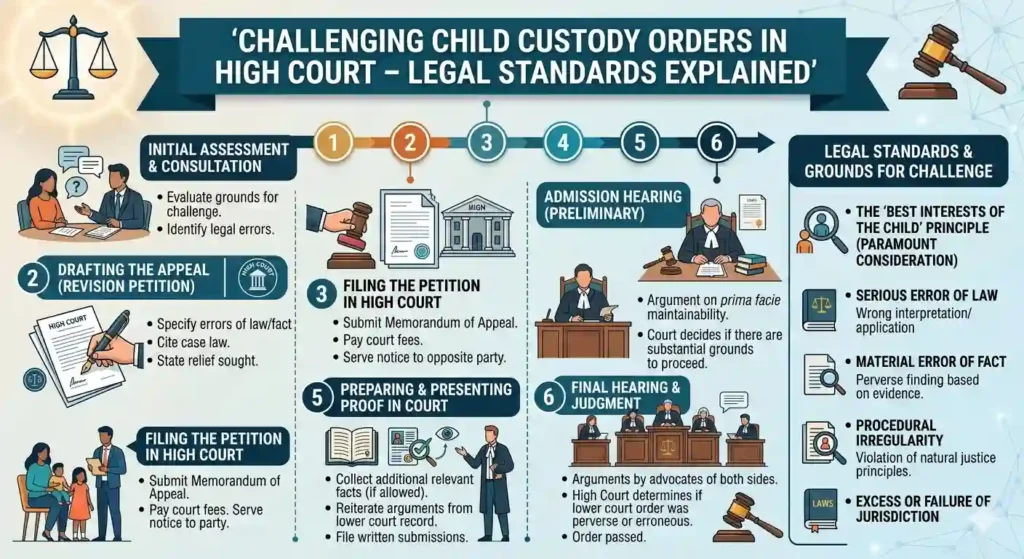
Step-by-Step Process
Let us now understand the general process involved:
Step 1: Legal Consultation
First, consult an experienced family lawyer. This helps you understand whether your case has strong grounds.
Step 2: Drafting the Petition
Next, your lawyer will prepare a detailed petition explaining why the custody order should be challenged.
Step 3: Filing in the High Court
The petition is then filed before the High Court with all necessary documents.
Step 4: Court Notice
After filing, the court issues notice to the other parent.
Step 5: Hearing
Both sides present their arguments. The court may also interact with the child in some cases.
Step 6: Final Order
Finally, the court passes an order, which may confirm, modify, or set aside the earlier decision.
Role of Evidence in High Court
Evidence plays a very important role in custody challenges. However, the High Court usually relies on existing records.
Still, in certain situations, new evidence may be allowed, especially if it directly affects the child’s welfare.
For example, if there is proof of neglect or abuse after the original order, the court will take it seriously.
Common Mistakes to Avoid
While challenging a custody order, many parents make mistakes that weaken their case. Some of these include:
- Filing without proper legal grounds
- Making emotional arguments without evidence
- Delaying the filing process
- Ignoring the child’s welfare focus
- Not following proper legal procedures
Therefore, professional legal guidance is essential.
Time and Cost Involved
Challenging a custody order in the High Court can take time, depending on the complexity of the case. Some cases are resolved quickly, while others may take several months.
Similarly, costs may vary based on legal fees, documentation, and court procedures. However, investing in a strong case can make a significant difference in the outcome.
Importance of Legal Representation
Family law cases require both legal knowledge and sensitivity. A skilled lawyer not only presents your case effectively but also ensures that the child’s interests are protected.
At Legacy Family Court Law Firm: Chennai Divorce Experts, we focus on:
- Clear legal strategy
- Strong documentation
- Child-centered approach
- Timely action
As a result, our clients receive practical and effective legal solutions.
Alternative Options Before Challenging
Before approaching the High Court, it is also wise to consider alternative options.
Mediation
Sometimes, disputes can be resolved through mutual discussion and compromise.
Modification Application
Instead of challenging the order, you may apply for modification in the same court if circumstances have changed.
These options can save time, reduce stress, and protect the child from prolonged conflict.
Final Thoughts
Challenging a child custody order in the High Court is a serious legal step. It requires more than just disagreement with the earlier decision. You must clearly show that the order is legally incorrect or harmful to the child’s welfare.
Moreover, the High Court follows strict standards and interferes only in deserving cases. Therefore, preparation, proper evidence, and expert legal advice are crucial.
If you are facing such a situation, do not act in haste. Instead, take informed steps with the right legal support.
Frequently Asked Questions
Yes, you can challenge a child custody order in the High Court if you have valid legal grounds. However, you cannot file a case just because you are unhappy with the decision. Instead, you must show that the lower court made a legal error, ignored important evidence, or passed an order that is not in the best interest of the child. Therefore, proper legal advice is essential before proceeding.
The High Court always gives top priority to the welfare of the child. In other words, the child’s safety, emotional well-being, education, and stability matter more than the rights of either parent. Even if one parent has strong legal arguments, the court will focus on what arrangement benefits the child the most.
No, the High Court usually does not conduct a full fresh trial. Instead, it reviews the lower court’s decision to check for legal or factual mistakes. However, in exceptional cases, the court may consider new evidence if it directly affects the child’s welfare.
The time required varies depending on the complexity of the case and court procedures. Some cases may be resolved within a few months, while others can take longer. Therefore, timely filing, proper documentation, and strong legal representation can help speed up the process.
Yes, if the child is mature enough, the High Court may consider their preference. However, this is not the only factor. The court will carefully examine whether the child’s opinion is genuine and free from influence before taking it into account.
How We Can Help
At Legacy Family Court Law Firm: Chennai Divorce Experts, we understand how important your child’s future is. We provide:
- Honest case evaluation
- Clear legal guidance
- Strong High Court representation
- Compassionate support throughout the process
If you believe a custody order needs to be challenged, reach out to us. Together, we can work towards securing the best possible outcome for your child.
Read More
- Top Divorce Lawyers in Chennai: Expert Guidance for Your Case
- Effective Solutions for Inheritance Issues Under the Indian Succession Act
- Legal Guidance for Muslims Under the Muslim Personal Law (Shariat) Application Act
- Secure Custody Rights Under the Hindu Minority and Guardianship Act
- Child Custody and Guardianship Under the Guardians and Wards Act
- Ministry of Law and Justice (India)