

Welfare of Child vs Parental Rights – In family law, one of the most sensitive and emotional issues is the conflict between the welfare of a child and the rights of parents. While parents naturally believe they have a right over their children, the law in India takes a different and more balanced approach. Over time, the Supreme Court has clearly stated that the welfare of the child is the highest priority, even if it means limiting or overriding parental rights.
Therefore, whenever disputes arise—especially in cases of divorce, custody battles, or guardianship—the courts carefully examine what truly benefits the child. In this article, we explain in simple words how the Supreme Court approaches this issue and what it means for parents.
Welfare of Child vs Parental Rights – Supreme Court Approach : Legacy Family Court Law Firm: Chennai Divorce Experts
Understanding the Concept of Child Welfare
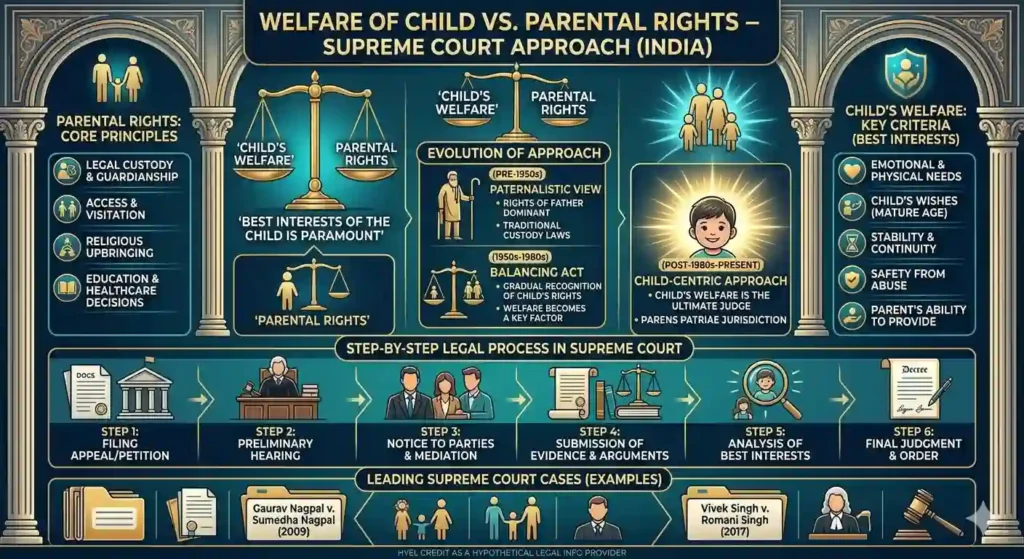
To begin with, it is important to understand what “welfare of the child” actually means. It is not limited to financial support or basic needs. Instead, it includes the overall well-being of the child.
This includes:
- Emotional and psychological health
- Education and development
- Safety and security
- Moral and ethical upbringing
- Stability in life
In other words, the court looks at the complete environment in which the child will grow. Therefore, even if a parent is financially strong, it does not automatically mean they will get custody.
What Are Parental Rights?
On the other hand, parental rights refer to the legal authority that parents have over their children. These rights include:
- Custody and guardianship
- Decision-making regarding education and health
- Right to spend time with the child
- Responsibility for upbringing
However, these rights are not absolute. The law recognizes them, but at the same time, it places limitations when the child’s welfare is at risk.
Supreme Court’s Key Principle: Welfare Comes First
The Supreme Court has repeatedly emphasized one important principle: the welfare of the child is supreme.
This means that:
- The child’s interests come before the parents’ wishes
- Emotional and mental well-being is given high importance
- The court does not treat children as property or objects
Moreover, even if a parent has a legal right, the court may deny custody if it believes that the child’s welfare will be affected.
Thus, the focus always remains on what is best for the child—not what is convenient for the parents.
Factors Considered by the Court
Whenever a custody or guardianship case comes before the court, several factors are carefully evaluated.
1. Age of the Child
Younger children are often given to the mother, especially during early years. However, this is not a strict rule.
2. Emotional Bond
The court examines which parent has a stronger emotional connection with the child.
3. Stability and Environment
A stable home environment is crucial. Frequent changes or uncertainty may harm the child.
4. Education and Future
The court considers which parent can provide better educational opportunities and overall development.
5. Conduct of Parents
If a parent has a history of abuse, neglect, or harmful behavior, the court may deny custody.
6. Child’s Preference
In certain cases, especially when the child is mature enough, the court may consider the child’s opinion.
Therefore, the decision is always based on a combination of factors rather than a single condition.
Custody vs Guardianship
At this stage, it is important to understand the difference between custody and guardianship.
- Custody refers to who the child lives with on a daily basis.
- Guardianship refers to legal authority over the child’s decisions.
In many cases, one parent may get custody while both parents retain certain rights. This ensures that the child maintains a relationship with both parents.
Types of Custody Arrangements
The courts may grant different types of custody depending on the situation.
Physical Custody
The child lives with one parent, while the other parent gets visitation rights.
Joint Custody
Both parents share responsibilities, and the child spends time with both.
Legal Custody
Both parents have the right to make important decisions regarding the child.
Third-Party Custody
In rare cases, custody may be given to grandparents or relatives if neither parent is suitable.
Thus, the court chooses the arrangement that best serves the child’s welfare.
Visitation Rights and Their Importance
Even when one parent gets custody, the other parent usually receives visitation rights. This is important because the child benefits from maintaining a relationship with both parents.
However, visitation may be restricted or supervised in cases involving:
- Violence or abuse
- Substance addiction
- Unsafe environments
Therefore, the court ensures that visitation supports the child’s well-being and does not harm them.
Role of Mediation in Child Custody Cases
Nowadays, courts strongly encourage mediation before deciding custody matters. Mediation helps parents reach a mutual agreement without long legal battles.
Through mediation:
- Parents can create flexible arrangements
- Conflicts are reduced
- The child’s interests are prioritized
As a result, mediation often leads to better and more peaceful outcomes.
Changing Custody Orders
Custody orders are not always permanent. If circumstances change, either parent can approach the court for modification.
For example:
- Change in financial condition
- Relocation of a parent
- Change in the child’s needs
- Evidence of neglect or harm
In such cases, the court again reviews the situation and makes a decision based on the child’s welfare.
Challenges Faced by Parents
While the law focuses on the child, parents often face emotional and legal challenges.
Firstly, custody disputes can be stressful and time-consuming. Secondly, parents may feel that their rights are being ignored.
However, it is important to understand that the court’s intention is not to punish parents but to protect the child. Therefore, cooperation and understanding can make the process smoother.
Importance of Legal Guidance
Child custody cases involve legal complexities and emotional sensitivity. Therefore, professional legal guidance is essential.
At Legacy Family Court Law Firm: Chennai Divorce Experts, we help parents navigate these challenges with clarity and care.
Our approach includes:
- Understanding your situation in detail
- Providing practical legal advice
- Representing your interests effectively
- Focusing on the child’s best interests
With the right support, parents can handle custody matters more confidently and responsibly.
Supreme Court’s Evolving Approach
Over the years, the Supreme Court has adopted a more child-centric approach. Earlier, courts sometimes followed rigid rules, such as automatically granting custody to one parent.
However, now:
- Each case is decided on its own facts
- The child’s voice is given importance
- Emotional well-being is prioritized
This shift reflects a deeper understanding of children’s needs in modern society.
Balancing Rights and Responsibilities
Although parental rights are important, they come with responsibilities. Parents must ensure that their actions support the child’s growth and happiness.
Therefore:
- Cooperation between parents is encouraged
- Conflicts should be minimized
- The child should not be used as a tool in disputes
By focusing on responsibilities rather than rights alone, parents can create a healthier environment for their children.
Practical Tips for Parents
To handle custody matters effectively, parents can follow some simple steps:
Firstly, always prioritize the child’s needs over personal differences.
Secondly, maintain a respectful relationship with the other parent.
Thirdly, keep proper records of communication and expenses.
Finally, seek legal advice early to avoid complications.
These steps can make a significant difference in the outcome of the case.
Frequently Asked Questions
The welfare of the child refers to the overall well-being of the child, including emotional, physical, educational, and psychological needs. It is not limited to financial support alone. Courts consider factors such as a stable home environment, safety, proper upbringing, and emotional bonding. Therefore, even if a parent is financially strong, the court may still deny custody if other aspects of the child’s welfare are not satisfied.
No, parental rights are not absolute. Although parents have legal rights over their children, these rights are always subject to the child’s welfare. The Supreme Court has consistently held that the best interests of the child come first. As a result, courts may restrict or override parental rights if they conflict with the child’s well-being.
The Supreme Court examines each case based on its facts. It considers factors such as the child’s age, emotional attachment with each parent, living conditions, education, and safety. In some cases, the child’s preference is also taken into account. Therefore, the decision is made after carefully balancing all relevant aspects to ensure the child’s best interests.
Yes, custody orders can be modified if there is a significant change in circumstances. For example, changes in financial stability, relocation, or evidence of neglect may lead to a review of the order. However, the court will again focus on the child’s welfare before making any changes.
Yes, non-custodial parents usually have visitation or access rights. This allows them to maintain a relationship with the child. However, these rights may be limited or supervised if the child’s safety is at risk.
Conclusion
In conclusion, the Supreme Court’s approach clearly establishes that the welfare of the child is more important than parental rights. While parents do have legal rights, these rights are not absolute and must always align with the child’s best interests.
Moreover, the courts carefully evaluate all aspects of the child’s life before making a decision. From emotional well-being to education and safety, every factor is considered.
At Legacy Family Court Law Firm: Chennai Divorce Experts, we understand the emotional and legal complexities involved in such cases. Therefore, we are committed to guiding our clients with compassion, professionalism, and a clear focus on the child’s welfare.
Read More
- Challenging Child Custody Orders in High Court – Legal Standards Explained
- Top Divorce Lawyers in Chennai: Expert Guidance for Your Case
- Effective Solutions for Inheritance Issues Under the Indian Succession Act
- Child Custody and Guardianship Under the Guardians and Wards Act
- Legal Guidance for Muslims Under the Muslim Personal Law (Shariat) Application Act
- Supreme Court of India – Official Website