


Appeal Against Interim Custody Orders – Child custody disputes are often the most emotionally charged part of any family law case. When courts pass interim custody orders—decisions made temporarily during the pendency of a case—parents may feel dissatisfied or even distressed. Naturally, many ask: Can I challenge this order? Is an appeal even maintainable?
This article explains the concept of appealing interim custody orders in a simple and practical manner. We will walk through what interim custody means, when appeals are allowed, and what legal remedies are available if you disagree with such an order.
Appeal Against Interim Custody Orders – Maintainability Explained : Legacy Family Court Law Firm: Chennai Divorce Experts
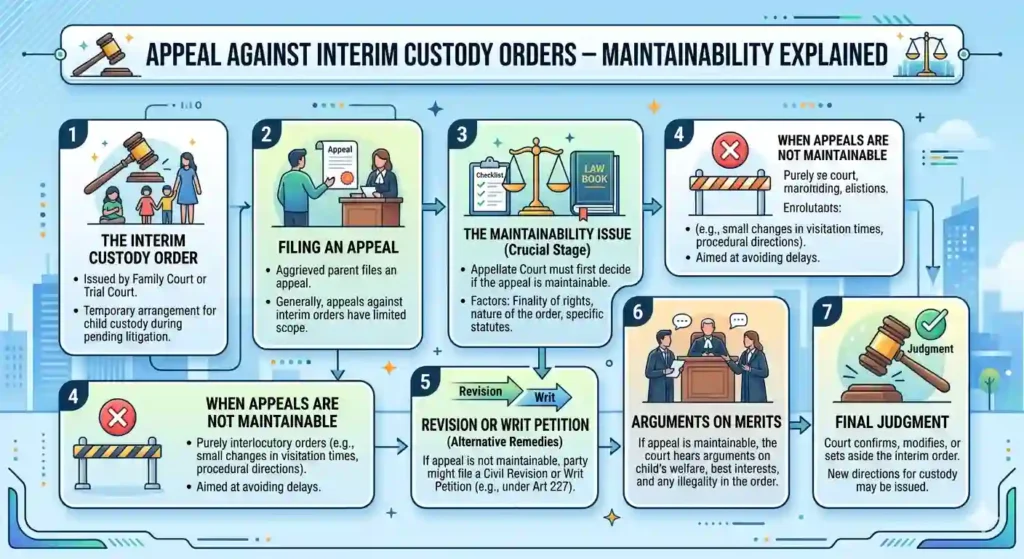
What Is an Interim Custody Order?
To begin with, an interim custody order is a temporary arrangement made by the court regarding the care and custody of a child while the main case is still ongoing. Since custody disputes can take months or even years to resolve, courts step in early to ensure the child’s welfare is protected.
For example, the court may grant temporary custody to one parent while giving visitation rights to the other. These orders are not final. Instead, they are subject to change based on new evidence or circumstances.
Why Interim Orders Matter So Much
Although interim orders are temporary, they carry significant weight. In many cases, they shape the child’s routine and emotional environment for a long period. As a result, parents often feel that an unfair interim order can influence the final outcome.
Moreover, courts tend to maintain stability for the child. So, if a child has been living with one parent under an interim order for a long time, the court may hesitate to disrupt that arrangement later. Therefore, interim orders are not just procedural—they are practically impactful.
Can Interim Custody Orders Be Appealed?
Now comes the crucial question: Is an appeal against an interim custody order maintainable?
The answer is not always straightforward. It depends on the nature of the order, the law under which it is passed, and the jurisdiction of the court.
Generally speaking, not all interim orders are appealable. Courts usually discourage frequent appeals against temporary orders because doing so can delay proceedings and increase conflict.
However, there are exceptions.
Understanding “Maintainability”
Before going further, let us clarify the term “maintainability.” In simple words, maintainability refers to whether a legal action—such as an appeal—is allowed under the law.
So, when we ask whether an appeal is maintainable, we are essentially asking:
Does the law permit me to file this appeal?
If the answer is yes, the court will hear the appeal. If not, the appeal will be dismissed at the outset.
Legal Framework Governing Custody Appeals
In India, child custody matters are governed by laws such as:
- The Guardians and Wards Act, 1890
- The Hindu Minority and Guardianship Act, 1956
- Personal laws applicable to different religions
Under these laws, appeals are typically allowed against final orders. However, interim orders fall into a grey area.
That said, certain provisions and judicial interpretations do allow appeals against interim custody orders under specific conditions.
When Is an Appeal Maintainable?
An appeal against an interim custody order may be maintainable in the following situations:
1. When the Order Affects Substantial Rights
If the interim order significantly affects the rights of a parent or the welfare of the child, courts may allow an appeal. For instance, if a parent is completely denied access to the child without valid reasons, it may justify appellate intervention.
2. When the Order Is Arbitrary or Unreasonable
If the lower court passes an order without proper reasoning or ignores key evidence, the aggrieved party can challenge it. Courts expect decisions to be fair, balanced, and based on the child’s best interests.
3. When There Is a Jurisdictional Error
If the court that passed the interim order did not have the proper authority, the order can be challenged. This is a strong ground for appeal.
4. When the Law Specifically Allows It
In some cases, statutes or procedural laws expressly permit appeals against certain types of interim orders. In such cases, maintainability becomes clearer.
When Is an Appeal Not Maintainable?
On the other hand, appeals may not be maintainable in the following situations:
1. Purely Temporary or Routine Orders
If the order is procedural or minor—for example, fixing a date for visitation—courts may refuse to entertain an appeal.
2. Availability of Alternative Remedies
Instead of filing an appeal, parties may be expected to approach the same court for modification or clarification. Courts often prefer this route to avoid unnecessary litigation.
3. Lack of Urgency or Harm
If the appellant cannot show that the order causes serious harm or injustice, the appeal may be dismissed.
Alternative Remedies You Should Consider
Even when an appeal is not maintainable, you are not without options. In fact, there are several alternative remedies available:
1. Application for Modification
You can approach the same court and request a change in the interim order. This is often the fastest and most practical solution.
2. Revision Petition
In some cases, a revision petition can be filed before a higher court if there is a legal error in the order.
3. Writ Petition
If the order violates fundamental rights or principles of natural justice, you may approach the High Court through a writ petition.
Each of these remedies has its own requirements and limitations. Therefore, choosing the right approach is crucial.
The Role of the Child’s Welfare
At every stage, one principle remains constant: the welfare of the child is paramount.
Courts do not focus on the rights of the parents alone. Instead, they evaluate what arrangement best serves the child’s physical, emotional, and psychological well-being.
As a result, even if an appeal is technically maintainable, it may still fail if it does not align with the child’s best interests.
Practical Challenges in Filing Appeals
While appealing an interim custody order may seem like a solution, it comes with challenges:
- Time delays: Appeals can take time, during which the interim order remains in force.
- Emotional strain: Prolonged litigation can affect both the parents and the child.
- Costs involved: Legal proceedings can become expensive.
Therefore, it is important to weigh the pros and cons before proceeding.
Strategic Approach: What Should You Do?
Instead of reacting emotionally, it is advisable to take a strategic approach:
First, carefully review the order and understand the reasoning behind it.
Next, consult a legal expert to evaluate whether an appeal is maintainable.
Then, consider alternative remedies that may offer quicker relief.
Most importantly, always keep the child’s welfare at the center of your decisions.
How Courts View Frequent Appeals
Courts generally discourage repeated challenges to interim orders. They expect parties to cooperate and work towards a stable environment for the child.
Frequent appeals can be seen as an attempt to delay proceedings or harass the other party. As a result, courts may impose costs or even refuse to entertain such appeals.
Therefore, it is essential to act responsibly and avoid unnecessary litigation.
Importance of Legal Guidance
Given the complexities involved, professional legal advice becomes indispensable. A skilled family lawyer can:
- Assess the maintainability of your appeal
- Suggest the most effective remedy
- Represent your interests while prioritizing the child’s welfare
Without proper guidance, you may end up pursuing a remedy that is not legally sustainable.
Frequently Asked Questions
Yes, you can file an appeal in certain situations, but it is not always automatic. Courts usually allow appeals only when the interim order seriously affects your rights or the child’s welfare. If the order is routine or temporary in nature, the appeal may not be maintainable. Therefore, it is important to first evaluate whether the order causes real harm or injustice before proceeding.
Maintainability simply means whether the law permits you to file an appeal. In custody matters, not all interim orders can be challenged through appeal. The court will first check if your appeal is legally valid before hearing the case. If it is not maintainable, the court will dismiss it without going into the merits.
If an appeal is not allowed, you still have options. You can file an application for modification before the same court that passed the order. Additionally, you may consider filing a revision petition or a writ petition in higher courts if there is a legal error or violation of rights. These remedies are often quicker and more effective.
Courts always focus on the child’s best interests. They consider factors such as emotional well-being, stability, education, and the relationship with both parents. Even during appeals, the welfare of the child remains the top priority, not the preferences of either parent.
No, it is not advisable to challenge every order. Frequent appeals can delay the case and negatively affect the child. Instead, you should act strategically and seek legal advice before deciding.
Conclusion
Appealing against an interim custody order is not always straightforward. While the law does provide avenues for challenge, maintainability depends on several factors, including the nature of the order, the impact on rights, and the availability of alternative remedies.
In many cases, approaching the same court for modification may be more practical than filing an appeal. However, when the order is unjust or harmful, higher courts can and do intervene.
At Legacy Family Court Law Firm: Chennai Divorce Experts, we understand how sensitive custody matters can be. We believe in combining strong legal strategy with a compassionate approach. If you are facing difficulties with an interim custody order, the right legal guidance can make all the difference.
Read More
- Welfare of Child vs Parental Rights – Supreme Court Approach
- Challenging Child Custody Orders in High Court – Legal Standards Explained
- Top Divorce Lawyers in Chennai: Expert Guidance for Your Case
- Effective Solutions for Inheritance Issues Under the Indian Succession Act
- Secure Custody Rights Under the Hindu Minority and Guardianship Act
- Department of Justice – Ministry of Law & Justice