


Habeas Corpus in Child Custody Matters – Habeas corpus is one of India’s most powerful constitutional remedies protecting personal liberty. Therefore, parents and guardians use it urgently when a child is illegally detained. Article 226 of the Indian Constitution empowers High Courts to issue habeas corpus writs. Additionally, Article 32 grants the Supreme Court the same power for fundamental rights violations. In child custody matters, courts prioritise the child’s welfare above all other legal considerations. Moreover, the Bharatiya Nyaya Sanhita (BNS), 2023 and Bharatiya Nagarik Suraksha Sanhita (BNSS), 2023 now govern criminal dimensions of child detention. Furthermore, the Code of Civil Procedure (CPC), 1908 and Guardians and Wards Act, 1890 provide civil remedies. Legacy Family Court Law Firm specialises exclusively in these sensitive matters. Our senior advocates provide urgent, strategic legal intervention across all Indian courts. Consequently, we protect children’s rights and restore lawful custody without delay.
Habeas Corpus in Child Custody Matters – When Is It Applicable? – Legacy Family Court Law Firm
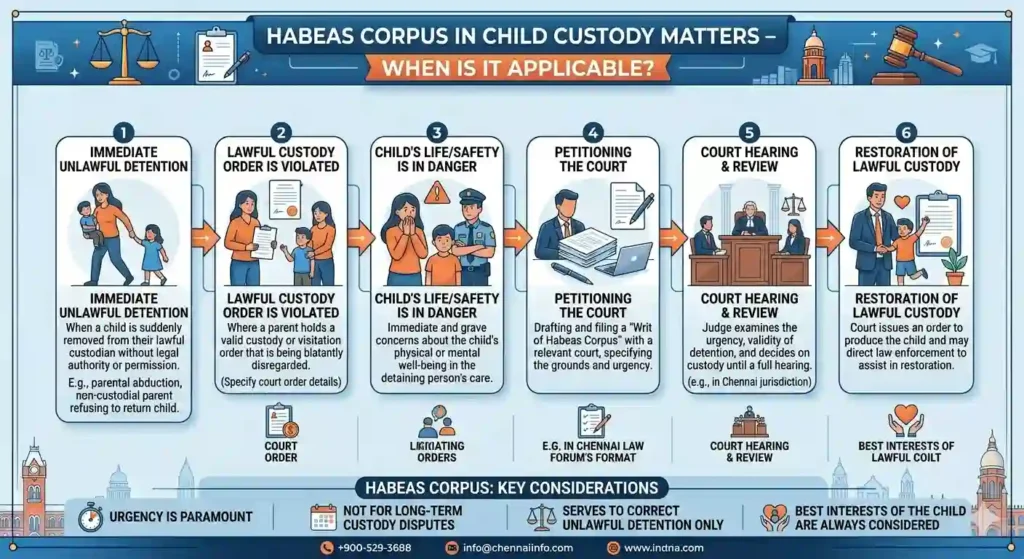
Understanding Habeas Corpus in the Context of Child Custody Law
Habeas corpus literally means “you shall have the body” in Latin. Therefore, this writ commands whoever detains a person to produce them before the court immediately. In child custody disputes, courts treat the child as the person whose liberty is restrained. Accordingly, the writ applies whenever one parent, relative, or institution unlawfully retains a child. The Supreme Court in Sayed Saleemuddin v. Dr. Rukhsana confirmed this writ’s applicability in custody matters. Moreover, High Courts consistently exercise parens patriae jurisdiction to protect children’s welfare. The Guardians and Wards Act, 1890 (GWA) governs guardianship but does not bar habeas corpus petitions. Furthermore, the Hindu Minority and Guardianship Act, 1956 (HMGA) applies to Hindu children specifically. The Special Marriage Act, 1954 and Divorce Act, 1869 also contain custody provisions. Consequently, habeas corpus acts as an emergency bridge before regular custody proceedings conclude.
Constitutional Basis and Governing Laws for Habeas Corpus in Custody Cases
The constitutional and statutory framework governing habeas corpus in custody matters is multi-layered. Therefore, understanding each applicable law helps families pursue the correct legal strategy effectively. The following key laws govern habeas corpus petitions in Indian child custody matters:
| Law / Provision | Applicability | Forum |
|---|---|---|
| Article 226, Constitution | All persons, writ jurisdiction | High Court |
| Article 32, Constitution | Fundamental rights violations | Supreme Court |
| Guardians and Wards Act, 1890 | Guardianship, custody orders | Family Court / District Court |
| Hindu Minority & Guardianship Act, 1956 | Hindu children’s custody | Family Court |
| Family Courts Act, 1984 | Matrimonial and custody disputes | Family Court |
| BNS, 2023 – Section 137 | Kidnapping / abduction of child | Sessions / Magistrate Court |
| BNSS, 2023 – Section 97 | Search for wrongfully confined persons | Magistrate Court |
| BSA, 2023 | Evidence in custody proceedings | All Courts |
| CPC, 1908 – Order 32A | Proceedings involving minors | Civil Courts |
| Protection of Children Act (POCSO), 2012 | Child sexual abuse in custody disputes | Special POCSO Court |
Additionally, the Hague Convention on International Child Abduction informs Indian courts in cross-border custody matters. The Supreme Court in V. Ravi Chandran v. Union of India applied Hague Convention principles to an international custody case. Moreover, the Muslim Personal Law (Shariat) Application Act, 1937 governs custody of Muslim children under hizanat principles. Furthermore, the Indian Christian Marriage Act, 1872 and Parsi Marriage Act, 1936 contain religion-specific custody provisions. The Juvenile Justice (Care and Protection of Children) Act, 2015 (JJ Act) additionally protects children in need of state care. Consequently, selecting the correct applicable law significantly determines the success of a habeas corpus petition in custody matters.
When Does Habeas Corpus Become Applicable in Child Custody Disputes?
Habeas corpus becomes applicable in child custody matters under specific factual circumstances. Therefore, courts examine whether the child’s detention is illegal, wrongful, or contrary to the child’s welfare. The following situations trigger the applicability of habeas corpus in custody cases:
- One parent retains the child in violation of a subsisting court custody order
- A grandparent, relative, or third party illegally withholds the child from lawful guardian
- A child is taken to another state or country without court permission or guardian’s consent
- An institution, school, or organisation refuses to release the child to the lawful parent
- A parent takes the child before or during divorce proceedings to create unlawful custody
- A child is retained by a stepparent after the biological parent’s death without legal authority
- An unmarried father retains a child against the mother’s rights under applicable personal law
- State authorities detain a child without following JJ Act procedures or obtaining court orders
Moreover, the Supreme Court in Tejaswini Gaud v. Shekhar Jagdish Prasad Tewari held that habeas corpus lies even against a private individual illegally detaining a child. Accordingly, the petitioner need not prove criminal intent to invoke this writ successfully. Furthermore, courts consistently hold that the child’s best interests override technical procedural objections. The principle of parens patriae empowers courts to act as the child’s supreme guardian. Additionally, courts appoint amicus curiae or child welfare committees to independently assess children’s preferences. Consequently, habeas corpus provides the swiftest available path to restoring lawful custody in urgent situations.
Jurisdiction: Which Courts Handle Habeas Corpus in Child Custody Cases?
Jurisdictional clarity is critical before filing a habeas corpus petition in child custody matters. Therefore, Legacy Family Court Law Firm analyses each case to identify the most appropriate forum. The following courts and forums have jurisdiction over habeas corpus and related custody matters in India:
- Supreme Court of India – Article 32 writ jurisdiction; inter-state and international custody cases
- High Courts – Article 226 writ jurisdiction; the most commonly invoked forum for child custody habeas corpus
- Family Courts – Established under Family Courts Act, 1984; primary forum for all matrimonial custody disputes
- District Courts / Principal Civil Courts – Guardianship petitions under GWA, 1890 where no Family Court exists
- Magistrate Courts (BNSS, 2023) – Criminal complaints involving child abduction under BNS Section 137
- Special POCSO Courts – Child abuse dimensions of custody matters under POCSO Act, 2012
- Juvenile Justice Boards (JJBs) – When a child requires state care and protection under JJ Act, 2015
- Child Welfare Committees (CWC) – Administrative body for children in need of care and protection
Additionally, High Courts across India have consistently held that Family Courts and habeas corpus jurisdiction are not mutually exclusive. Therefore, a parent may simultaneously pursue habeas corpus at the High Court and file a custody petition before the Family Court. Moreover, the Supreme Court in Nithya Anand Rajkumar v. State of Maharashtra clarified that habeas corpus lies even when a custody order exists. Furthermore, courts retain power to modify interim custody arrangements pending final hearing. Consequently, knowing the correct forum prevents procedural delays that harm children’s welfare and recovery timelines.
Filing a Habeas Corpus Petition: Process, Remedies, and Legal Support
Filing a habeas corpus petition requires precise legal drafting, urgent court access, and strategic evidence assembly. Therefore, engaging an experienced family law advocate significantly improves outcomes in these sensitive matters. Legacy Family Court Law Firm offers emergency filing services within 24 hours of consultation. Our senior advocates understand the urgency that child custody crises demand at every stage. Moreover, we coordinate with police, government departments, and child welfare bodies simultaneously. The BNSS, 2023 introduced reformed timelines for criminal complaints linked to child custody matters. Additionally, the BSA, 2023 governs the evidentiary standard in all custody and habeas corpus hearings. Furthermore, our team prepares detailed affidavits, documentary evidence, and child welfare reports. Consequently, each petition filed by Legacy Family Court Law Firm is procedurally sound and substantively compelling. Therefore, we consistently obtain favourable interim orders within days of filing.
Step-by-Step Process for Filing Habeas Corpus in Child Custody Cases
Filing a habeas corpus petition involves several critical steps that must be completed correctly. Therefore, understanding the process helps parents act decisively during custody emergencies. The step-by-step process for filing is as follows:
- Emergency Consultation – Meet with a senior family law advocate immediately to assess facts
- Evidence Collection – Gather birth certificate, custody orders, photographs, and communication records
- Police Complaint (BNSS Section 173) – File FIR at the nearest police station for child abduction/illegal detention
- Drafting the Petition – Prepare a detailed habeas corpus petition with supporting affidavit
- Filing Before High Court – Submit under Article 226 with urgent mention for immediate hearing
- Serving Notice – Court issues notice to respondent and State to produce the child
- Child Produced Before Court – Court interviews child privately to assess welfare and preference
- Interim Custody Order – Court grants interim custody pending final disposal of the petition
- Final Order – Court passes final custody order based on child’s best interests
- Contempt Petition (if needed) – File contempt if respondent violates court’s custody order
Moreover, the petitioner must clearly establish that the child’s detention is illegal, wrongful, or harmful to their welfare. Additionally, the court may appoint a District Child Protection Officer to investigate the child’s living conditions. Furthermore, the Child Welfare Committee may be directed to submit an independent welfare report. Under BNSS Section 97, a Magistrate may additionally authorise a search for a wrongfully confined child. Consequently, simultaneous action before criminal courts and the High Court maximises pressure for immediate child recovery. Therefore, coordinated multi-forum action is the most effective strategy in serious child custody crises.
Evidence Required for a Successful Habeas Corpus Custody Petition
Strong evidentiary foundation is essential for succeeding in a habeas corpus custody petition. Therefore, our lawyers guide clients systematically in gathering all required documentary and testimonial evidence. Under the Bharatiya Sakshya Adhiniyam (BSA), 2023, electronic evidence is fully admissible in court proceedings. The following evidence is typically required in a child custody habeas corpus petition:
- Child’s birth certificate establishing parentage and petitioner’s legal status
- Marriage certificate or divorce decree evidencing the family’s legal relationship
- Existing court custody or visitation orders being violated by the respondent
- Photographs, videos, and WhatsApp/SMS messages proving illegal detention (BSA Section 63)
- School records, medical records, and passport showing the child’s current location
- Witness affidavits from neighbours, teachers, or relatives confirming wrongful detention
- Police FIR copy filed under BNSS Section 173 / BNS Section 137
- Psychological assessment reports indicating harm from continued detention
Additionally, digital evidence like location data, call records, and social media posts is admissible under BSA Section 63. Moreover, courts regularly direct production of school attendance records to confirm the child’s current residence. Furthermore, financial records can establish whether the detaining party has the child’s best interests at heart. The court may appoint a Child Psychologist to assess trauma caused by unlawful detention. Consequently, well-documented evidence enables courts to act swiftly and decisively in child custody habeas corpus matters. Therefore, beginning evidence collection immediately upon realising the child is detained is critically important.
Legal Remedies Available Through Habeas Corpus in Child Custody Matters
Habeas corpus in child custody matters delivers a range of powerful legal remedies. Therefore, petitioners can seek multiple forms of relief simultaneously before courts. The following legal remedies are available through habeas corpus proceedings in custody cases:
| Remedy | Legal Basis | Forum |
|---|---|---|
| Production of child before court | Article 226 / BNSS S.97 | High Court / Magistrate |
| Interim custody order | GWA S.12 / HMGA S.6 | Family Court / HC |
| Permanent custody order | GWA S.25 / HMGA S.13 | Family Court |
| Visitation rights order | Family Courts Act, 1984 | Family Court |
| Injunction against removal from jurisdiction | CPC Order 39 Rule 1 & 2 | Civil Court / Family Court |
| Arrest warrant for child abductor | BNS S.137 / BNSS S.70 | Sessions / Magistrate Court |
| Look-out circular / passport impounding | Passport Act, 1967 / BNSS | High Court / Passport Authority |
| Compensation for child’s wrongful detention | Article 226 / Tort Law | High Court |
| Contempt of Court proceedings | Contempt of Courts Act, 1971 | High Court |
| Child counselling and rehabilitation order | JJ Act, 2015 / POCSO, 2012 | CWC / JJB / Special Court |
Moreover, courts increasingly order supervised handover in neutral locations to protect children during custody transitions. Additionally, Look-Out Circulars (LOC) prevent a detaining parent from fleeing India with the child. Furthermore, passport impounding orders under the Passports Act, 1967 block international removal of the child effectively. The Supreme Court regularly exercises its extraordinary jurisdiction under Article 142 to do complete justice. Consequently, combining habeas corpus with criminal complaints and civil injunctions creates a legally impenetrable protective net around the child. Therefore, Legacy Family Court Law Firm designs multi-layered legal strategies for every child custody crisis.
International Child Custody: Habeas Corpus and Cross-Border Abduction
International child custody disputes present unique legal complexities requiring specialised advocacy. Therefore, Legacy Family Court Law Firm handles cross-border child custody cases with experienced international family law counsel. India is not yet a signatory to the Hague Convention on Civil Aspects of International Child Abduction, 1980. However, Indian courts voluntarily apply Hague Convention principles in international custody habeas corpus cases. The Supreme Court in Surya Vadanan v. State of Tamil Nadu directed return of a child to the foreign court’s jurisdiction. Moreover, courts consider the child’s habitual residence, nationality, and welfare before deciding international custody matters. Additionally, Mutual Legal Assistance Treaties (MLATs) facilitate cross-border evidence gathering in international custody cases. The Ministry of External Affairs and Indian embassies assist in locating children taken abroad. Furthermore, Interpol Red Notices may be issued for international parental child abducters in extreme cases. Consequently, our lawyers coordinate with foreign legal counsel to ensure comprehensive protection of children’s rights internationally. Therefore, no jurisdiction is beyond reach when a child’s welfare is at stake.
Role of Police and Government Departments in Child Custody Habeas Corpus
Police and government departments play essential roles in enforcing habeas corpus orders in child custody matters. Therefore, understanding each authority’s function helps parents pursue comprehensive legal strategies. The following government departments and police authorities are involved in child custody habeas corpus enforcement:
- Local Police Station – FIR under BNSS S.173 / BNS S.137; search and recovery operations
- District Child Protection Unit (DCPU) – Investigates child welfare; reports to court and CWC
- Child Welfare Committee (CWC) – Administrative body protecting children in need of care and protection
- Women and Child Development (WCD) Department – Coordinates rehabilitation and shelter for rescued children
- Passport Authority of India – Impounds passports of minor children on court direction
- Ministry of External Affairs (MEA) – Assists in international child recovery through diplomatic channels
- National Commission for Protection of Child Rights (NCPCR) – Accepts complaints on child rights violations
- State Commission for Protection of Child Rights (SCPCR) – State-level child rights enforcement body
Moreover, the Women’s Cell attached to most district police stations handles child recovery complaints sensitively. Additionally, the Crime Against Women and Children (CAWC) Wing has specialised jurisdiction in serious child abduction matters. Furthermore, the Cyber Crime Wing assists in tracing children’s digital footprints across social media and messaging platforms. Look-Out Circulars are issued through the Bureau of Immigration at the Ministry of Home Affairs. Consequently, coordinated action involving police, government departments, and courts produces the fastest child recovery outcomes. Therefore, our legal team activates all relevant government channels simultaneously from day one of engagement.
BNS and BNSS Provisions Directly Applicable to Child Custody Abduction
The Bharatiya Nyaya Sanhita (BNS), 2023 and the Bharatiya Nagarik Suraksha Sanhita (BNSS), 2023 introduce updated criminal provisions protecting children in custody disputes. Therefore, understanding these new provisions helps parents pursue criminal remedies effectively alongside habeas corpus. The following BNS and BNSS provisions apply directly to child custody abduction cases:
- BNS Section 137 – Kidnapping from lawful guardianship; imprisonment up to 7 years
- BNS Section 138 – Kidnapping from India; applies in international child abduction cases
- BNS Section 140 – Kidnapping to subject a person to grievous hurt or slavery
- BNS Section 87 – Enticing or taking away a child under 18 years of age
- BNSS Section 97 – Magistrate’s power to search for wrongfully confined persons including children
- BNSS Section 173 – Zero FIR provision; permits FIR at any police station regardless of jurisdiction
- BNSS Section 482 – Bail provisions in child abduction cases before Sessions Court
Additionally, BNSS Section 530 enables video-conference testimony for children who cannot travel to court. Therefore, children recovered from distant locations can provide evidence remotely without further trauma. Moreover, the BNSS mandates police to investigate child abduction complaints within 60 days and submit chargesheet. Furthermore, courts regularly order police to file status reports during pending habeas corpus petitions involving child recovery. Consequently, criminal law provisions under BNS and BNSS create parallel pressure compelling immediate child production. Therefore, simultaneous criminal complaints exponentially strengthen the habeas corpus petition’s effectiveness and urgency.
Child’s Best Interest Standard in Habeas Corpus Custody Proceedings
The child’s best interest is the paramount and non-negotiable standard in all Indian custody proceedings. Therefore, courts evaluate every relevant factor before deciding custody in habeas corpus matters. The following factors determine the child’s best interest in Indian habeas corpus custody proceedings:
| Factor | Why It Matters |
|---|---|
| Child’s age and gender | Younger children preferably stay with mothers (tender years doctrine) |
| Child’s expressed preference | Courts interview children above 9 years privately in chambers |
| Parent’s financial capability | Ability to provide education, healthcare, and stable living |
| Psychological stability | Parent’s mental health and emotional fitness assessed |
| Sibling relationships | Courts avoid separating siblings unless compelling reason exists |
| Continuity of education | School stability and educational environment considered |
| Past conduct toward child | Evidence of abuse, neglect, or domestic violence evaluated |
| Proximity to extended family | Social support network and cultural continuity assessed |
Moreover, the Supreme Court in Roxann Sharma v. Arun Sharma held that the child’s welfare is the first and paramount consideration. Additionally, courts appoint guardians ad litem or amicus curiae to independently represent the child’s interests. Furthermore, Child Psychologist reports carry significant weight in courts evaluating best interest determinations. Courts consistently reject arguments of legal technicality where they conflict with the child’s welfare. Consequently, a parent’s strong legal rights may yield to the child’s best interest if the facts demand it. Therefore, building a holistic child-welfare-centred case is the winning strategy in habeas corpus custody petitions.
Interim Custody Orders Pending Final Disposal of Habeas Corpus Petitions
Interim custody orders protect the child’s welfare during the pendency of habeas corpus proceedings. Therefore, Legacy Family Court Law Firm seeks interim custody orders at the very first hearing. Courts possess inherent power under Section 151 CPC and Article 226 to pass interim orders urgently. Additionally, Section 12 of the Guardians and Wards Act, 1890 explicitly empowers courts to grant interim custody. The following types of interim orders are commonly passed in habeas corpus custody petitions:
- Interim custody to the petitioning parent pending final hearing and disposal
- Supervised visitation order for the respondent parent during proceedings
- Travel ban preventing the child from being taken out of court’s jurisdiction
- Passport impounding order for the minor child’s protection
- Direction to produce the child before court or Child Welfare Committee
- Police protection order during custody handover to prevent confrontation
- Direction to maintain status quo regarding the child’s school and residence
Moreover, courts regularly pass exparte interim orders on the very first day when urgency is established. Additionally, our lawyers use urgent mention procedures in High Courts to obtain same-day hearings. Furthermore, vacation bench procedures allow filing and hearing habeas corpus petitions even during court holidays. The court may additionally appoint a Commissioner to visit the child’s location and submit a welfare report. Consequently, interim orders create immediate practical protection for the child while substantive legal proceedings continue. Therefore, obtaining early interim relief is often the single most important step in any custody habeas corpus case.
Contempt of Court Proceedings for Violation of Custody Habeas Corpus Orders
Contempt of court proceedings enforce compliance with habeas corpus and custody orders in child matters. Therefore, a parent who violates a custody order faces serious legal consequences. The Contempt of Courts Act, 1971 empowers High Courts and the Supreme Court to punish contempt with imprisonment and fines. Additionally, civil contempt arises when a respondent wilfully disobeys a court’s custody order. Furthermore, criminal contempt arises from conduct that scandalises or obstructs court proceedings. The following consequences arise from contempt in habeas corpus child custody matters:
- Imprisonment of the contemnor for up to six months under Section 12 of the Act
- Fine up to ₹2,000 in addition to or instead of imprisonment
- Sealing of the contemnor’s property through court-directed attachment orders
- Adverse inference against contemnor in the main custody proceedings
- Cancellation of bail or anticipatory bail in related criminal proceedings
- Police directed to arrest and produce contemnor before court immediately
Moreover, courts take an extremely serious view of contempt in child custody matters due to children’s vulnerability. Additionally, the Supreme Court has held that custodial disobedience harms children irreparably and deserves strict punishment. Furthermore, the court may permanently modify custody arrangements against the contemnor parent following proven wilful disobedience. Consequently, contempt proceedings serve as a powerful deterrent against non-compliance with habeas corpus custody orders. Therefore, our lawyers file contempt petitions swiftly whenever court orders are violated to enforce child custody rights decisively.
Mental Health, Child Psychology, and Welfare Assessments in Custody Proceedings
Mental health and psychological welfare assessments are increasingly central to child custody habeas corpus proceedings. Therefore, courts regularly direct expert psychological evaluations of both the child and disputing parents. Child psychologists assess trauma, attachment bonds, and the child’s adjustment to current living conditions. Additionally, psychiatric evaluations of parents are ordered where mental health affects parenting capacity. Furthermore, the National Institute of Mental Health and Neurosciences (NIMHANS) guidelines inform judicial assessment processes. The following psychological and welfare measures are commonly ordered in custody habeas corpus cases:
- Court-directed psychological evaluation of the child by a certified child psychologist
- Parental psychiatric assessment where mental health is contested by either party
- Child counselling sessions to reduce trauma caused by custody disputes and detention
- Play therapy assessments to evaluate younger children’s emotional states non-verbally
- School-based welfare reports from teachers and counsellors regarding child’s behaviour
- District Child Protection Officer’s home visit report on living conditions assessment
Moreover, the Supreme Court in Gaurav Nagpal v. Sumedha Nagpal emphasised holistic child welfare assessment beyond mere legal technicalities. Additionally, courts recognise Parental Alienation Syndrome (PAS) as a factor harming child welfare in contested custody cases. Furthermore, a parent deliberately undermining the child’s relationship with the other parent may lose custody as a result. Consequently, child welfare reports from qualified professionals carry decisive evidentiary weight in habeas corpus custody proceedings. Therefore, investing in thorough psychological and welfare assessments dramatically strengthens the petitioner’s overall legal position before the court.
Mediation and Alternative Dispute Resolution in Child Custody Habeas Corpus Matters
Mediation provides a child-sensitive alternative for resolving custody disputes alongside habeas corpus proceedings. Therefore, courts regularly direct parties to mediation before or during habeas corpus hearings to explore settlement. The Family Courts Act, 1984 and Section 89 CPC mandate courts to explore settlement options in family disputes. Additionally, the Supreme Court Mediation Centre and High Court Mediation Centres offer specialised family mediation services. Furthermore, the Mediation Act, 2023 provides a comprehensive statutory framework for mediation in civil disputes. Mediated custody settlements have several significant advantages over litigated outcomes, including the following:
- Faster resolution with less emotional trauma for the child and both parents
- Mutually acceptable parenting plans tailored to the child’s specific needs
- Lower litigation costs and reduced court appearances for both parties
- Preservation of co-parenting relationship for the child’s long-term benefit
- Greater compliance with mediated agreements compared to litigated court orders
- Confidential process protecting family privacy from public court records
Moreover, a mediated settlement agreement must be recorded as a consent decree before the Family Court for legal enforceability. Additionally, the Mediation Act, 2023 makes mediated settlement agreements enforceable as court decrees. Furthermore, even during habeas corpus proceedings, courts may refer parties to mediation without delaying child production. Consequently, mediation often achieves sustainable co-parenting solutions that litigation alone cannot produce. Therefore, Legacy Family Court Law Firm incorporates mediation strategy into every child custody habeas corpus matter where child welfare permits it.
Legacy Family Court Law Firm: Our Child Custody Habeas Corpus Legal Services
Legacy Family Court Law Firm provides comprehensive, senior-led legal services for child custody habeas corpus matters. Therefore, clients receive end-to-end representation from emergency consultation through to final court order enforcement. Our advocates have appeared before the Supreme Court, multiple High Courts, and all Family Courts across India. Moreover, we handle both domestic and international child custody abduction cases with equal expertise. Additionally, our firm coordinates with police authorities, child welfare agencies, and government departments simultaneously. Furthermore, we maintain a 24-hour emergency response line for urgent child custody crises requiring immediate legal intervention. The following are the key legal services offered by Legacy Family Court Law Firm in habeas corpus custody matters:
- Emergency habeas corpus petition drafting and filing within 24 hours
- Urgent mention applications for same-day hearings before High Courts
- Criminal FIR filing under BNS S.137 / BNSS S.173 at police stations
- Interim custody and injunction applications before Family Courts and High Courts
- Look-Out Circular and passport impounding applications for international cases
- Psychological and welfare assessment coordination with certified child experts
- Mediation representation before court-annexed mediation centres
- Contempt of court petitions for custody order violations
- International child recovery coordination with foreign legal counsel
- RTI applications and government grievance filings through relevant child welfare departments
Moreover, our firm provides transparent fee structures with no hidden charges for child custody habeas corpus clients. Additionally, we offer Pro Bono legal support for economically vulnerable parents in genuine child custody emergencies. Furthermore, our dedicated Child Custody Practice Group stays current with every Supreme Court and High Court judgment in this area. Consequently, Legacy Family Court Law Firm delivers the highest standard of legal advocacy in every child custody habeas corpus matter. Therefore, your child’s safety and welfare deserve nothing less than our firm’s full and unwavering legal commitment.
Frequently Asked Questions: Habeas Corpus in Child Custody Matters
Our clients frequently seek clarity on habeas corpus and child custody legal matters. Therefore, we have answered the ten most common questions with expert, concise responses below.
1. Can a mother file habeas corpus if the father refuses to return the child?
Yes. A mother can file habeas corpus before the High Court under Article 226 if the father illegally detains the child against a custody order or legal right.
2. Is habeas corpus applicable even when no custody order exists?
Yes. Courts apply habeas corpus based on the child’s welfare even without a prior custody order, especially when the child’s best interests require immediate judicial intervention.
3. How quickly can a habeas corpus petition be heard in a child custody case?
Urgent habeas corpus petitions in child custody matters can be heard on the same day via the urgent mention procedure before the High Court’s mentioning officer.
4. Which police station should I approach if my child is abducted by my spouse?
File a Zero FIR at the nearest police station under BNSS Section 173 and BNS Section 137. The station will transfer the FIR to the jurisdictional station automatically.
5. Can grandparents file habeas corpus for custody of a grandchild?
Yes. Grandparents with legitimate welfare concerns can file habeas corpus petitions. Courts evaluate the child’s best interests independently of the grandparent-parent relationship.
6. What happens if my spouse takes the child abroad without permission?
File habeas corpus before the High Court or Supreme Court immediately. Courts issue Look-Out Circulars and passport impounding orders to prevent international child removal.
7. Does the child’s preference matter in habeas corpus custody proceedings?
Yes. Courts interview children above 9 years privately in chambers. The child’s preference carries significant but not absolute weight in the court’s final custody determination.
8. Can a habeas corpus petition be filed against a school or institution retaining a child?
Yes. Habeas corpus lies against any person or institution, including schools, that illegally detains a child against the lawful guardian’s wishes and legal right.
9. What is contempt of court in child custody habeas corpus matters?
Wilfully violating a court’s custody or production order constitutes contempt. Courts punish contempt with imprisonment up to six months under the Contempt of Courts Act, 1971.
10. How does Legacy Family Court Law Firm assist in child custody habeas corpus emergencies?
We provide 24-hour emergency consultation, file urgent habeas corpus petitions within 24 hours, coordinate with police, and appear before High Courts for immediate interim custody relief.
Read More
- Appeal Against Interim Custody Orders – Maintainability Explained
- Welfare of Child vs Parental Rights – Supreme Court Approach
- Challenging Child Custody Orders in High Court – Legal Standards Explained
- Effective Solutions for Inheritance Issues Under the Indian Succession Act
- Top Divorce Lawyers in Chennai: Expert Guidance for Your Case
- Department of Justice