

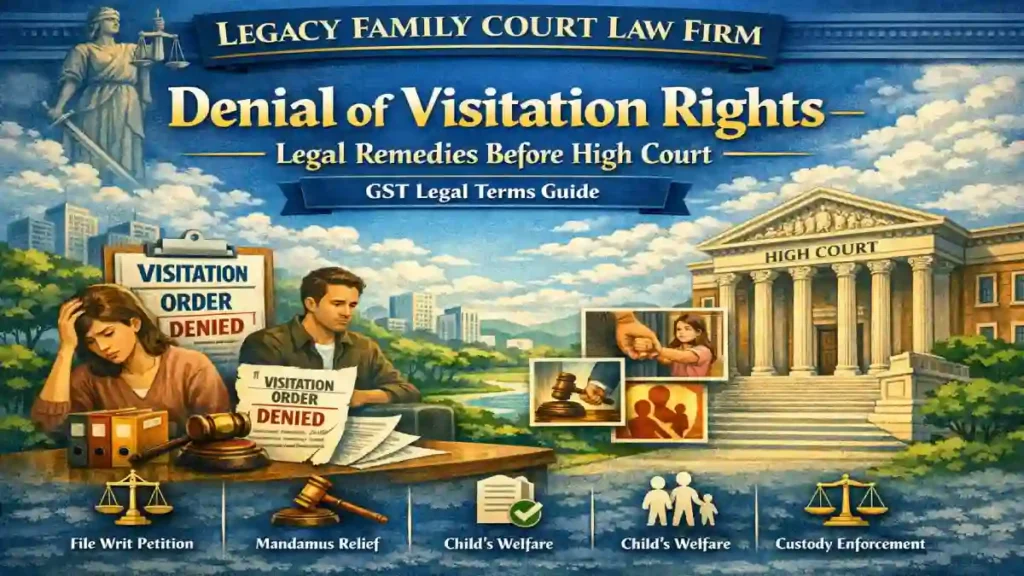
Denial of Visitation Rights – Visitation rights derive their legal force from multiple statutes and constitutional protections in India. Therefore, every parent denied access must understand this foundational legal architecture clearly. Article 21 of the Constitution guarantees the right to life, which courts interpret to include meaningful parent-child relationships. Consequently, denying visitation can violate both the parent’s and the child’s fundamental rights simultaneously. The Guardians and Wards Act, 1890 (GWA) is the primary statute governing custody and visitation disputes. Furthermore, the Hindu Minority and Guardianship Act, 1956 (HMGA) applies specifically to Hindu families. The Special Marriage Act, 1954 governs visitation disputes in inter-faith and civil marriages. Additionally, Muslim personal law and the Dissolution of Muslim Marriages Act, 1939 address visitation within Islamic jurisprudence. Moreover, the Protection of Women from Domestic Violence Act, 2005 (PWDVA) intersects with visitation through residence and protection orders. Courts consistently prioritise the best interest of the child as the paramount consideration. Legacy Family Court Law Firm builds every visitation rights case on this robust constitutional foundation.
Denial of Visitation Rights – Legal Remedies Before High Court : Published by Legacy Family Court Law Firm
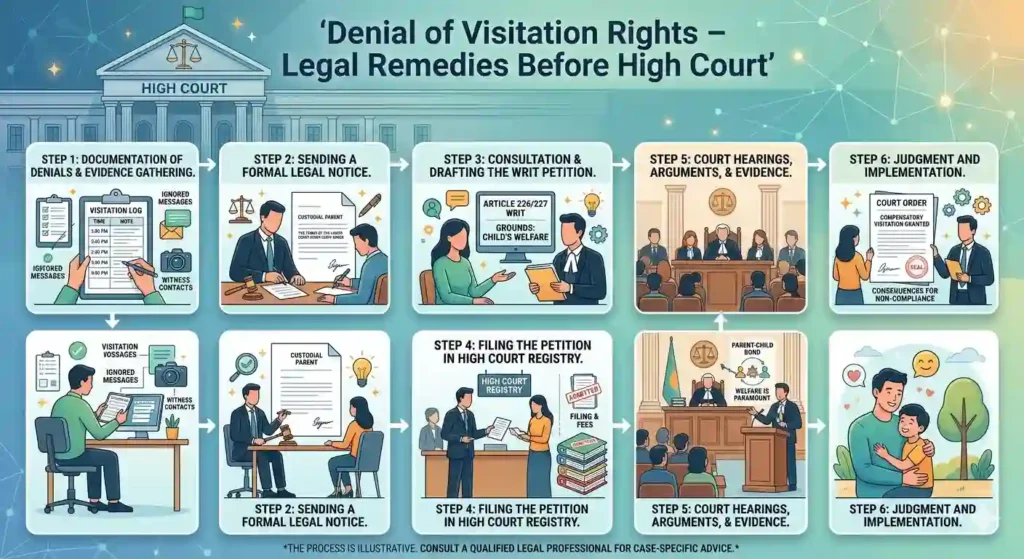
Understanding Visitation Rights: Legal Framework and Parental Entitlements in India
Constitutional and Statutory Basis of Visitation Rights in Indian Family Law
Visitation rights derive their legal force from multiple statutes and constitutional protections in India. Therefore, every parent denied access must understand this foundational legal architecture clearly. Article 21 of the Constitution guarantees the right to life, which courts interpret to include meaningful parent-child relationships. Consequently, denying visitation can violate both the parent’s and the child’s fundamental rights simultaneously. The Guardians and Wards Act, 1890 (GWA) is the primary statute governing custody and visitation disputes. Furthermore, the Hindu Minority and Guardianship Act, 1956 (HMGA) applies specifically to Hindu families. The Special Marriage Act, 1954 governs visitation disputes in inter-faith and civil marriages. Additionally, Muslim personal law and the Dissolution of Muslim Marriages Act, 1939 address visitation within Islamic jurisprudence. Moreover, the Protection of Women from Domestic Violence Act, 2005 (PWDVA) intersects with visitation through residence and protection orders. Courts consistently prioritise the best interest of the child as the paramount consideration. Legacy Family Court Law Firm builds every visitation rights case on this robust constitutional foundation.
What Constitutes Denial of Visitation Rights: Legal Definition and Common Patterns
Denial of visitation rights occurs when the custodial parent wilfully prevents court-ordered or agreed access. Therefore, correctly identifying denial is the first critical step toward effective legal action. Denial is not always overt; it frequently occurs through subtle, systematic obstruction tactics. Consequently, recognising these patterns helps the aggrieved parent build a strong evidentiary record. The following list identifies the most common forms of visitation denial encountered in Indian courts.
- Physically refusing to hand over the child during scheduled visitation periods
- Relocating the child to another city or state without court permission
- Alienating the child emotionally against the non-custodial parent systematically
- Filing false police complaints to intimidate the visiting parent before access dates
- Influencing the child to refuse visits through psychological pressure or coaching
- Violating interim visitation orders passed by Family Court or High Court
- International removal of the child without the court’s permission (parental abduction)
Furthermore, courts under the Bharatiya Nyaya Sanhita (BNS), 2023 now recognise parental alienation as a form of emotional harm. Denial backed by false complaints additionally attracts scrutiny under Section 220 of BNS. Consequently, documenting every incident of denial is vital for High Court proceedings. Legacy Family Court Law Firm meticulously documents denial patterns for maximum courtroom impact.
Jurisdiction and Proper Forum for Filing Visitation Rights Enforcement Actions
Choosing the correct forum is fundamentally important to enforce visitation rights quickly and effectively. Therefore, understanding each court’s jurisdiction prevents procedural delays and wasted resources. The Family Court under the Family Courts Act, 1984 is the primary forum for initial custody and visitation orders. Consequently, Family Courts exercise exclusive jurisdiction in matrimonial and custody matters in cities with designated courts. The following table maps the correct forum to each type of visitation dispute comprehensively.
| Dispute Type | Primary Forum | Legal Basis | Remedy Available |
|---|---|---|---|
| Violation of Family Court visitation order | Family Court (Contempt) | Family Courts Act, 1984 | Contempt, police enforcement |
| Writ of Habeas Corpus (child withheld) | High Court | Article 226, Constitution | Production and access order |
| Urgent interim visitation | High Court / Family Court | CPC Order 39, GWA Sec 12 | Interim access order |
| Inter-state child removal | High Court (transferee state) | GWA Sec 9 / Article 226 | Return and visitation order |
| International parental abduction | High Court / Supreme Court | Article 226 / SLP | Return order, Interpol alert |
| DV Act visitation modification | Magistrate / Sessions Court | PWDVA, 2005 Sec 21 | Custody/visitation directions |
Moreover, in areas without designated Family Courts, the District Court exercises equivalent jurisdiction. Legacy Family Court Law Firm identifies the fastest and most effective forum for every client.
High Court Remedies for Denial of Visitation Rights: Petitions, Writs, and Enforcement
Writ of Habeas Corpus Before the High Court: The Fastest Remedy for Child Withheld
The Writ of Habeas Corpus under Article 226 of the Constitution is the most powerful and fastest remedy when a child is unlawfully withheld. Therefore, a parent denied all access should immediately approach the High Court with a habeas corpus petition. The High Court commands the custodial parent to produce the child before the court physically. Consequently, the child’s welfare and access situation are examined directly by the High Court judge. This writ bypasses the often slow Family Court process, providing immediate judicial intervention. Furthermore, the High Court can issue access directions alongside the production order in the same hearing. The petition must disclose the child’s name, age, last known location, and the denial circumstances. Additionally, supporting documents like prior court orders, WhatsApp messages, and communication records must be annexed. Moreover, the High Court issues notice to the opposite party and can also direct police assistance. The Commissioner of Police or local Station House Officer (SHO) can be directed to execute the order. Legacy Family Court Law Firm files habeas corpus petitions with precision and urgency for distressed parents.
Contempt of Court Petition for Violation of Visitation Orders: Procedure and Consequences
Contempt proceedings are the most direct enforcement mechanism when a court visitation order is deliberately violated. Therefore, a parent possessing a valid Family Court or High Court visitation order must act immediately upon violation. Civil contempt under the Contempt of Courts Act, 1971 applies when a party wilfully disobeys a court’s order. Consequently, the contemner faces imprisonment up to six months or a fine up to ₹2,000 or both. The following numbered steps outline the contempt petition procedure before the High Court.
- File a contempt petition in the High Court citing the specific order violated.
- Annex a certified copy of the violated court order as primary evidence.
- File an affidavit detailing each specific incident of non-compliance with dates.
- Serve notice on the contemner through the High Court registry formally.
- Attend the hearing and present oral and documentary evidence of denial.
- The court issues Show Cause Notice asking the contemner to explain the violation.
- If contempt is proved, the court imposes punishment and enforcement directions.
Furthermore, the High Court can simultaneously modify the visitation order to include stricter enforcement mechanisms. Additionally, police assistance can be directed through the jurisdictional Station House Officer. Consequently, repeated contempt escalates into criminal contempt with more severe punishment. Legacy Family Court Law Firm aggressively pursues contempt proceedings to enforce every client’s visitation rights.
Interim Visitation Orders Under CPC and GWA: Emergency Applications Before High Court
Courts can grant interim visitation even before the main petition is finally decided in appropriate cases. Therefore, applying for interim relief prevents prolonged separation from the child during litigation. Section 12 of the Guardians and Wards Act, 1890 empowers courts to make interim custody and access orders. Consequently, High Courts routinely pass interim visitation directions in urgent habeas corpus and custody matters. Furthermore, Order 39 Rules 1 and 2 of the CPC, 1908 support interim injunctions protecting visitation entitlements. The applicant must demonstrate a prima facie case, balance of convenience, and irreparable harm. Additionally, the court considers the child’s age, relationship with each parent, and current living conditions. Moreover, the High Court can appoint a Court Commissioner to facilitate supervised visitation immediately. Video-call visitation orders are also now routinely granted by Indian High Courts as interim measures. Evidence supporting interim applications must be compiled under the Bharatiya Sakshya Adhiniyam (BSA), 2023. Legacy Family Court Law Firm drafts compelling interim applications with strong affidavit evidence for every client.
Transfer Petition to High Court: Consolidating Multiple State Court Proceedings
When visitation disputes span multiple states, a Transfer Petition consolidates fragmented proceedings effectively. Therefore, the High Court or Supreme Court can transfer cases for unified adjudication in one forum. Section 25 of the CPC, 1908 empowers the Supreme Court to transfer any civil suit between states. Consequently, conflicting orders from different state courts can be avoided through timely transfer petitions. The High Court can also transfer within-state proceedings under Section 24 of the CPC. Furthermore, transfer petitions prove essential when the child is relocated across state boundaries to frustrate visitation. The petitioner must demonstrate genuine hardship, multiple proceedings, and risk of conflicting orders. Additionally, the transfer petition must identify all pending proceedings, courts, and case numbers accurately. Moreover, the Supreme Court regularly entertains transfer petitions in inter-state parental abduction cases. The National Commission for Protection of Child Rights (NCPCR) can also intervene in high-stakes inter-state removals. Legacy Family Court Law Firm files strategic transfer petitions to unify fragmented multi-court visitation disputes.
Role of Child Welfare Committees, NCPCR, and Mediation in Visitation Disputes
Beyond courts, statutory bodies and alternative dispute resolution mechanisms significantly assist visitation disputes. Therefore, parents should explore these complementary avenues alongside formal litigation strategy. The Child Welfare Committee (CWC) under the Juvenile Justice Act, 2015 protects child welfare in custody conflicts. Consequently, CWC can provide welfare reports used as evidence in High Court proceedings. The National Commission for Protection of Child Rights (NCPCR) investigates complaints of child rights violations. Furthermore, NCPCR can intervene when custodial parents systematically deny children access to the other parent. Mediation under the Mediation Act, 2023 offers structured, confidential dispute resolution before litigation escalates. Additionally, High Courts now routinely refer custody and visitation disputes to empanelled mediators. Moreover, Mediation Centres attached to High Courts and Family Courts provide free services. A mediated agreement, once filed in court, carries the same enforcement weight as a court order. District Legal Services Authorities (DLSA) offer free mediation for economically weaker parties. Legacy Family Court Law Firm integrates mediation strategy with litigation to achieve the fastest resolution for clients.
Evidence Required to Prove Denial of Visitation Rights Before the High Court
Strong, admissible evidence is the foundation of every successful visitation enforcement petition. Therefore, parents must systematically collect and preserve evidence from the moment denial begins. The Bharatiya Sakshya Adhiniyam (BSA), 2023 now explicitly recognises electronic evidence as fully admissible. Consequently, WhatsApp messages, call logs, emails, and video recordings carry significant evidentiary weight. The following list identifies the key evidence categories courts examine in visitation denial cases.
- Certified copy of the existing visitation or custody order being violated
- WhatsApp/SMS messages showing custodial parent’s refusal with timestamps
- Call detail records (CDRs) proving repeated unanswered contact attempts
- Video recordings of refusal at school gate, home, or handover location
- Witness affidavits from relatives, school staff, or neighbours observing denial
- Police complaint records (if police assistance was earlier sought)
- Diary or journal entries recording each denial incident with date and time
- Child’s school or medical records showing the non-custodial parent’s exclusion
Furthermore, electronic evidence must be supported by a certificate under Section 63 of the BSA, 2023 for admissibility. Additionally, a forensic expert’s report strengthens the authenticity of digital evidence significantly. Consequently, courts give greater weight to contemporaneous documentary evidence over oral testimony alone. Legacy Family Court Law Firm advises clients on evidence collection from the very first denial incident.
Police Assistance in Enforcing Visitation Orders: Rights, FIR, and Nearest Police Station
Police play a critical enforcement role when custodial parents defy court visitation orders wilfully. Therefore, understanding how to engage police assistance is essential for every aggrieved parent. When a High Court or Family Court order exists, the aggrieved parent can approach the jurisdictional police station directly. Consequently, the Station House Officer (SHO) is legally obligated to assist in executing valid court orders. The parent must present a certified copy of the court order at the nearest police station immediately. Furthermore, police can accompany the parent to the handover location to ensure peaceful compliance. If the custodial parent creates a public disturbance during handover, the police can act under Section 127 of the BNSS, 2023. Additionally, if the child is hidden or removed, an FIR for wrongful confinement under Section 127 of the BNS, 2023 can be registered. Moreover, in parental abduction cases, the High Court can direct the Commissioner of Police to trace and recover the child. Key police stations handling family disputes in major cities include dedicated Women and Child Protection Cells. Legacy Family Court Law Firm coordinates police engagement to enforce every client’s visitation order on the ground.
Parental Alienation Syndrome: Legal Recognition and Remedies Under Indian Courts
Parental alienation is a deliberate pattern where the custodial parent turns the child against the non-custodial parent. Therefore, courts now recognise this conduct as a serious child welfare concern warranting judicial intervention. Indian High Courts have increasingly cited parental alienation syndrome in custody and visitation judgments. Consequently, courts treat systematic alienation as a ground for modifying the custody arrangement fundamentally. The Supreme Court in landmark judgments has held that alienation harms the child’s psychological development gravely. Furthermore, alienation-related emotional harm to the child is recognisable under Section 3(b) of the BNS, 2023 definitions. The following table maps alienation behaviours to their legal consequences comprehensively.
| Alienation Behaviour | Legal Classification | Judicial Remedy |
|---|---|---|
| Coaching child to resist visits | Contempt / Child harm | Custody change, contempt order |
| Speaking negatively about visiting parent | Parental alienation | Counselling order, monitoring |
| Blocking all communication channels | Visitation denial | Supervised visitation direction |
| Filing false abuse complaints | BNS Sec 220 (false information) | FIR, contempt, police report |
| Relocating child without permission | Contempt / GWA violation | Return order, habeas corpus |
Moreover, courts routinely order psychological evaluations of the child by empanelled experts. Legacy Family Court Law Firm presents parental alienation evidence effectively before High Courts.
Modification of Custody Orders: When Persistent Denial Justifies Custody Change
Persistent denial of visitation is a judicially recognised ground for modifying the existing custody arrangement. Therefore, the non-custodial parent can petition the High Court or Family Court for custody modification. Courts modify custody when the custodial parent’s conduct demonstrates consistent disregard for court orders. Consequently, persistent denial signals to the court that the custodial parent prioritises personal conflict over child welfare. The following numbered steps outline the custody modification petition process before the High Court.
- File a modification petition under Section 26 of the Hindu Marriage Act or Section 38 of the GWA.
- Annex evidence of all documented visitation denial incidents with supporting documents.
- Request an interim custody direction pending final hearing of the modification petition.
- Seek a child psychologist’s evaluation to assess impact of denial on the child.
- Request the court to direct the CWC to file a child welfare report independently.
- Present evidence that changed circumstances justify altering the custody arrangement.
- Demonstrate your ability to facilitate the child’s continued relationship with both parents.
Furthermore, courts consider the child’s own preference when the child is old enough to express views meaningfully. Additionally, the child’s school performance, emotional health, and social development are evaluated. Consequently, a comprehensive presentation of changed circumstances maximises the modification petition’s success. Legacy Family Court Law Firm builds compelling custody modification cases backed by expert evidence.
International Parental Abduction: Hague Convention, High Court Remedies, and Return Orders
International parental abduction occurs when a parent removes a child to another country without consent or court permission. Therefore, this is one of the most legally complex and urgent visitation-related emergencies. India is not yet a signatory to the Hague Convention on International Child Abduction, 1980. Consequently, Indian courts rely on domestic law, bilateral agreements, and comity of courts principles instead. The aggrieved parent must file a writ of habeas corpus before the jurisdictional High Court immediately. Furthermore, the High Court can direct the Ministry of External Affairs (MEA) and the Passport Authority to revoke the child’s passport. The MEA’s Consular Services Division coordinates with Indian embassies to locate and assist the child. Additionally, Interpol’s Yellow Notice can be requested through the Central Bureau of Investigation (CBI). Moreover, the Supreme Court has issued return orders invoking its parens patriae jurisdiction in several landmark cases. The Ministry of Women and Child Development also coordinates in international abduction cases. Legacy Family Court Law Firm handles international parental abduction with emergency High Court filings and MEA coordination.
Criminal Law Remedies Under BNS and BNSS for Extreme Visitation Denial Cases
Extreme cases of visitation denial can attract criminal liability under the Bharatiya Nyaya Sanhita (BNS), 2023. Therefore, understanding criminal law options gives aggrieved parents additional enforcement leverage. Section 127 of the BNS, 2023 penalises wrongful confinement, directly applicable when a child is hidden. Consequently, the custodial parent concealing the child can be prosecuted criminally alongside civil contempt. Section 87 of the BNS, 2023 addresses kidnapping from lawful guardianship, relevant in parental abduction cases. Furthermore, Section 220 BNS penalises filing false information to frustrate legitimate visitation enforcement. The procedure for criminal complaints is governed entirely by the Bharatiya Nagarik Suraksha Sanhita (BNSS), 2023. Additionally, FIRs in visitation-related criminal matters can be registered at the nearest police station with jurisdiction. Moreover, the Women and Child Protection Cell at the district police headquarters handles sensitive family-related FIRs. Criminal proceedings create independent pressure on the violating parent to comply with court orders. Bail conditions under the BNSS can be designed to compel visitation compliance as a condition. Legacy Family Court Law Firm strategically deploys criminal remedies alongside civil petitions for maximum enforcement effect.
Legal Aid, Free Legal Services, and Support Available for Visitation Rights Cases
Parents unable to afford private legal representation can access substantial free legal support for visitation cases. Therefore, awareness of available free legal services is crucial for economically disadvantaged parents. The Legal Services Authorities Act, 1987 mandates free legal aid for eligible individuals through NALSA and DLSA. Consequently, the District Legal Services Authority (DLSA) provides free attorneys for Family Court and High Court proceedings. The following list identifies all key free legal support resources available in India for visitation disputes.
- NALSA (National Legal Services Authority): Free High Court and Supreme Court legal representation
- DLSA (District Legal Services Authority): Free Family Court representation and mediation services
- State Legal Services Authority (SLSA): Coordinates free legal aid at the High Court level
- High Court Legal Services Committee: Free legal aid for High Court habeas corpus petitions
- National Commission for Women (NCW): Legal support and advocacy for women in custody disputes
- NCPCR Helpline (1800-121-2830): Free assistance for child rights violations including visitation denial
- Child Helpline (1098): Reports child welfare concerns and triggers CWC intervention
Furthermore, NGOs like iCall and Vandrevala Foundation provide psychological support for parents and children during disputes. Additionally, Law School Legal Aid Clinics assist with petition drafting under attorney supervision. Consequently, no parent should abandon their visitation rights due to financial constraints. Legacy Family Court Law Firm also offers flexible fee structures for clients facing genuine financial hardship.
Grandparents’ Visitation Rights: Emerging Legal Protections and High Court Position
Grandparents increasingly approach courts seeking visitation rights when parents deny all access. Therefore, understanding the emerging legal framework for grandparents’ visitation is vital for affected families. Indian courts have no specific statute conferring automatic visitation rights on grandparents. Consequently, grandparents must approach courts under the Guardians and Wards Act, 1890 or the parens patriae jurisdiction. High Courts recognise grandparent visitation as beneficial when it serves the child’s best interests genuinely. Furthermore, grandparents can file an independent application before the Family Court seeking defined access schedules. The High Court has held in several cases that severing grandparent relationships harms child development. Additionally, grandparents can seek interim visitation directions pending final disposal of their access application. Moreover, grandparents from the non-custodial parent’s family face particular difficulty in obtaining access directly. Courts balance the custodial parent’s autonomy with the child’s right to meaningful extended family relationships. Furthermore, cultural and religious contexts also inform judicial discretion in grandparent visitation cases. Legacy Family Court Law Firm successfully represents grandparents seeking meaningful access to their grandchildren before courts.
Visitation Rights Under Special Circumstances: Domestic Violence, Remarriage, and Relocation
Special circumstances create complex overlapping legal issues in visitation rights enforcement. Therefore, understanding how these situations modify the standard legal framework is critically important. Where domestic violence is alleged, the PWDVA, 2005 under Section 21 empowers Magistrates to grant visitation despite protection orders. Consequently, supervised visitation in a neutral venue is often ordered to balance safety and access. The following table maps special circumstances to their applicable legal framework and judicial remedy.
| Special Circumstance | Applicable Law | Court | Remedy |
|---|---|---|---|
| Domestic Violence allegation | PWDVA, 2005 Sec 21 | Magistrate / Sessions | Supervised visitation order |
| Custodial parent remarriage | GWA, 1890 / HMGA, 1956 | Family Court / High Court | Custody modification review |
| Custodial parent relocation | GWA Sec 26 / HMA Sec 26 | High Court | Injunction / revised schedule |
| Child with disability | RPWD Act, 2016 / GWA | Family Court / High Court | Specialised visitation plan |
| Interfaith custody dispute | SMA, 1954 / GWA, 1890 | Family Court | Secular best-interest order |
Furthermore, courts consistently hold that domestic violence between parents does not automatically justify terminating the child’s relationship with the accused parent. Additionally, supervised visitation through a neutral third party or CWC remains available in sensitive cases. Legacy Family Court Law Firm navigates these complex intersecting legal frameworks with specialist expertise.
Enforcement Challenges and Practical Legal Strategies for Persistent Denial Cases
Even valid court orders face enforcement challenges when the custodial parent is determined to obstruct access. Therefore, combining multiple legal strategies simultaneously creates the strongest enforcement pressure. The following numbered action plan outlines the most effective multi-pronged enforcement strategy available.
- File a contempt petition before the High Court or Family Court for order violation immediately.
- File a habeas corpus writ if the child’s location is unknown or access is completely blocked.
- Register a police complaint at the nearest police station citing the violated court order.
- Apply to the court for appointment of a Court Commissioner to supervise handovers.
- Seek custody modification simultaneously if denial is systematic and prolonged.
- Request a child psychologist evaluation to document alienation impact on the child.
- File a complaint before NCPCR if child rights violations are involved in the dispute.
- Engage mediation through the High Court or DLSA to explore negotiated solutions.
Furthermore, maintaining a detailed written log of every denial incident strengthens all parallel proceedings. Additionally, notifying the child’s school and doctor to record access restrictions creates an independent paper trail. Consequently, simultaneous multi-forum action creates maximum legal pressure for compliance. Legacy Family Court Law Firm deploys coordinated multi-strategy enforcement for every persistent denial case.
How Legacy Family Court Law Firm Protects Your Visitation Rights
Legacy Family Court Law Firm provides comprehensive, compassionate, and strategically aggressive visitation rights enforcement. Therefore, every client receives a customised legal strategy based on their specific circumstances and urgency. Our senior family law attorneys file habeas corpus petitions, contempt applications, and custody modification petitions expertly. Consequently, clients benefit from the full spectrum of High Court and Family Court remedies simultaneously. Furthermore, our team coordinates directly with the Women and Child Protection Cell for police enforcement. We also engage certified child psychologists and forensic experts to strengthen evidence packages. Additionally, our mediation specialists pursue negotiated solutions to minimise trauma for the child. Moreover, our criminal law team deploys BNS and BNSS remedies when civil enforcement alone proves insufficient. Our attorneys have successfully argued visitation enforcement cases before multiple High Courts across India. Consequently, our clients receive experienced representation from the Family Court through to the Supreme Court level. Contact Legacy Family Court Law Firm today for an urgent consultation and protect your right to your child.
Frequently Asked Questions (FAQs) on Denial of Visitation Rights
FAQ 1: Can I file a habeas corpus petition if my child is being hidden from me?
Yes. A habeas corpus petition under Article 226 before the High Court is the fastest remedy. The court orders the child’s production and can simultaneously grant access or interim custody.
FAQ 2: What punishment does the custodial parent face for violating a visitation order?
Civil contempt under the Contempt of Courts Act, 1971 provides imprisonment up to six months or fine up to ₹2,000. Courts may additionally modify custody arrangements as a stronger deterrent.
FAQ 3: Can I get police help to enforce a visitation order?
Yes. Present the certified court order at the nearest police station. The SHO is obligated to assist execution. The High Court can also direct the Commissioner of Police to enforce orders.
FAQ 4: What is parental alienation and can courts act against it?
Parental alienation is when the custodial parent systematically turns the child against the other parent. Indian High Courts treat this as a ground for custody modification and contempt proceedings.
FAQ 5: Can grandparents apply for visitation rights in India?
Yes. Grandparents can petition Family Courts or High Courts under the Guardians and Wards Act, 1890. Courts grant access when it serves the child’s best interests and emotional development.
FAQ 6: What happens if the custodial parent relocates with the child without permission?
Relocation without court permission violates existing orders and attracts contempt proceedings. The High Court can issue an injunction and order the child’s return to the original jurisdiction immediately.
FAQ 7: Is visitation allowed when there is a domestic violence protection order?
Yes. Section 21 of the PWDVA, 2005 allows Magistrates to grant supervised visitation alongside protection orders. Courts balance the child’s access rights with the safety concerns of affected parties.
FAQ 8: What electronic evidence is admissible in visitation denial cases?
WhatsApp messages, call logs, emails, and video recordings are admissible under the BSA, 2023. A certificate under Section 63 of the BSA is required for electronic evidence admissibility in court.
FAQ 9: Can I get free legal aid for a visitation rights case?
Yes. NALSA and the District Legal Services Authority (DLSA) provide free legal representation. The High Court Legal Services Committee offers free aid for habeas corpus and urgent custody petitions.
FAQ 10: What is the remedy if the child is taken abroad without consent?
File a habeas corpus petition before the High Court immediately. Courts can direct MEA passport revocation, Interpol Yellow Notice through CBI, and embassy coordination for the child’s return.
Read More
- Habeas Corpus in Child Custody Matters – When Is It Applicable?
- Appeal Against Interim Custody Orders – Maintainability Explained
- Welfare of Child vs Parental Rights – Supreme Court Approach
- Top Divorce Lawyers in Chennai: Expert Guidance for Your Case
- Effective Solutions for Inheritance Issues Under the Indian Succession Act
- National Legal Services Authority (NALSA)