


Legacy Family Court Law Firm: Chennai Divorce Experts guides families through India’s most complex cross-border custody battles. International child custody disputes involve competing legal systems, sovereign jurisdictions, and vulnerable children. Therefore, understanding Supreme Court jurisprudence is essential before initiating legal action. This guide compiles the latest case law, statutes, and remedies for parents in Chennai and across Tamil Nadu.
International Child Custody Disputes – Supreme Court Jurisprudence – Legacy Family Court Law Firm
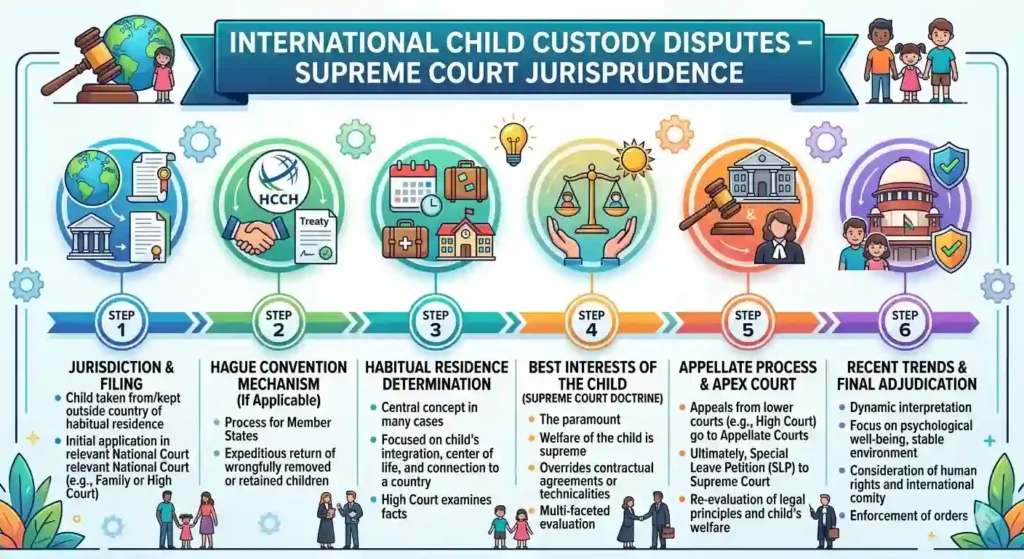
Legal Framework Governing International Child Custody in India
India’s approach to international child custody combines statutory law, constitutional principles, and judge-made doctrine. Consequently, litigants must understand each layer before approaching any forum. The Guardian and Wards Act, 1890 (GWA) remains the primary legislation governing guardianship across all religions. Additionally, the Hindu Minority and Guardianship Act, 1956 (HMGA) supplements GWA for Hindu families. The Bharatiya Nyaya Sanhita, 2023 (BNS) replaced the Indian Penal Code and introduced updated offences for parental child abduction. Similarly, the Bharatiya Nagarik Suraksha Sanhita, 2023 (BNSS) modernised criminal procedure affecting urgent custody relief. The Bharatiya Sakshya Adhiniyam, 2023 (BSA) governs evidence admissibility in custody hearings. Furthermore, the Constitution’s Article 21 protects every child’s right to life and dignity. Indian courts also draw on international instruments even without formal ratification. Therefore, practitioners must navigate multiple layers simultaneously to protect child welfare effectively.
India’s Position on the Hague Convention and Cross-Border Treaties
India has not ratified the 1980 Hague Convention on the Civil Aspects of International Child Abduction. Nevertheless, the Supreme Court regularly references its principles in landmark rulings. In Surya Vadanan v. State of Tamil Nadu (2015), the court held that comity of courts favours honouring foreign custody orders, subject to paramount child welfare. Additionally, the court distinguished between “jurisdiction” and “best interests” when evaluating foreign decrees. The Ministry of External Affairs (MEA) manages diplomatic responses to international parental abduction cases. Furthermore, bilateral treaties between India and some nations create soft obligations for child return. Courts in Chennai, therefore, examine the following when encountering cross-border orders:
- Whether the foreign court applied a welfare-centric standard
- Whether the child has sufficient Indian connection
- Whether enforcing the order endangers the child
- Whether the petitioning parent acted in good faith
- Whether cultural and educational continuity can be maintained in India
Statutory Provisions Under BNS, BNSS, and BSA Relevant to Child Custody
The 2023 criminal code trilogy significantly impacts international custody litigation. Under BNS Section 100, kidnapping and abduction offences now carry clearer definitions affecting parental abduction cases. Furthermore, BNS Section 97 specifically addresses enticing or taking away a child under fourteen years. The BNSS Section 94 empowers courts to summon documents across jurisdictions more efficiently. Moreover, BNSS Section 479 introduces stricter bail conditions where child abduction involves international travel. The BSA Section 57 allows electronic evidence—WhatsApp messages, emails, and foreign court documents—to be admitted as proof in custody hearings. Consequently, parents can now submit digital communication records as evidence of the other party’s intentions. Additionally, BSA Section 65 facilitates admission of foreign public documents with proper authentication. These provisions collectively strengthen the procedural arsenal available to Chennai-based family law attorneys handling cross-border disputes effectively.
Constitutional Principles: Article 21 and Parens Patriae Jurisdiction
The Supreme Court treats child custody as a constitutional matter rooted in Article 21 of the Indian Constitution. Consequently, every child’s right to life encompasses the right to dignity, education, and emotional stability. The court exercises parens patriae jurisdiction—acting as the ultimate guardian—when ordinary remedies fail. In Nil Ratan Kundu v. Abhijit Kundu (2008), the Supreme Court clearly articulated that welfare of the minor is the paramount consideration. Therefore, even valid foreign court orders yield to this welfare doctrine in Indian proceedings. Furthermore, the Madras High Court has consistently applied parens patriae in Tamil Nadu cases involving NRI parents. The doctrine empowers courts to:
- Override foreign custody decrees threatening the child’s safety
- Appoint independent amicus curiae to represent the child’s voice
- Order psychological assessments of both parents
- Restrict a parent’s travel pending final orders
- Mandate supervised visitation in cross-border scenarios
Supreme Court Jurisprudence on International Child Custody: Landmark Rulings
The Supreme Court of India has progressively developed a sophisticated jurisprudence on international custody. Notably, the landmark decision in V. Ravi Chandran v. Union of India (2010) established that Indian courts retain jurisdiction regardless of existing foreign proceedings. Moreover, the court in Arathi Bandi v. Bandi Jagadrakshaka Rao (2013) clarified that comity does not mean automatic enforcement of foreign orders. Therefore, each case demands fresh judicial examination of child welfare. Furthermore, the recent ruling in Smruti Pahariya v. Sanjay Pahariya (2009) emphasised that courts must act swiftly in international abduction cases to preserve the child’s existing living arrangements. Consequently, courts now prioritise speed and interim relief over protracted procedural battles. The Supreme Court also directed Union and state governments to create specialised mechanisms for resolving cross-border custody disputes expeditiously. Hence, Chennai families have recourse to both state and central governmental channels for urgent intervention. Understanding this evolving judicial landscape is critical for NRI parents seeking relief.
Welfare of the Child as the Paramount Consideration
Every international custody decision in India centres on the child’s welfare. Furthermore, the Supreme Court has repeatedly stated that welfare encompasses physical, emotional, intellectual, and moral development. In Gaurav Nagpal v. Sumedha Nagpal (2009), the court enumerated welfare factors comprehensively. Accordingly, Indian courts examine the following welfare indicators in international custody disputes:
| Welfare Factor | Assessment Method | Relevant Authority |
|---|---|---|
| Physical safety | Medical records, home study | Family Court, Chennai |
| Emotional stability | Child psychologist report | Madras High Court |
| Educational continuity | School records, curriculum analysis | Family Court |
| Cultural identity | Expert testimony | Supreme Court |
| Sibling relationships | Social welfare officer report | District Court |
| Parental capacity | Psychological evaluation | All forums |
Comity of Courts: Balancing Indian Sovereignty and Foreign Decrees
Comity of courts requires Indian judges to respect foreign judicial decisions without surrendering sovereign authority. Therefore, the Supreme Court has crafted a nuanced approach distinguishing recognition from automatic enforcement. In Surya Vadanan (2015), the court instructed that return of a child to a foreign jurisdiction should generally be ordered unless it causes grave harm. Consequently, the burden of proving harm lies on the parent resisting return. However, the court also held that Indian judges need not blindly follow foreign orders if the welfare standard differs. Moreover, the court applied a “closest connection” test to determine which jurisdiction should retain primary authority over the child. Tamil Nadu courts, including the Madras High Court, have adopted this framework in several subsequent rulings. Furthermore, courts here examine whether the child’s habitual residence was in India before the dispute arose. This analytical framework ensures fairness to both parents while protecting the child above all else.
Habitual Residence Doctrine in Indian Courts
The concept of habitual residence determines which country’s courts have primary custody jurisdiction. Accordingly, Indian courts apply this doctrine even though India has not ratified the Hague Convention formally. The Supreme Court in Prateek Gupta v. Shilpi Gupta (2018) held that habitual residence is a factual question, not merely a matter of domicile or citizenship. Furthermore, a child’s habitual residence can change over time as circumstances evolve. Notably, unilateral relocation by one parent does not automatically shift habitual residence to the new country. Therefore, a parent who wrongfully removes a child from Chennai cannot claim foreign habitual residence. Courts examine the following to establish habitual residence:
- Length of time the child lived in each country
- School enrollment and social integration records
- Language spoken at home and community ties
- Parents’ mutual intention regarding the child’s primary home
- Immigration status and visa records in each country
Interim Orders, Injunctions, and Emergency Custody Relief in Chennai
Parents facing international custody emergencies have immediate judicial recourse in Chennai. Therefore, the Family Court on Kuppam Road and the Madras High Court both grant urgent interim custody orders. Consequently, a parent can obtain emergency relief within 24 to 48 hours by filing the appropriate petition. Under Order 39 CPC, courts issue temporary injunctions preventing the removal of the child from India. Additionally, courts impound passports and issue Look-Out Circulars (LOC) through the Crime Branch, Chennai. The BNSS Section 88 further empowers courts to issue production warrants for the child’s appearance. Moreover, under the Writ of Habeas Corpus (Article 226, Constitution), any detained child can be produced before the High Court immediately. The process for emergency interim relief involves:
- Filing a custody petition or habeas corpus writ immediately
- Applying for ex-parte temporary injunction under Order 39 CPC
- Requesting LOC through the court to all immigration checkpoints
- Filing FIR under BNS Section 100 at the nearest police station
- Approaching the MEA’s Consular Division for passport impoundment
NRI Child Custody: Special Considerations for Tamil Nadu Families
Non-Resident Indian (NRI) custody disputes present unique procedural challenges for Tamil Nadu families. Furthermore, service of process across international borders requires compliance with the Hague Service Convention procedures where applicable. The BNSS Section 105 outlines the procedure for summoning persons residing outside India in criminal custody matters. Additionally, the Ministry of External Affairs’ Pravasi Bharatiya Sahayata Kendra in Chennai assists NRI families navigating international custody disputes. Tamil Nadu families should note that the Madras High Court has original jurisdiction over guardianship matters involving NRI parents. Moreover, the court regularly appoints amicus curiae to independently represent children whose parents are in different countries. Courts also consider the child’s Indian citizenship rights when evaluating return orders. Significantly, dual citizens enjoy special protection under both Indian and foreign legal systems. Therefore, NRI parents must engage Chennai-based family law specialists with international dispute experience immediately upon becoming aware of any custody threat.
Role of the Family Court, Chennai in International Custody Proceedings
The Family Court, Chennai (Kuppam Road, Adyar) is the primary trial forum for international custody disputes in Tamil Nadu. Consequently, most initial petitions under the GWA and HMGA are filed here before escalation to the High Court. Under the Family Courts Act, 1984, family courts exercise exclusive jurisdiction over matters of custody and guardianship. Furthermore, the court assigns cases to conciliators first, encouraging settlement before adversarial proceedings commence. Notably, the court now accepts digital filing of petitions and supporting documents under the BNSS framework. Additionally, the court coordinates with the Tamil Nadu Social Welfare Department when appointing child welfare officers. Parents initiating proceedings should prepare:
- Certified copies of all foreign court orders (apostilled/authenticated)
- Child’s birth certificate and passports (Indian and foreign)
- Marriage certificate and divorce decree if applicable
- School records, medical reports, and welfare evidence
- Affidavit on child’s habitual residence and welfare status
Role of Madras High Court in Cross-Border Guardianship Matters
The Madras High Court exercises both original and appellate jurisdiction in international child custody cases. Therefore, parties dissatisfied with family court orders appeal directly to the Madras High Court’s Family Court Appeal Division. Additionally, the High Court entertains writ petitions for habeas corpus when a child is wrongfully detained by one parent. Importantly, the High Court has issued several path-breaking orders directing the return of children from abroad to Tamil Nadu. Furthermore, the court has jurisdiction to appoint guardians for children of Indian origin even when parents reside in foreign countries. Notably, the High Court can issue Letters of Request to foreign courts under the BNSS when evidence must be collected internationally. The High Court’s Principal Bench in Chennai and the Madurai Bench both handle such matters. Consequently, parties in southern Tamil Nadu may approach the Madurai Bench for faster geographical access. The court’s international law expertise makes it the preferred forum for NRI custody disputes.
Police Stations, Crime Branch, and Government Departments in Custody Emergencies
Several law enforcement and government agencies play critical roles in international child custody emergencies. Therefore, parents must engage them simultaneously with court proceedings. The following table identifies key agencies and their specific functions:
| Agency / Department | Location / Contact | Function in Custody Cases |
|---|---|---|
| Chennai City Police – Women’s Helpline | Call 1091 / Vepery | Immediate FIR, child protection |
| Crime Branch CID, Chennai | Vepery, Chennai | Look-Out Circulars, tracing |
| Tamil Nadu SLSA (State Legal Services Authority) | High Court Campus | Free legal aid, mediation |
| Ministry of Women & Child Development | New Delhi / Regional | International abduction coordination |
| NCPCR (National Commission for Protection of Child Rights) | New Delhi | Child welfare complaints, inquiry |
| MEA – Consular Services Division | Jawaharlal Nehru Bhavan, Delhi | Passport impoundment, diplomatic liaison |
| Pravasi Bharatiya Sahayata Kendra | Chennai Airport Area | NRI family assistance, guidance |
| Anna Nagar Police Station | Anna Nagar, Chennai | FIR filing for NRI custody cases |
| Egmore Women Police Station | Egmore, Chennai | Women and child protection FIRs |
| Cyber Crime Wing | Commissioner Office, Vepery | Online evidence, digital tracing |
Legal Remedies Available to Parents in International Child Custody Disputes
Indian law provides a comprehensive arsenal of civil, criminal, and constitutional remedies for international custody disputes. Consequently, parents need not rely on a single forum or statute to protect their child. The following remedies are available to aggrieved parents in Chennai and Tamil Nadu:
- Guardianship petition under GWA, 1890 before Family Court, Chennai
- Habeas corpus writ under Article 226/32 before Madras High Court or Supreme Court
- Injunction under Order 39 CPC to prevent removal of child from India
- FIR under BNS Section 100 (kidnapping) at nearest Chennai police station
- Look-Out Circular through Crime Branch to prevent illegal departure
- Passport impoundment via MEA Consular Division or court order
- Mediation at SAMADHAN centres under BNSS Section 359
- Appeal to Supreme Court under Article 136 (Special Leave Petition)
- Diplomatic intervention via MEA for children wrongfully taken abroad
- NCPCR complaint for violation of child’s fundamental rights
Mediation, SAMADHAN Centres, and Alternative Dispute Resolution
The Indian legal system now strongly encourages mediation before contested hearings in child custody cases. Therefore, the SAMADHAN Mediation Centres operating within Tamil Nadu’s court complexes offer structured mediation for custody disputes. Under BNSS Section 359, courts can refer parties to registered mediators, including in international cases. Additionally, the Tamil Nadu Mediation and Conciliation Centre at the Madras High Court handles complex NRI custody mediations. Furthermore, international custody mediation can be conducted via video-conferencing, allowing foreign-based parents to participate meaningfully. Mediators trained in cross-cultural family dynamics facilitate child-centred agreements. Consequently, mediated settlements are more durable than court-imposed orders in international scenarios. Parents who reach mediated agreements benefit from:
- Faster resolution compared to full litigation timelines
- Confidential proceedings protecting family dignity
- Flexible, customised custody arrangements suited to NRI lifestyles
- Lower litigation costs for both parents
- Court-recorded settlements enforceable as decrees under BNSS
Frequently Asked Questions – International Child Custody in India
1. Can an Indian court resolve international child custody disputes?
Yes. Indian family courts and the Supreme Court exercise parens patriae jurisdiction to protect children’s welfare in cross-border custody matters, regardless of where proceedings are also pending.
2. Is India a signatory to the Hague Convention on child abduction?
India has not ratified the 1980 Hague Convention, but courts apply its welfare and comity principles while deciding international child custody and abduction cases in India.
3. Which Chennai court handles international custody disputes?
The Family Court Chennai (Kuppam Road, Adyar) and the Madras High Court both handle international child custody and guardianship matters, with the High Court having original and appellate jurisdiction.
4. What law governs NRI child custody cases in India?
The Guardian and Wards Act 1890, Hindu Minority and Guardianship Act 1956, BNS 2023, BNSS 2023, and the Supreme Court’s paramount welfare principle govern NRI custody cases in India.
5. Can I file an FIR for international parental child abduction?
Yes. File an FIR under BNS Section 100 at your nearest Chennai police station; the Crime Branch CID can then issue a Look-Out Circular to prevent the child from leaving India.
6. Can a foreign custody order be enforced in India?
Foreign orders are persuasive but not automatically binding in India. Indian courts independently re-examine child welfare before deciding whether to enforce or modify any foreign custody decree.
7. What documents are needed for an international custody petition in Chennai?
Required documents include the child’s birth certificate, both parents’ passports, marriage and divorce certificates, authenticated foreign court orders, and welfare evidence such as school and medical records.
8. What interim relief can a parent get immediately in Chennai?
A parent can obtain ex-parte interim custody, passport impoundment, Look-Out Circular, and a travel ban within 24–48 hours by approaching the Family Court Chennai or the Madras High Court urgently.
9. Can mediation resolve international child custody disputes?
Yes. SAMADHAN Mediation Centres and the Tamil Nadu Mediation Centre at Madras High Court offer structured mediation under BNSS Section 359 for international custody disputes, including video-conferencing for NRI parents.
10. What is the role of the Ministry of External Affairs in custody cases?
The MEA’s Consular Division coordinates international parental abduction responses, liaises with foreign embassies, and facilitates passport impoundment and diplomatic child recovery for Indian families abroad.
Read More
- Denial of Visitation Rights – Legal Remedies Before High Court
- Habeas Corpus in Child Custody Matters – When Is It Applicable?
- Appeal Against Interim Custody Orders – Maintainability Explained
- Welfare of Child vs Parental Rights – Supreme Court Approach
- Challenging Child Custody Orders in High Court – Legal Standards Explained
- Supreme Court of India (Official Portal)