


Child’s Preference in Custody Appeals – When parents separate or divorce, child custody becomes one of the most sensitive and emotional issues. Naturally, both parents want what they believe is best for their child. However, courts do not decide custody based only on the wishes of the parents. Instead, they focus on the child’s welfare above everything else. In this process, the child’s own preference can play an important role, especially during custody appeals.
At Legacy Family Court Law Firm, we understand how complex and emotional these cases can be. Therefore, in this article, we explain how courts evaluate a child’s preference in custody appeals, what factors matter, and how legal support can help you present your case effectively.
Child’s Preference in Custody Appeals – How Courts Evaluate – By Legacy Family Court Law Firm
Understanding Child Custody Appeals
To begin with, a custody appeal happens when one party challenges a lower court’s custody decision. This means the case moves to a higher court for review. During this stage, the appellate court re-examines the evidence, legal reasoning, and overall fairness of the earlier decision.
Importantly, the court may also consider new developments, including changes in the child’s situation or preferences. As a result, custody appeals are not just about legal arguments; they are also about the evolving needs of the child.
Legal Framework Governing Custody in India
In India, child custody decisions are guided by several laws, including the Guardians and Wards Act, 1890. This law empowers courts to appoint guardians and decide custody matters based on the child’s best interests.
Additionally, personal laws may apply depending on the religion of the parties. However, regardless of the specific law, one principle remains constant: the welfare of the child is the highest priority.
What Does “Child’s Preference” Mean?
Now, let us understand what is meant by a child’s preference. Simply put, it refers to the child’s expressed wish about which parent they want to live with.
However, courts do not treat this preference as the final decision. Instead, they consider it as one of many factors. This is because children, especially younger ones, may not fully understand the long-term impact of their choice.
Therefore, while the child’s voice is important, it is not the only deciding factor.
At What Age Does a Child’s Preference Matter?
Age plays a crucial role in determining how much weight the court gives to a child’s preference.
Generally:
- Younger children’s views are considered but given limited weight
- Older children, especially teenagers, are taken more seriously
Although there is no fixed age, courts often consider whether the child is mature enough to form an independent opinion. In many cases, children above 9–12 years are heard more carefully.
However, maturity matters more than age alone. A well-reasoned preference carries more value than a casual or influenced statement.
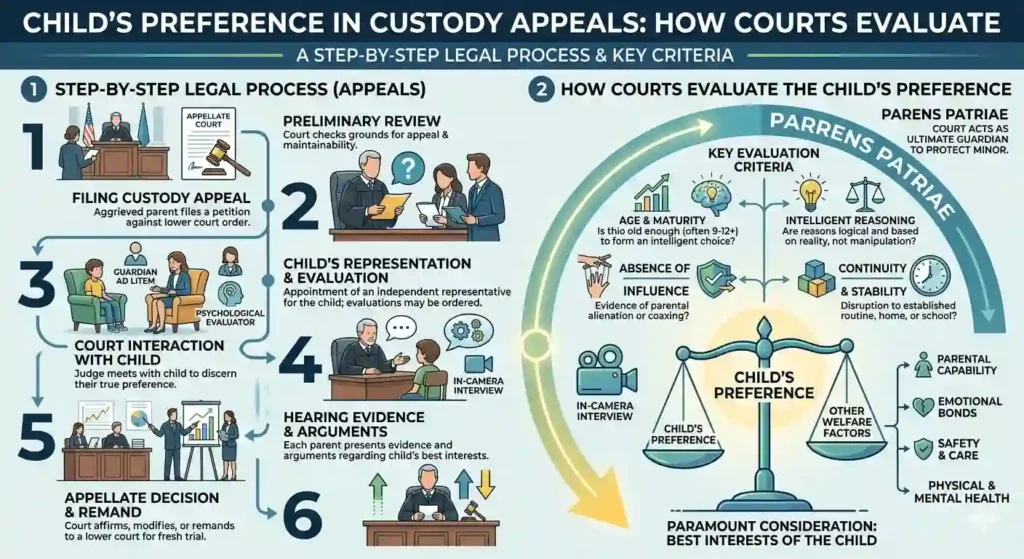
How Courts Evaluate the Child’s Preference
Courts follow a careful and sensitive approach while evaluating a child’s wishes. They do not rely solely on what the child says. Instead, they look deeper into the circumstances.
1. Maturity and Understanding
First, the court assesses whether the child understands the situation. A mature child who can explain their reasons clearly is more likely to be heard.
2. Voluntariness
Next, the court ensures that the preference is voluntary. If there is any sign of pressure, coaching, or manipulation by a parent, the court may disregard the child’s statement.
3. Consistency
Courts also check whether the child’s preference is consistent over time. Frequent changes may indicate confusion or external influence.
4. Emotional Well-being
The emotional health of the child is another key factor. The court evaluates which environment will provide better stability and care.
5. Relationship with Each Parent
Finally, the court considers the child’s bond with each parent. A strong, healthy relationship often influences the decision.
Methods Used by Courts to Hear the Child
Given the sensitive nature of custody matters, courts use special methods to interact with children.
In-Camera Interaction
Judges often speak to the child privately in chambers. This creates a comfortable environment where the child can speak freely.
Child Counselors or Experts
Sometimes, psychologists or child welfare experts are involved. They help assess the child’s mental and emotional state.
Reports and Observations
Courts may rely on reports prepared by welfare officers or experts to understand the child’s situation better.
Through these methods, courts aim to ensure that the child’s voice is heard without causing stress or pressure.
Role of Welfare Principle
Even though the child’s preference is important, the welfare principle remains the ultimate test. This means the court will choose the option that best supports the child’s overall development.
For example, if a child prefers one parent but that parent cannot provide a stable environment, the court may decide otherwise. Similarly, factors such as education, safety, and emotional support are given priority.
Thus, the child’s preference is balanced with practical considerations.
Challenges in Evaluating Child’s Preference
While considering a child’s wishes, courts face several challenges.
Influence by Parents
Sometimes, one parent may try to influence the child’s decision. This makes it difficult to determine the true preference.
Emotional Pressure
Children may feel guilty or stressed while choosing between parents. This can affect their statements.
Changing Circumstances
A child’s needs and preferences may change over time. Courts must consider these changes carefully.
Because of these challenges, courts take a cautious and balanced approach.
Importance of Legal Representation
In custody appeals, strong legal representation can make a significant difference.
At Legacy Family Court Law Firm, we ensure that your case is presented clearly and effectively. We focus on:
- Highlighting the child’s best interests
- Presenting evidence of a stable environment
- Addressing concerns about influence or pressure
- Ensuring proper documentation and arguments
Moreover, we guide clients through every step, reducing stress and uncertainty.
Practical Tips for Parents
If you are involved in a custody appeal, there are certain steps you can take to strengthen your case.
Respect the Child’s Feelings
Encourage open communication without pressuring the child.
Avoid Negative Influence
Do not attempt to manipulate or coach the child. Courts can detect such behavior.
Maintain Stability
Provide a safe and supportive environment for the child.
Cooperate with Legal Process
Attend hearings and follow court directions sincerely.
By following these steps, you not only support your case but also protect your child’s well-being.
Real-Life Perspective
Consider a situation where a teenager expresses a clear preference to live with one parent due to better educational opportunities and emotional support. In such a case, the court is likely to give significant weight to the child’s opinion.
On the other hand, if a younger child expresses a preference based on temporary reasons, such as lenient rules or gifts, the court may not consider it decisive.
This shows how courts balance the child’s voice with practical realities.
Evolving Approach of Indian Courts
Over time, Indian courts have adopted a more child-centric approach. They increasingly recognize the importance of listening to children while ensuring their protection.
Courts now focus on:
- Emotional well-being
- Psychological development
- Long-term stability
As a result, custody decisions have become more balanced and thoughtful.
Frequently Asked Questions
Child’s preference refers to the child’s expressed wish about which parent they want to live with after separation or divorce. Courts consider this opinion as one of many factors. However, under the Guardians and Wards Act, 1890, the child’s welfare remains the primary concern, not just their preference.
There is no fixed age in Indian law. Generally, courts give more importance to the views of older and more mature children, especially teenagers. However, maturity is more important than age. Even younger children may be heard, but their opinion carries less weight compared to older, more understanding children.
Courts carefully examine whether the child’s preference is voluntary and free from pressure. Judges often interact with the child privately in chambers. They also look for signs of parental influence, emotional pressure, or coaching. If the preference appears unnatural or influenced, it may be disregarded.
No, the child’s preference is not the final decision. Courts always prioritize the child’s welfare, including education, emotional stability, safety, and overall development. Even if a child prefers one parent, the court may choose the other parent if it serves the child’s best interests better.
In custody appeals, courts re-examine earlier decisions and consider new facts, including the child’s current situation. They assess emotional bonds, living conditions, and stability with each parent. Additionally, they ensure that the child’s preference is considered fairly but balanced with long-term welfare and developmental needs.
Conclusion
In conclusion, a child’s preference plays an important role in custody appeals, but it is not the only factor. Courts carefully evaluate the child’s maturity, voluntariness, and overall welfare before making a decision.
While the legal process can be complex, the ultimate goal remains simple: to ensure the best possible future for the child.
At Legacy Family Court Law Firm, we are committed to guiding families through these challenging times. We combine legal expertise with a compassionate approach, ensuring that both your rights and your child’s well-being are protected.
Read More
- International Child Custody Disputes – Supreme Court Jurisprudence
- Denial of Visitation Rights – Legal Remedies Before High Court
- Habeas Corpus in Child Custody Matters – When Is It Applicable?
- Appeal Against Interim Custody Orders – Maintainability Explained
- Welfare of Child vs Parental Rights – Supreme Court Approach
- Ministry of Law and Justice (Legislative Department)