

Fight Dowry Cases – Dowry-related violence is one of the most tragic realities that continues to affect many families across India. The practice of demanding dowry during marriage has been legally prohibited, yet it still exists in different forms, often leading to harassment, abuse, and even death. When a woman dies under unnatural or suspicious circumstances within seven years of marriage, and it is connected to dowry demands, it becomes a serious criminal offence under Section 304B of the Indian Penal Code (IPC) — also known as dowry death.
At Legacy Family Court Law Firm: Chennai Divorce Experts, we stand firm in helping families seek justice in dowry-related cases. Whether you are a victim’s family seeking accountability or someone falsely accused in a dowry death case, our team of experienced lawyers provides compassionate, strategic, and result-oriented legal support.
Fight Dowry Cases Under Section 304B of the Indian Penal Code: Legacy Family Court Law Firm
Understanding Section 304B of the IPC
Section 304B IPC deals specifically with dowry deaths. According to this law, if a woman dies due to burns, bodily injury, or under unnatural circumstances within seven years of marriage, and it is proven that she was subjected to cruelty or harassment by her husband or his relatives related to dowry demands, the death will be classified as a dowry death.
The law also states that the husband or his relatives are presumed responsible for the death unless they can prove otherwise. The punishment for a dowry death is a minimum of seven years of imprisonment, which may extend to life imprisonment.
This section aims to discourage dowry harassment and ensure that women receive legal protection from exploitation and violence.
Legal Ingredients of a Dowry Death Case
To prove an offence under Section 304B IPC, the prosecution must establish the following elements:
- Death of a woman occurred under unnatural circumstances.
- The death took place within seven years of marriage.
- There was cruelty or harassment related to dowry demands.
- The cruelty or harassment happened soon before her death.
If these conditions are met, the court presumes the involvement of the husband or his relatives in the offence, shifting the burden of proof to the accused.
The Role of Legacy Family Court Law Firm in Dowry Cases
Dowry death cases are emotionally intense and legally complex. Families often feel lost between grief and confusion, while the accused face immense social pressure and legal scrutiny. At Legacy Family Court Law Firm, our goal is to bring clarity, compassion, and competent legal guidance to both sides.
We have a dedicated team of criminal and family law experts who handle cases related to:
- Dowry deaths under Section 304B IPC
- Cruelty by husband or relatives under Section 498A IPC
- Domestic violence cases under the Domestic Violence Act, 2005
- False dowry allegations and defense representation
Our lawyers carefully examine every piece of evidence, including post-mortem reports, witness statements, and police records, to build a strong legal strategy.
Helping Victims’ Families Seek Justice
When a woman dies due to dowry harassment, her family deserves justice and accountability. Our firm assists grieving families in filing FIRs, pursuing investigations, and representing them in court to ensure that those responsible are punished.
We also guide them through related legal procedures such as:
- Filing complaints under Section 498A IPC for cruelty.
- Seeking compensation and protection orders.
- Coordinating with women’s welfare organizations and legal aid authorities.
Our lawyers handle every case with sensitivity and respect, ensuring that the victim’s dignity remains intact throughout the legal process.
Defending Against False Dowry Death Allegations
Unfortunately, not all dowry cases are genuine. Sometimes, false accusations are made out of anger, marital disputes, or family conflicts. A wrongful allegation under Section 304B can destroy reputations, careers, and families.
At Legacy Family Court Law Firm, we also defend clients who have been falsely implicated. We examine the case facts, identify inconsistencies, and ensure that our clients’ rights are protected during investigation and trial.
We take the following steps to build a strong defense:
- Collecting independent evidence to disprove dowry demands.
- Highlighting inconsistencies in witness statements.
- Ensuring that the presumption under Section 113B of the Evidence Act is properly challenged.
- Arguing for bail or anticipatory bail to prevent arrest.
Our senior lawyers present factual, logical, and persuasive arguments in court to secure fair treatment and justice for the accused.
Difference Between Section 304B and Section 498A IPC
It is important to understand that Section 304B (dowry death) and Section 498A (cruelty by husband or relatives) are closely related but distinct offences.
- Section 498A IPC deals with cruelty, mental harassment, or physical abuse related to dowry but does not involve death.
- Section 304B IPC applies only when a woman dies under suspicious circumstances within seven years of marriage, and dowry harassment is proven.
Both sections can be applied together in the same case, depending on the facts. Our firm’s lawyers analyze which provisions are relevant and create the most effective legal strategy for our clients.
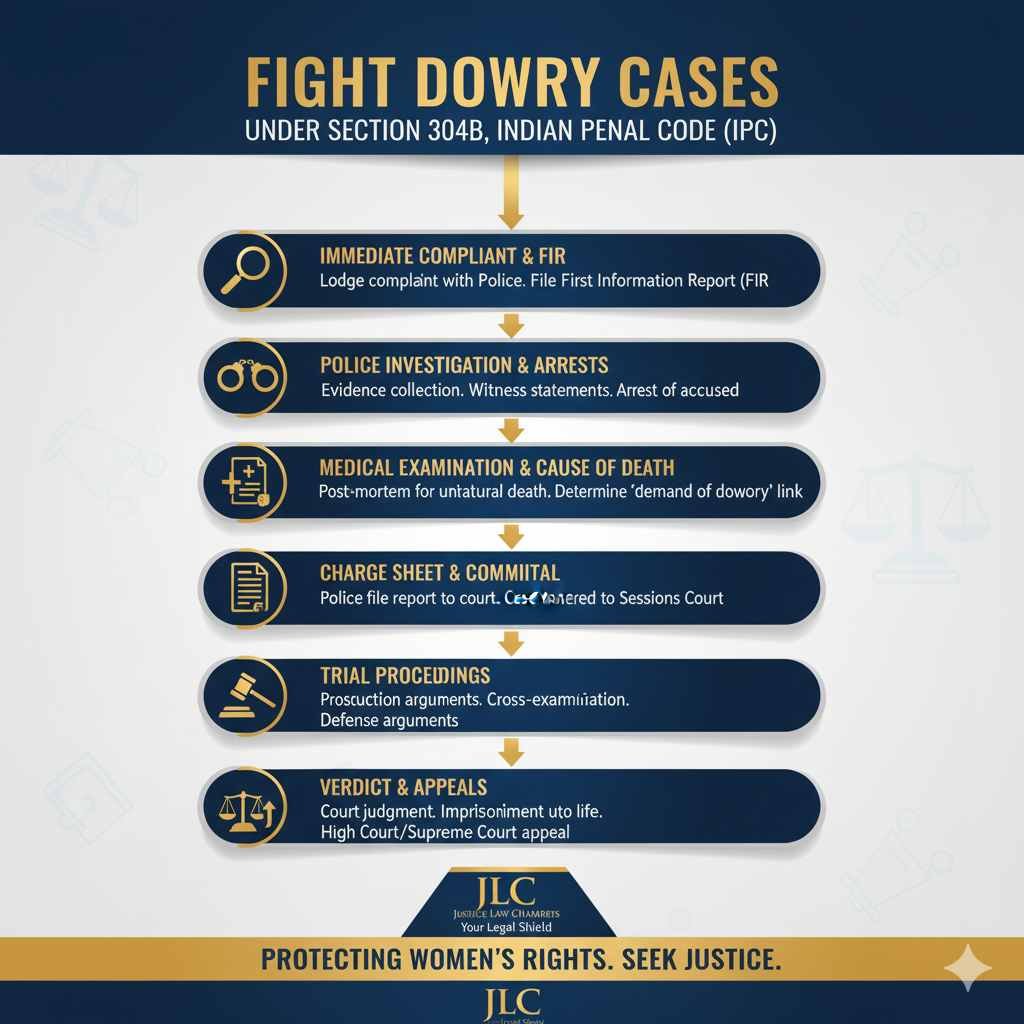
Step-by-Step Legal Process in Dowry Death Cases
Dowry death cases move through several legal stages. At Legacy Family Court Law Firm, we guide our clients through each step with care and transparency.
1. Filing the FIR
The process starts when the victim’s family files a complaint at the nearest police station. The police register a case under Section 304B IPC and begin investigation.
2. Investigation and Evidence Collection
Police collect evidence, witness statements, and forensic reports. Our lawyers monitor this process to ensure fairness and prevent misuse of legal provisions.
3. Arrest and Bail
In some cases, the husband and his relatives may be arrested. Our firm promptly files bail or anticipatory bail petitions to protect our clients’ rights.
4. Trial Proceedings
Once the charge sheet is filed, the case proceeds to trial. Our experienced advocates present evidence, cross-examine witnesses, and argue effectively to prove or disprove the charges.
5. Appeal or Revision
If the trial court’s judgment is unsatisfactory, we assist in filing appeals or revisions before higher courts.
Rights of the Accused and the Victim’s Family
In every dowry death case, both sides have important legal rights.
- The victim’s family has the right to seek investigation, prosecution, and compensation.
- The accused has the right to legal representation, bail, and a fair trial under Article 21 of the Constitution.
At Legacy Family Court Law Firm, we respect these rights and ensure that justice is not compromised by emotion or pressure.
Importance of Legal Expertise in Dowry Cases
Dowry death cases involve overlapping sections of the IPC, the Evidence Act, and the Domestic Violence Act. Without professional legal guidance, families may face procedural delays or wrongful convictions.
Our firm’s senior advocates and family court experts have decades of experience in criminal and matrimonial cases. We use our expertise to:
- Identify legal loopholes and strengthen client positions.
- Present documentary and witness evidence effectively.
- Handle media-sensitive or high-profile dowry cases discreetly.
- Negotiate settlements where appropriate, ensuring peace and fairness.
How Legacy Family Court Law Firm Supports NRIs
Dowry-related cases often involve Non-Resident Indians (NRIs) and cross-border marriages. In such situations, legal coordination becomes more complicated.
Our firm assists NRIs by:
- Handling cases filed in India while clients are abroad.
- Managing summons, appearances, and affidavits through proper legal channels.
- Coordinating with Indian embassies and consulates for official representation.
- Protecting against Lookout Circulars (LOCs) and passport impoundment.
We ensure that NRIs receive the same level of defense and justice as residents of India.
Government Initiatives and Legal Support Systems
The Indian government has established several mechanisms to prevent dowry harassment and assist victims, such as:
- Dowry Prohibition Act, 1961 – Prohibits giving or taking dowry.
- Protection of Women from Domestic Violence Act, 2005 – Provides civil relief to women.
- National Commission for Women (NCW) – Handles complaints and provides guidance.
- Legal Services Authorities (NALSA and State LSAs) – Offer free legal aid to eligible women.
At Legacy Family Court Law Firm, we often collaborate with these institutions to ensure our clients receive full support and protection under the law.
Preventive Measures to Avoid Dowry Disputes
Prevention is better than cure. Families can take proactive steps to avoid dowry-related misunderstandings, such as:
- Registering marriage legally under the Hindu Marriage Act or Special Marriage Act.
- Keeping clear records of marriage expenses and gifts exchanged.
- Avoiding any form of dowry demand or acceptance.
- Communicating openly between families to resolve differences.
- Seeking legal advice early in case of marital disputes.
Our firm also provides pre-marital legal counseling to help couples understand their legal rights and obligations, reducing the risk of future conflicts.
Frequently Asked Questions
Section 304B of the IPC deals with dowry death. If a woman dies under unnatural or suspicious circumstances within seven years of marriage and it is proven that she faced cruelty or harassment over dowry demands, her husband or his relatives can be charged. The punishment ranges from seven years to life imprisonment.
The victim’s family should immediately file a complaint or FIR at the nearest police station under Section 304B IPC. The police will start an investigation, collect evidence, and file a charge sheet. Our lawyers at Legacy Family Court Law Firm assist families in filing complaints, guiding investigations, and ensuring that the accused are brought to justice.
False allegations can ruin lives. The accused should contact a criminal lawyer immediately. We at Legacy Family Court Law Firm help by filing for anticipatory bail, collecting evidence, and challenging the presumption of guilt in court. Our defense focuses on proving innocence and protecting the accused’s rights.
Yes. In many cases, Section 498A (cruelty by husband or relatives) is added with Section 304B. Section 498A covers mental or physical cruelty, while 304B deals with death caused by dowry harassment. Both can proceed together depending on evidence.
NRIs should appoint a legal representative in India immediately. Our firm helps NRIs by managing court appearances, responding to summons, and preventing passport restrictions while ensuring fair defense.
Conclusion: Standing Up for Justice and Equality
Dowry deaths are not just legal violations — they are human tragedies. Section 304B IPC exists to punish the guilty and to protect the dignity and safety of women. However, the law must be applied carefully to ensure that justice is served on both sides.
At Legacy Family Court Law Firm: Chennai Divorce Experts, we combine compassion with legal strength. We support victims’ families in seeking justice while also defending individuals falsely accused. Our mission is to restore faith in the legal system, uphold equality, and promote harmony within families.
Read More
- Marriage Dissolution Guidance Under the Indian Divorce Act
- Legal Help for Christian Marriages Under the Indian Christian Marriage Act
- Secure Your Alimony Rights Under Section 25 of the Hindu Marriage Act
- Comprehensive Legal Guidance Under the Hindu Marriage Act
- Child Support and Custody Laws Under the Hindu Marriage Act
- The National Commission for Women (NCW) page for the Dowry Prohibition Act, 1961