


Introduction: Inheritance Dispute Legal Support in Chennai
Inheritance disputes can divide families when property, Wills, bank assets, or succession rights remain unclear. Therefore, early legal advice can prevent avoidable disagreements and procedural mistakes. The Indian Succession Act, 1925 consolidates rules concerning intestate and testamentary succession. However, the Act does not govern every inheritance situation in India. Personal laws can determine succession for particular communities and circumstances. For example, the Hindu Succession Act, 1956 governs intestate succession among persons covered by that legislation. Consequently, lawyers must first identify the deceased person’s applicable personal law. They should then examine the Will, family structure, property documents, debts, and previous transfers. Additionally, jurisdiction can depend upon property location, residence, estate administration, and proceeding type. Chennai inheritance disputes may involve civil courts, District Courts, High Courts, banks, registration offices, and revenue authorities. Criminal allegations can also arise from forgery, cheating, criminal breach of trust, or document manipulation. Therefore, legal support should combine succession law, civil procedure, evidence, and appropriate criminal remedies.
Understanding Inheritance Rights and Succession Disputes
Indian Succession Act and Applicable Personal Law
Scope of the Indian Succession Act
The Indian Succession Act, 1925 remains an important statute for testamentary and intestate succession. It defines concepts including executor, administrator, codicil, and District Judge. Therefore, inheritance planning often requires understanding whether the estate falls within its provisions. Testamentary succession concerns distribution according to a valid Will. Intestate succession applies when a person dies without an effective testamentary disposition. However, other personal laws may govern particular estates instead. Consequently, lawyers should not automatically apply the Indian Succession Act to every family dispute. They should establish the deceased person’s religion, domicile, family relationships, and nature of assets. Additionally, special statutory provisions may affect particular properties or transactions. A Chennai succession lawyer can examine these preliminary questions before recommending proceedings. Proper classification reduces the risk of filing the wrong application. Furthermore, early classification helps identify whether probate, letters of administration, succession certification, partition, or declaratory relief may become necessary.
Testamentary Succession and Wills
A Will can determine how a person’s estate passes after death when the document satisfies applicable legal requirements. The Indian Succession Act contains provisions concerning testamentary succession and execution of Wills. Therefore, beneficiaries should preserve the original Will whenever possible. Lawyers should examine signatures, attestation, testamentary capacity, execution circumstances, and subsequent codicils. Additionally, they should investigate whether another later Will exists. Questions can arise when relatives allege coercion, fraud, undue influence, incapacity, or suspicious circumstances. However, suspicion alone does not automatically invalidate a testamentary document. Courts examine evidence and applicable legal requirements before deciding validity. Consequently, witnesses, medical records, correspondence, and document history can become relevant. A lawyer can also assess whether probate or letters of administration is required. Furthermore, disputes may concern interpretation rather than authenticity. Clear legal drafting can therefore prevent uncertainty about beneficiaries, executors, property descriptions, and distribution intentions.
Intestate Succession and Heirship Rights
Intestate succession applies when a person dies without an effective Will covering the relevant estate. However, the applicable succession rules depend upon the deceased person’s governing personal law. The Hindu Succession Act, 1956 specifically codifies intestate succession among persons covered by that Act. Therefore, legal analysis should identify the correct succession statute before calculating shares. Family relationships can include spouses, children, parents, siblings, and other legally recognised heirs. Additionally, adopted children and certain other relationships may receive specific statutory treatment. The lawyer should prepare a family tree supported by birth, marriage, adoption, and death records. Consequently, accurate heir identification can prevent later objections. Property classification also matters because separate property and other interests can receive different treatment. Furthermore, previous gifts, settlements, partitions, and transfers may affect the estate. A succession lawyer can prepare a preliminary heirship analysis before recommending litigation. This approach can clarify whether the dispute concerns entitlement, possession, valuation, documentation, or distribution.
Common Inheritance Legal Issues
Will Validity and Suspicious Circumstances
Will disputes frequently arise when family members question how the deceased distributed assets. Therefore, lawyers should examine the entire execution history rather than focusing on one disputed clause. Relevant issues can include signature authenticity, attestation, mental capacity, coercion, fraud, and undue influence. Additionally, substantial changes shortly before death may require careful factual examination. However, unusual provisions do not automatically prove invalidity. Courts assess evidence under the governing succession law and established judicial principles. Consequently, witnesses to execution can become important evidence during contested proceedings. Medical records may also become relevant when capacity is specifically disputed. Furthermore, earlier correspondence may explain why the testator changed testamentary intentions. Lawyers should preserve the original Will and avoid unnecessary alterations or annotations. A forensic document expert may assist when signature authenticity becomes disputed. Therefore, Will litigation requires careful evidence preservation and legally focused pleadings. Experienced family-law counsel can help determine whether probate, caveat proceedings, or a separate declaration is appropriate.
Property Share and Partition Disputes
Inheritance disputes commonly involve disagreement about each heir’s share in immovable or movable property. Therefore, lawyers should first establish title and the succession rules governing the deceased’s estate. Property documents may include sale deeds, settlement deeds, gift deeds, partition deeds, release deeds, and previous Wills. Additionally, encumbrance records can reveal mortgages or other registered interests. A family tree should then be compared with the ownership history. Consequently, lawyers can identify whether the dispute requires partition, declaration, possession, or cancellation relief. The Civil Procedure Code, 1908 can govern civil litigation procedure where applicable. Courts may also consider limitation, jurisdiction, valuation, court fees, and necessary parties. Furthermore, interim injunctions may protect disputed property from alienation during litigation. Parties can explore mediation when relationships and settlement prospects permit. A properly prepared partition claim should identify every relevant asset and claimant. This prevents incomplete adjudication and reduces future disputes concerning omitted properties.
Probate, Letters of Administration, and Succession Certificates
Probate, letters of administration, and succession certificates serve different legal purposes. Probate generally concerns judicial recognition of a Will and authority for administration. Letters of administration can assist estate administration where applicable circumstances exist. A succession certificate generally concerns specified debts and securities rather than title to every property. Therefore, parties should not treat these remedies as interchangeable. The Indian Succession Act contains provisions addressing testamentary jurisdiction and succession certificates. Additionally, the location of the deceased, property, and estate may affect jurisdiction. Lawyers should identify the correct District Court or other competent forum before filing. Consequently, procedural accuracy can reduce objections and unnecessary delays. Banks and financial institutions may request succession documentation before releasing certain assets. However, institutional requirements can differ depending upon asset type and applicable rules. A legal professional can coordinate court orders with banks, insurers, registrars, and other institutions. Proper remedy selection remains central to effective inheritance administration.
Jurisdiction, Forums, and Government Authorities
District Courts and High Courts
Inheritance proceedings may come before District Courts or other competent civil courts depending upon their nature. Testamentary matters can involve the jurisdiction prescribed by succession law and applicable court rules. Therefore, jurisdiction should be assessed before preparing the petition or suit. Property location can become important in disputes involving immovable assets. Additionally, the deceased person’s residence or ordinary jurisdiction may affect certain proceedings. High Courts can exercise original or appellate jurisdiction where applicable under law and local arrangements. Consequently, lawyers should verify the current jurisdictional structure before filing. Chennai cases may involve the Madras High Court and competent subordinate courts. However, not every inheritance dispute belongs in a Family Court. Family Courts have specialised jurisdiction over specified family-related disputes under their governing legislation. Pure title or partition disputes between wider family members may require civil-court proceedings. Therefore, the facts and relief sought should determine the forum. Careful jurisdiction analysis prevents procedural objections and unnecessary expense.
Family Courts, Mediation, and Settlement Forums
Family Courts can become relevant when the inheritance dispute arises within a matter falling within their statutory jurisdiction. However, ordinary succession disputes do not automatically become Family Court cases. Therefore, counsel should distinguish matrimonial property issues from independent estate disputes. Mediation can offer another route when family members remain willing to negotiate. Courts may encourage settlement where legally appropriate and parties voluntarily participate. Additionally, negotiated family arrangements can resolve several connected property disputes together. Lawyers can structure settlements covering possession, partition, release, payment, and future claims. Consequently, written settlement terms should clearly identify every asset and obligation. Registration requirements may apply to particular instruments transferring rights in immovable property. Furthermore, tax and stamp-duty implications should receive separate professional consideration. Mediation can preserve relationships while reducing prolonged litigation. However, settlement should remain informed and voluntary. A lawyer should explain legal rights before a client accepts a proposed family arrangement.
Evidence, Litigation Strategy, and Legal Remedies
Building an Inheritance Case
Family Tree and Heirship Evidence
A reliable family tree forms the foundation of many inheritance disputes. Therefore, lawyers should establish every relevant relationship using official records. Birth certificates can establish parentage and dates of birth. Marriage certificates can support spousal relationships and marital history. Death certificates establish the succession event and relevant date. Additionally, adoption documents may become important where applicable. Legal heir certificates can assist with administrative processes, although their precise legal effect depends upon the context. Consequently, parties should not treat every heirship document as conclusive title evidence. Lawyers should compare family records with property documents and existing court orders. Furthermore, previous partitions can change the present estate available for succession. A detailed genealogy can reveal omitted heirs before litigation begins. This helps identify necessary parties and reduces later challenges. Proper evidence preparation therefore strengthens succession applications and partition proceedings.
Property, Bank, and Financial Asset Records
Inheritance disputes frequently involve assets beyond residential properties. Bank accounts, shares, insurance policies, securities, deposits, vehicles, and business interests may form part of an estate. Therefore, lawyers should prepare a comprehensive estate inventory. Property records can include title deeds, encumbrance certificates, tax receipts, patta records, and registration documents. Bank records may identify nominees, account holders, deposits, and outstanding liabilities. However, nomination does not necessarily determine beneficial ownership in every succession dispute. Consequently, lawyers should distinguish nomination, ownership, and succession rights. Financial institutions may require probate, succession certificates, or other documentation depending upon the asset. Additionally, demat accounts and securities may involve separate procedural requirements. A complete asset schedule can prevent accidental omission from settlement or litigation. Furthermore, debts and liabilities should be identified before distributing estate assets. Professional assistance can help reconcile asset values and competing claims. Accurate estate documentation supports negotiation, court pleadings, and final administration.
Electronic Evidence and Document Authenticity
Digital records increasingly influence inheritance disputes involving Wills, property transactions, and family communications. Emails, messages, scanned documents, digital photographs, and electronic payment records may support or contradict claims. Therefore, parties should preserve original electronic records whenever possible. The Bharatiya Sakshya Adhiniyam, 2023 forms the current statutory framework for evidence in Indian proceedings. Consequently, lawyers should assess electronic evidence according to applicable admissibility and authenticity requirements. Metadata can sometimes help establish document creation or modification history. However, screenshots without context may create evidentiary challenges. Therefore, counsel should preserve complete conversations and relevant source material. Expert examination may become appropriate when signatures or electronic records are disputed. Additionally, lawyers should document how records were obtained and maintained. Evidence should never be altered merely to strengthen a claim. Proper preservation supports credibility during court proceedings. Consequently, digital evidence requires the same disciplined approach as traditional documentary evidence.
Fraud, Forgery, and Criminal Allegations
Some inheritance disputes develop criminal allegations when relatives accuse others of document manipulation. Allegations can involve forged Wills, fabricated signatures, fraudulent transfers, cheating, or dishonest use of property documents. Therefore, parties should distinguish genuine civil disputes from conduct that may attract criminal law. The Bharatiya Nyaya Sanhita, 2023 contains substantive criminal provisions applicable to relevant offences. The Bharatiya Nagarik Suraksha Sanhita, 2023 governs criminal procedure under the current framework. Consequently, a criminal complaint may require separate assessment from the underlying succession case. Police authorities can become relevant where cognisable criminal allegations are properly raised. However, every disputed Will does not automatically establish forgery. Evidence must support the specific criminal allegation. Lawyers can advise on complaints, investigation responses, bail, evidence preservation, and appropriate court remedies. Additionally, civil and criminal proceedings can involve overlapping documents. Coordinated legal strategy can therefore prevent contradictory positions across proceedings.
Civil and Criminal Legal Remedies
Partition, Declaration, and Injunctions
Partition proceedings can determine shares and facilitate separate enjoyment of inherited property. A declaration may address disputed legal rights or title where appropriate. Injunctions can protect property from transfer or interference during litigation. Therefore, lawyers should identify the exact relief required rather than filing broad claims without legal basis. The Civil Procedure Code provides procedural mechanisms for civil suits and related applications. Additionally, limitation periods can affect the maintainability of claims. Property valuation and court-fee requirements also require careful assessment. Consequently, pleadings should identify the property, ownership history, family relationships, and legal basis for the claimed share. Interim applications can address urgent risks involving sale, construction, possession, or alteration. Furthermore, parties should disclose connected proceedings to avoid inconsistent orders. Mediation may provide an alternative where all necessary parties participate. Proper drafting can help the court understand the precise dispute. Legal representation can therefore combine substantive succession rights with appropriate civil procedure.
Cancellation and Challenging Fraudulent Documents
A disputed transfer document can create serious obstacles to inheritance administration. Therefore, beneficiaries may need to challenge documents allegedly executed without authority or through fraud. The appropriate remedy depends upon the document, parties, limitation, possession, and nature of the alleged defect. Cancellation may be relevant where a document requires judicial invalidation. Declaration may address legal status where appropriate. Additionally, injunctions can protect the property while the dispute remains unresolved. Lawyers should examine registration records and certified copies before drafting pleadings. Consequently, the complete document history can reveal whether later instruments depend upon an earlier disputed transaction. If criminal allegations exist, counsel should separately assess the evidence supporting those allegations. Furthermore, forensic examination may help resolve signature or alteration disputes. Courts determine relief based on evidence and applicable statutory principles. Therefore, clients should avoid unilateral action against disputed property. Proper legal proceedings can preserve rights while the court examines competing claims.
Appeals, Revisions, and Review Remedies
Inheritance litigation may continue through appellate stages after an initial judicial decision. Therefore, parties should understand that an adverse order may create specific procedural deadlines. Appeals depend upon the type of order, applicable statute, court jurisdiction, and prescribed limitation period. Revision or review may apply only in circumstances permitted by law. Consequently, lawyers should examine the judgment before choosing a remedy. Certified copies and complete trial records can become important for appellate preparation. Additionally, the grounds should identify specific legal or evidentiary errors. A general disagreement with the judgment may not establish sufficient grounds for every appellate remedy. Furthermore, interim protection may require a separate application depending upon circumstances. High Courts can hear appropriate appeals or petitions within their jurisdiction. The Supreme Court can exercise appellate jurisdiction in matters reaching its constitutional or statutory requirements. Therefore, succession litigation benefits from careful record management from the beginning. Timely legal advice can prevent missed limitation periods and procedural complications.
Practical Legal Support for Families
Estate Administration and Executor Guidance
Executors play important roles when a Will appoints them to administer the deceased’s estate. Therefore, executors should understand their duties before distributing assets. They may need to identify assets, settle lawful liabilities, and implement testamentary directions. Additionally, probate or another court process may become necessary depending upon the circumstances. The Indian Succession Act expressly defines an executor as a person entrusted with executing the deceased’s Will. Consequently, executors should maintain detailed records of estate transactions. Bank statements, property records, tax documents, and receipts can support transparent administration. Furthermore, beneficiaries may request information concerning estate management. Lawyers can assist executors with petitions, correspondence, asset transfers, and dispute management. If beneficiaries challenge administration, professional representation can protect the executor’s legal position. However, executors should not treat estate assets as personal property. Proper separation of estate funds reduces future allegations. Careful administration can therefore reduce conflict among beneficiaries.
NRI Inheritance and Cross-Border Estate Issues
NRI families often face additional challenges when Indian property forms part of an overseas estate. Therefore, legal planning should consider both Indian succession rules and relevant foreign procedures. Documents executed abroad may require appropriate authentication, apostille, notarisation, or other formalities. Additionally, powers of attorney can require careful drafting and registration treatment in India. Property located in Chennai may require interaction with local registration and revenue authorities. Bank assets can involve separate institutional procedures. Consequently, NRIs should obtain certified copies of essential Indian documents. Foreign probate orders may also raise recognition or procedural questions under Indian law. Lawyers can coordinate with overseas counsel when foreign proceedings affect Indian assets. Furthermore, tax implications should receive advice from qualified tax professionals. Cross-border inheritance disputes can become complicated when family members live in different countries. Early coordination can reduce duplicated proceedings and conflicting instructions. A Chennai inheritance lawyer can assist with Indian proceedings while coordinating required documentation.
Government Departments and Record Verification
Inheritance matters often require interaction with several government offices. Registration authorities maintain records concerning registered property transactions. Revenue authorities maintain land-related records and mutation information. Courts issue probate, succession, partition, and other judicial orders. Banks and financial institutions administer certain financial assets after receiving required documentation. Therefore, lawyers should identify the correct authority for each record or remedy. Additionally, municipal authorities may maintain property tax records. These records can support factual verification but may not independently establish final title. Consequently, title analysis should consider registered instruments and judicial orders. Certified copies can provide stronger documentary support than informal copies. Furthermore, parties should verify records before relying on historical transactions. Government departments may follow different procedures and documentary requirements. Professional assistance can help coordinate applications and responses. Accurate official records can strengthen both settlement negotiations and litigation. Therefore, administrative verification should accompany legal analysis.
Police Complaints and Criminal Procedure
Police involvement may become relevant when an inheritance dispute includes allegations of forgery, cheating, criminal breach of trust, or document fabrication. Therefore, complainants should provide specific facts and supporting evidence. The BNSS, 2023 provides the current criminal procedure framework. Lawyers can help prepare complaints and respond to investigative notices where appropriate. Additionally, accused persons may require advice before providing statements or documents. Arrest and bail issues require immediate attention when criminal proceedings escalate. However, a property disagreement should not automatically be presented as a criminal case without supporting facts. Courts distinguish civil entitlement disputes from criminal conduct according to applicable law and evidence. Consequently, lawyers should identify the precise criminal ingredients before recommending action. Police stations near the alleged transaction or property may have territorial relevance. Still, jurisdiction should be verified from the actual allegations and applicable procedural rules. Legal support can coordinate civil and criminal strategies without confusing their separate objectives.
Resolving Inheritance Disputes Efficiently
Settlement, Mediation, and Long-Term Estate Planning
Family Settlement and Release Arrangements
Family settlements can resolve inheritance disputes when relatives agree on practical distribution arrangements. Therefore, parties should document settlement terms with precise property descriptions and obligations. A settlement may address possession, partition, payments, release of claims, or future cooperation. Additionally, registration may be required for instruments creating or transferring rights in immovable property. Lawyers should examine stamp duty and registration requirements before execution. Consequently, informal promises should not replace properly drafted legal documents. A settlement can reduce litigation costs and preserve family relationships. However, every beneficiary should understand the legal effect of relinquishing or transferring rights. Furthermore, vulnerable parties should receive independent advice where appropriate. The final document should identify all parties, assets, consideration, and implementation responsibilities. Lawyers can also coordinate registration and subsequent mutation procedures. A carefully prepared family settlement can provide certainty where prolonged litigation would otherwise continue. Therefore, negotiated resolution may become a practical component of inheritance dispute management.
Mediation for Inheritance Conflicts
Mediation can provide a structured setting for family members to discuss inheritance disagreements. Therefore, it may help parties address both legal rights and practical concerns. Mediators facilitate communication but do not replace independent legal advice. Lawyers can explain entitlement, risks, evidence, and possible settlement structures during the process. Additionally, mediation can address multiple properties and financial claims together. This approach may reduce repeated litigation over connected family assets. However, mediation remains unsuitable when parties cannot negotiate freely or when urgent protection is required. Consequently, lawyers should assess suitability before recommending mediation. Courts may refer suitable disputes to mediation under applicable procedural mechanisms. A successful settlement should become a clear written agreement. Furthermore, parties should understand registration and implementation requirements. Mediation can therefore complement, rather than replace, sound succession-law analysis. Chennai families can consider mediation where relationships remain sufficiently cooperative for meaningful negotiation.
Succession Planning and Preventive Advice
Inheritance disputes can often be reduced through careful estate planning during a person’s lifetime. Therefore, individuals should maintain updated Wills and accurate asset records. Property descriptions should match current title documents and registration records. Bank accounts, securities, insurance policies, and business interests should also receive appropriate planning. Additionally, people should review nominations and understand their relationship with succession rights. A Will should clearly identify beneficiaries and relevant assets. Executors should be chosen with consideration for reliability and administrative ability. Furthermore, important documents should remain accessible to trusted persons. Periodic legal review can address marriage, divorce, childbirth, acquisition, or disposal of major assets. Consequently, estate planning should evolve when family circumstances change. Professional advice can identify potential conflicts before they become disputes. Clear documentation can also reduce uncertainty for NRIs and families with multiple properties. Preventive legal support therefore remains an important part of succession management.
Choosing Legacy Family Court Law Firm
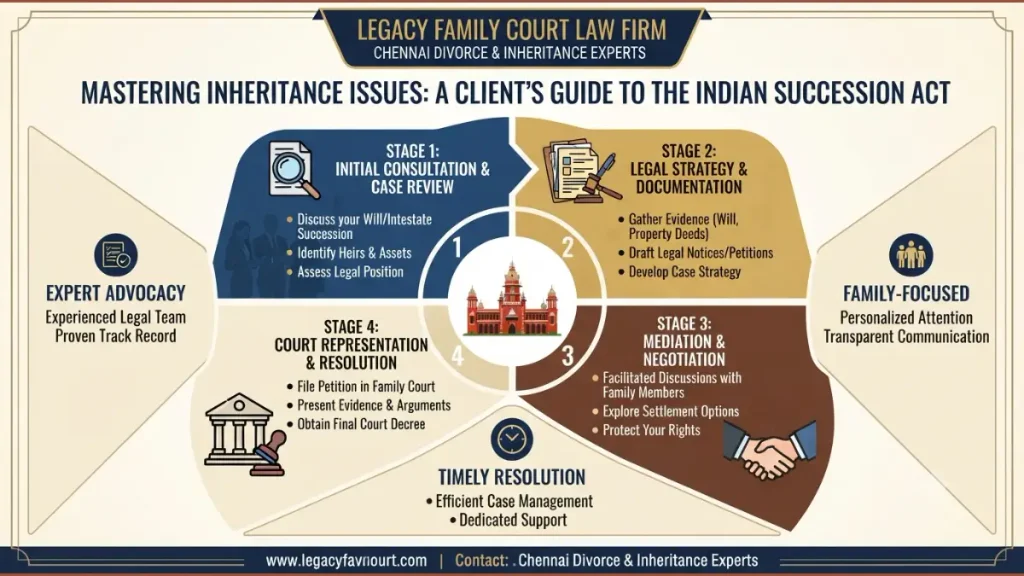
Inheritance disputes require lawyers who can understand succession law, civil procedure, evidence, and connected family concerns. Therefore, clients should choose counsel based on the actual nature of their dispute. Legacy Family Court Law Firm: Chennai Divorce Experts can assist families with succession-related legal concerns alongside broader family-law matters. Legal support may include Will review, heirship analysis, probate assistance, partition strategy, settlement drafting, and court representation. Additionally, counsel can examine disputes involving property documents, financial assets, and alleged fraud. Where criminal allegations arise, appropriate criminal-law coordination may also become necessary. Furthermore, NRI clients may require assistance with powers of attorney and Indian court proceedings. Clients should provide complete documents and disclose all relevant family relationships. Accurate disclosure allows lawyers to assess risks realistically. No legal professional can guarantee a particular judicial result. Courts determine disputes according to applicable law and evidence. Consequently, informed representation can help clients understand available remedies and procedural choices. Early advice can also reduce unnecessary delays and protect important evidence.
Frequently Asked Questions
1. Does the Indian Succession Act apply to every inheritance dispute in India?
No. The applicable law depends on personal law, facts, asset type, and circumstances. The Hindu Succession Act governs many Hindu intestate succession matters.
2. What can I do if a relative challenges my inheritance share?
A lawyer can examine the Will, heirship, title documents, and applicable succession law. Remedies may include declaration, partition, injunction, probate, or settlement.
3. Can I challenge a suspicious Will?
Yes, where legally sustainable grounds exist. Evidence may concern execution, signatures, attestation, capacity, coercion, fraud, or undue influence.
4. Is a succession certificate required for inherited property?
Not generally for every property. Succession certificates mainly concern specified debts and securities. Different assets may require probate, administration, or other documentation.
5. Can inheritance fraud become a criminal case?
Potentially, where evidence supports offences such as forgery, cheating, or document-related misconduct. The BNS and BNSS may become relevant to appropriate allegations.
6. Can NRIs resolve inheritance disputes involving Chennai property?
Yes. NRIs can use authorised legal representation and appropriate powers of attorney. Indian property proceedings may require local court and registration procedures.
Key Legal Remedies for Inheritance Disputes
Inheritance disputes can require different remedies depending upon the underlying legal issue. Therefore, a lawyer should identify the precise relief before initiating proceedings. Potential remedies may include:
- Probate of a valid Will.
- Letters of administration.
- Succession certificate applications.
- Partition proceedings.
- Declaration of inheritance rights.
- Permanent or interim injunctions.
- Cancellation of disputed instruments.
- Challenges to fraudulent documents.
- Civil appeals or revisions.
- Criminal complaints for supported fraudulent conduct.
- Mediation and family settlement.
- NRI representation through valid power of attorney.
The appropriate remedy depends upon facts, jurisdiction, limitation, evidence, and applicable personal law. Consequently, parties should obtain case-specific legal advice before filing proceedings. Courts and authorities determine outcomes according to applicable law and evidence.