


Confidently Handle Divorce – The Special Marriage Act, 1954 provides a secular legal framework for marriage and divorce in India. Section 27 permits either spouse to seek divorce before the competent District Court. Grounds include adultery, desertion, cruelty, imprisonment, mental disorder, and other statutory circumstances. Therefore, parties need not rely upon personal religious marriage laws after marrying under this Act. The law also provides specific provisions for judicial separation and restitution of conjugal rights. Moreover, Section 28 permits divorce by mutual consent when statutory conditions remain satisfied. A spouse should establish the chosen ground through reliable pleadings and supporting evidence. Relevant documents may include marriage certificates, communications, financial records, medical documents, and witness statements. Consequently, early advice from a family lawyer can prevent jurisdictional errors and incomplete petitions. Legacy Family Court Law Firm can assess eligibility and recommend an appropriate divorce strategy.
Confidently Handle Divorce Under the Special Marriage Act – Legacy Family Court Law Firm
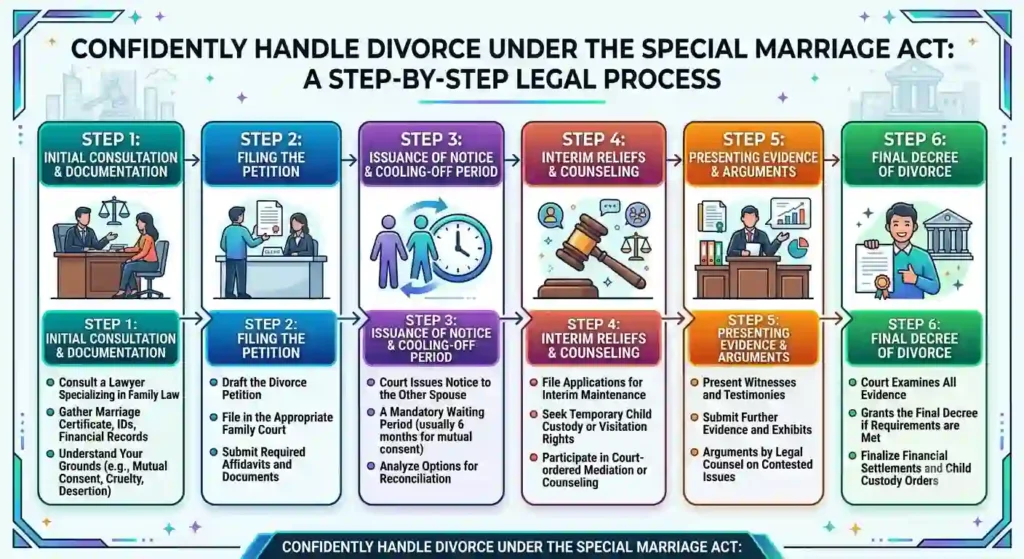
Grounds for Contested Divorce
Proving Matrimonial Grounds
Contested divorce under Section 27 requires the petitioner to establish a legally recognised ground. Adultery concerns voluntary sexual intercourse with another person after marriage. Desertion generally requires continuous abandonment for at least two years immediately before filing. Cruelty may involve serious physical or mental conduct affecting matrimonial life. Other statutory grounds can involve imprisonment, disappearance, mental disorder, or specified matrimonial circumstances. However, allegations require appropriate pleadings and supporting evidence. Courts examine facts rather than relying upon broad accusations or emotional statements. Therefore, spouses should preserve relevant messages, emails, photographs, financial records, medical papers, and witness details. Electronic evidence requires careful handling under the Bharatiya Sakshya Adhiniyam, 2023. Additionally, lawyers should distinguish matrimonial allegations from separate criminal offences. A carefully prepared petition improves clarity and helps the court identify the actual matrimonial dispute.
Mutual Consent Divorce
Section 28 Procedure
Section 28 allows spouses to jointly seek divorce by mutual consent under the Special Marriage Act. The parties must have lived separately for one year or more. They must also establish that they cannot live together and mutually agree to dissolve their marriage. The statutory process involves presentation of a joint petition before the competent District Court. After the prescribed period, both parties may make the required motion, subject to statutory conditions. The court must examine the parties and satisfy itself regarding the petition’s truth. Consequently, mutual consent divorce requires more than merely signing a private agreement. Spouses should settle maintenance, permanent alimony, child custody, visitation, education expenses, and property issues clearly. Furthermore, settlement terms should avoid vague promises that create future disputes. Legal representation helps ensure that the settlement remains practical, lawful, comprehensive, and properly recorded.
Jurisdiction and Family Court Proceedings
Choosing the Correct Court
District Court and Family Court
Divorce petitions under the Special Marriage Act proceed before the competent District Court. Where a Family Court exists, matrimonial jurisdiction generally operates through that specialised forum. The Family Courts Act, 1984 covers dissolution of marriage, matrimonial status, maintenance, custody, property disputes between spouses, and related reliefs. Therefore, parties should determine territorial jurisdiction before filing. Relevant factors can include the place of marriage, residence, respondent’s residence, and other statutory connecting circumstances. Jurisdiction mistakes can cause delay, additional expense, and procedural objections. Hence, lawyers should verify the applicable statutory provisions and local court arrangements before preparing pleadings. Family Courts also encourage settlement where appropriate. However, settlement efforts should not compromise a person’s safety or legitimate legal rights. Legacy Family Court Law Firm can examine the facts and identify the appropriate Family Court, District Court, or other competent forum.
Court Procedure and Evidence
Pleadings, Documents and Hearings
A divorce case normally begins with a properly drafted petition containing material facts and the required legal grounds. The respondent receives an opportunity to contest allegations and present a defence. Courts may consider documentary evidence, oral testimony, electronic communications, financial records, and other admissible material. The Bharatiya Sakshya Adhiniyam, 2023 governs evidence issues under the current legal framework. Electronic records can become important where spouses communicate through messaging applications, email, social media, or digital platforms. Accordingly, parties should preserve original devices and relevant electronic records whenever legally appropriate. Lawyers should also organise evidence according to each pleaded allegation. Moreover, parties should avoid deleting, altering, or selectively presenting potentially relevant communications. The court may examine credibility, consistency, relevance, and admissibility. A disciplined evidence strategy therefore strengthens matrimonial litigation and reduces unnecessary procedural complications.
Interim Relief During Divorce
Maintenance and Protection
Divorce litigation may require urgent interim relief while the main petition remains pending. Depending upon the circumstances, a spouse may seek interim maintenance, litigation expenses, child-related relief, custody arrangements, or protective orders. The Family Courts Act recognises jurisdiction concerning maintenance and custody matters. Criminal-law provisions may also become relevant where allegations involve domestic violence, cruelty, threats, assault, harassment, or other offences. The BNSS, 2023 now provides the principal criminal procedure framework replacing the earlier CrPC structure. Therefore, lawyers should separate matrimonial remedies from criminal remedies while coordinating appropriate proceedings. Financial disclosure can also become important when determining maintenance and support. Additionally, courts may consider the parties’ income, needs, responsibilities, and available resources. Timely interim applications can protect children and financially vulnerable spouses during prolonged litigation.
Strategic Divorce Support and Legal Remedies
Managing Related Matrimonial Issues
Children, Property and Financial Claims
Child Custody and Visitation
Divorce proceedings frequently involve disputes concerning children’s custody, residence, education, expenses, and visitation. Family Courts possess jurisdiction concerning guardianship, custody, and access to minor children. Courts generally focus on the child’s welfare rather than treating custody as a reward for either parent. Therefore, parents should present practical parenting proposals supported by stable circumstances. Important factors can include schooling, healthcare, emotional needs, safety, daily routines, and parental involvement. Moreover, parents should avoid using children as intermediaries during matrimonial conflict. Financial arrangements should clearly address education, healthcare, extracurricular activities, and extraordinary expenses. Where parents live in different cities or countries, detailed visitation arrangements become especially important. NRIs may require additional planning for travel, passports, schooling, communication, and cross-border enforcement. A family lawyer can develop custody and visitation terms that reduce uncertainty and future litigation.
Property and Financial Settlement
Financial disputes can complicate otherwise straightforward divorce proceedings. Spouses may disagree about jointly owned property, loans, bank accounts, investments, business interests, jewellery, household assets, or financial contributions. The Special Marriage Act provides matrimonial remedies, while property rights may also involve other applicable statutes. Therefore, lawyers should identify ownership documents and distinguish personal assets from jointly held assets. Financial claims should remain supported by bank statements, tax records, loan documents, property deeds, investment records, and employment information. Furthermore, spouses should document agreed settlement terms precisely. A settlement can address permanent alimony, maintenance, property transfer, liabilities, and withdrawal of related proceedings. Courts may examine whether proposed arrangements satisfy legal requirements. Consequently, parties should obtain independent legal advice before signing comprehensive divorce settlements. Careful financial planning can prevent later claims and protect long-term economic interests.
Criminal and Evidence Issues
BNS and BNSS Considerations
Matrimonial disputes sometimes involve allegations that extend beyond divorce grounds. Such allegations may concern cruelty, assault, intimidation, cheating, criminal breach of trust, harassment, or other offences. The Bharatiya Nyaya Sanhita, 2023 now provides the principal substantive criminal law framework. The Bharatiya Nagarik Suraksha Sanhita, 2023 governs criminal procedure. Therefore, legal counsel should examine criminal allegations independently from matrimonial pleadings. A complaint may involve the jurisdictional police station when facts disclose a cognisable offence. Depending upon circumstances, parties may approach specialised police units or appropriate courts. However, criminal proceedings should never become automatic bargaining tools during settlement discussions. Evidence must also remain reliable and lawfully obtained. Digital evidence can require compliance with the Bharatiya Sakshya Adhiniyam, including statutory requirements for electronic records. Strategic coordination helps prevent conflicting statements across Family Court and criminal proceedings.
CPC and Civil Procedure
The Code of Civil Procedure, 1908 can remain relevant to procedural aspects where applicable to matrimonial proceedings. Family Courts follow specialised procedures while exercising statutory jurisdiction. Therefore, lawyers must understand both matrimonial statutes and applicable procedural rules. Pleadings should clearly identify jurisdiction, material facts, reliefs, and supporting circumstances. Interim applications may address urgent financial, custody, property, or procedural concerns. Moreover, parties should comply with court directions and filing requirements within prescribed timelines. Procedural objections can delay a case when lawyers overlook jurisdiction or documentation requirements. Consequently, early scrutiny of the marriage certificate, residence details, prior litigation, children, assets, and existing orders remains important. Lawyers should also check whether related proceedings exist before another court or authority. This prevents inconsistent strategies and unnecessary duplication. Proper procedural planning can make Family Court litigation more focused, efficient, and manageable for both spouses.
Legal Remedies and Professional Assistance
Available Legal Remedies
Reliefs a Spouse May Seek
Depending on circumstances, a spouse may pursue several remedies alongside or within divorce proceedings. These remedies can include divorce, judicial separation, maintenance, permanent alimony, child custody, visitation, and litigation expenses. Section 27A permits alternative judicial separation relief in specified circumstances under the Special Marriage Act. Parties may also pursue appropriate property-related claims where another applicable law provides relief. Criminal complaints may arise separately when facts disclose offences under the BNS. Protection-related remedies may also become relevant under applicable matrimonial or domestic violence legislation. Therefore, lawyers should identify every available remedy before filing the principal petition. A remedy matrix can help prioritise urgent and long-term objectives. Furthermore, settlement negotiations can resolve several connected issues together. However, parties should obtain legal advice before withdrawing proceedings or accepting financial terms. A complete strategy protects legal rights while avoiding unnecessary parallel litigation.
Police, Courts and Authorities
Divorce matters may involve several institutions depending upon the dispute’s nature. Family Courts and District Courts handle appropriate matrimonial proceedings under applicable jurisdictional rules. Police stations may receive complaints concerning criminal allegations arising from matrimonial disputes. Courts exercising criminal jurisdiction may consider offences investigated under the BNSS framework. High Courts may exercise appropriate appellate, supervisory, constitutional, or statutory jurisdiction. Additionally, authorities may become involved where immigration, passports, foreign residence, or international family disputes arise. NRIs should consider jurisdiction, service of notices, evidence location, and enforceability before starting proceedings. Consequently, a coordinated legal strategy becomes especially important when spouses live in different countries. Lawyers should also examine existing orders from foreign courts before advising on parallel Indian proceedings. Appropriate forum selection can prevent conflicting litigation and unnecessary expense.
NRI and Cross-Border Divorce
Special Marriage Act for NRIs
NRIs married under the Special Marriage Act may face additional jurisdiction and enforcement concerns. Residence outside India does not automatically eliminate Indian matrimonial jurisdiction. However, lawyers must examine statutory jurisdiction, residence, service, evidence, and the location of matrimonial events. Cross-border cases may involve foreign addresses, overseas employment records, international assets, and foreign custody arrangements. Therefore, document preparation should anticipate practical difficulties in obtaining evidence abroad. Digital communication can provide relevant evidence, but admissibility requirements remain important under the BSA. Foreign divorce decrees may also raise recognition and enforceability questions in India. Consequently, NRIs should obtain Indian legal advice before relying upon an overseas matrimonial order. Power of attorney arrangements may assist with certain procedural requirements, subject to court rules. Legacy Family Court Law Firm can coordinate Indian matrimonial advice with the client’s overseas circumstances.
Professional Legal Assistance
Divorce under the Special Marriage Act requires more than preparing a petition and attending hearings. A lawyer should evaluate grounds, jurisdiction, evidence, financial issues, children, settlement prospects, and connected proceedings. Legacy Family Court Law Firm provides strategic assistance for contested divorce and mutual consent matters. Support can include legal consultation, petition drafting, evidence preparation, court representation, settlement negotiation, maintenance applications, and custody proceedings. Furthermore, lawyers can coordinate matrimonial cases involving criminal complaints under the BNS and BNSS. They can also advise on electronic evidence under the BSA. NRIs can receive assistance concerning Indian jurisdiction, documentation, remote coordination, and cross-border matrimonial issues. Timely legal advice can reduce procedural mistakes and unnecessary confrontation. Ultimately, the right legal strategy should protect dignity, financial security, parental interests, and long-term legal rights. Professional representation allows spouses to approach Family Court proceedings with greater confidence and preparation.
Frequently Asked Questions
What is divorce under the Special Marriage Act?
The Special Marriage Act, 1954 permits spouses to seek divorce through statutory grounds or mutual consent. The competent District Court or Family Court handles applicable proceedings.
Can spouses obtain mutual consent divorce?
Yes. Section 28 permits mutual consent divorce where spouses have lived separately for at least one year and satisfy statutory requirements.
Where should a Special Marriage Act divorce petition be filed?
Filing depends on statutory territorial jurisdiction and local Family Court arrangements. A lawyer should verify the correct court before preparing the petition.
What evidence helps in contested divorce?
Relevant evidence may include messages, emails, medical records, financial documents, photographs, witnesses, and other admissible materials. Digital evidence must satisfy BSA requirements.
Can an NRI obtain divorce in India?
Yes, depending on jurisdictional facts and applicable law. NRIs should obtain advice concerning residence, service, evidence, foreign proceedings, and enforceability.
Can criminal proceedings accompany divorce?
Yes. Where facts disclose offences, separate criminal proceedings may arise under the BNS and BNSS. Lawyers should coordinate matrimonial and criminal strategies carefully.
Read More
- Effective Legal Solutions for Dowry Cases Under Section 498A
- Legal Support for Christian Divorce Cases Under the Indian Divorce Act
- Protect Your Rights in Divorce Under the Dissolution of Muslim Marriages Act
- Resolve Custody Disputes Under the Hindu Minority and Guardianship Act
- Legal Support for Child Maintenance Under Section 125 CrPC
- Ministry of Law and Justice – Legislative Department