

Legal Support for Christian Divorce – The Divorce Act, 1869 remains the principal central statute governing Christian matrimonial divorce in India. The Act covers dissolution, mutual consent, judicial separation, alimony, custody, and related matrimonial remedies. Section 10 provides grounds available to Christian spouses seeking dissolution of marriage. Additionally, Section 10A recognises divorce by mutual consent under specified statutory conditions. Therefore, Christians should identify the correct legal provision before filing proceedings. The law applies irrespective of whether the marriage occurred before or after the 2001 amendment. Courts examine pleadings, evidence, jurisdiction, and statutory requirements carefully. Consequently, professional Christian divorce lawyers can prevent avoidable procedural and jurisdictional mistakes. The Ministry of Law and Justice maintains the statutory text through India Code. Legal advice should consider the latest amendments, judicial interpretations, and individual circumstances.
Legal Support for Christian Divorce Cases Under the Indian Divorce Act – Legacy Family Court Law Firm
Grounds for Contested Christian Divorce
Section 10 recognises several grounds for dissolution of a Christian marriage. These include adultery, conversion, specified mental illness, desertion, cruelty, and certain matrimonial circumstances. The provision also addresses non-consummation and failure to comply with restitution decrees. Furthermore, a wife may seek dissolution on specified additional grounds involving serious sexual misconduct. Courts require proper pleadings and supporting evidence for contested divorce petitions. Therefore, allegations should contain clear facts, dates, circumstances, and legally relevant details. Vague accusations can weaken a matrimonial case and create unnecessary procedural disputes. Evidence may include communications, documents, witness testimony, financial records, and other admissible material. Moreover, allegations should avoid exaggeration because credibility significantly influences contested proceedings. A family lawyer can assess whether the available facts satisfy statutory requirements before filing.
Mutual Consent Divorce
Requirements Under Section 10A
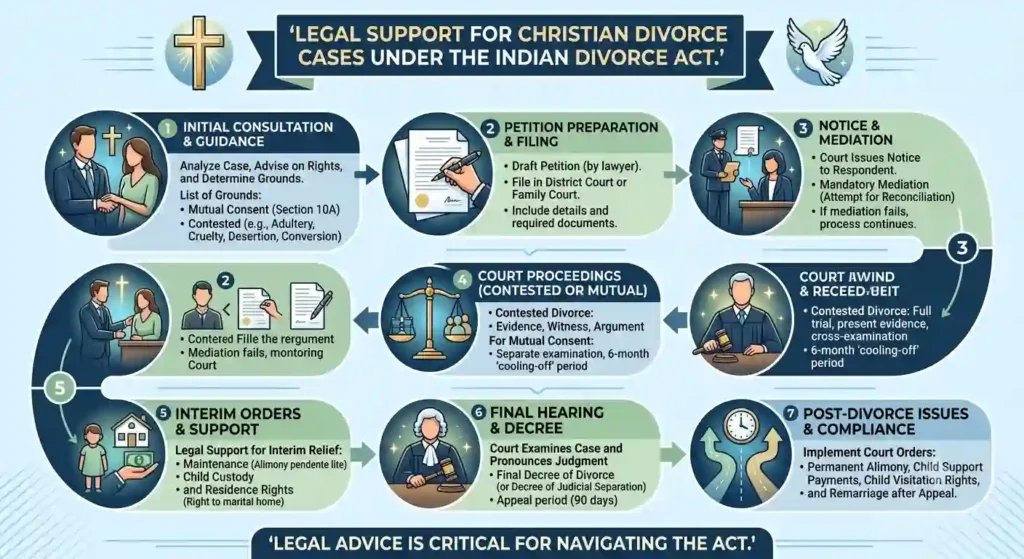
Section 10A provides a statutory route for Christian spouses seeking mutual consent divorce. Both spouses must jointly present the petition before the competent District Court. They must establish that they lived separately for at least two years. Additionally, they must show that reconciliation has failed and dissolution has been mutually agreed. The statute provides a six-month period before the joint motion can ordinarily proceed. That motion must occur within eighteen months from petition presentation, subject to statutory requirements. Therefore, spouses should carefully document separation, settlement, maintenance, custody, and property arrangements. Courts still examine whether statutory conditions and petition statements remain satisfied. Consequently, mutual consent does not mean automatic divorce without judicial scrutiny. Legal representation can help spouses negotiate comprehensive settlements and prepare compliant pleadings.
Contested Divorce Proceedings
A contested Christian divorce begins when spouses disagree about dissolution or related matrimonial relief. The petitioner must establish a legally recognised ground under the Divorce Act. Accordingly, the petition should clearly identify the marriage, jurisdiction, statutory ground, and supporting facts. The respondent receives an opportunity to contest allegations and present a defence. Courts may consider documentary evidence, witness testimony, electronic records, and other admissible evidence. Furthermore, interim applications can address maintenance, litigation expenses, custody, visitation, or protection. Parties should preserve relevant messages, financial documents, medical records, and other lawful evidence. However, evidence obtained unlawfully can create separate legal concerns. A family court advocate can formulate pleadings, evidence strategy, settlement proposals, and courtroom submissions. Thus, early legal assessment often improves procedural efficiency and protects important matrimonial rights.
Jurisdiction and Family Court Procedure
Choosing the Correct Court
Family Courts and District Courts
Christian divorce proceedings generally involve the competent District Court or Family Court exercising matrimonial jurisdiction. Jurisdiction depends upon statutory requirements and applicable territorial rules. Factors may include marriage location, respondent residence, petitioner residence, or parties’ last shared residence. Therefore, filing in the wrong forum can cause delay and procedural objections. Family Courts handle matrimonial disputes where the Family Courts Act applies to the relevant area. District Courts may exercise jurisdiction where Family Courts have not assumed jurisdiction. Additionally, High Courts can exercise specified matrimonial or appellate powers under applicable law. Consequently, parties should verify local court jurisdiction before preparing the petition. In Chennai, legal strategy should consider the appropriate Family Court or District Court jurisdiction. Professional family law advice can identify the correct forum and filing route before litigation begins.
High Court Appeals and Supervisory Remedies
High Courts can become relevant when parties challenge appropriate matrimonial orders or seek statutory remedies. The Divorce Act contains provisions concerning appeals from orders and decrees. Therefore, parties should examine the nature of the challenged order before selecting an appellate remedy. An appeal requires compliance with applicable limitation, court fee, documentation, and procedural requirements. Moreover, constitutional or supervisory jurisdiction may arise in suitable cases. However, parties should not assume that every matrimonial grievance creates a High Court remedy. The correct appellate route depends upon the order, statute, jurisdiction, and procedural history. Legal counsel can examine certified copies, pleadings, evidence, and previous orders before recommending proceedings. Consequently, prompt review after an adverse order can protect valuable appellate rights. Proper forum selection also prevents unnecessary parallel litigation and procedural complications.
Matrimonial Relief Beyond Divorce
Maintenance and Alimony
Christian spouses may require financial relief alongside divorce proceedings. The Divorce Act contains provisions concerning alimony and related matrimonial financial relief. Courts consider applicable statutory requirements and the financial circumstances of the parties. Therefore, applicants should prepare evidence concerning income, assets, liabilities, expenses, and financial responsibilities. Bank statements, salary records, tax documents, property information, and expenditure records can assist assessment. Furthermore, interim financial support may require urgent consideration during ongoing litigation. Legal counsel can formulate appropriate applications and respond to opposing financial claims. Courts also consider relevant circumstances involving children and household responsibilities. Consequently, financial disclosure should remain accurate, complete, and supported by credible documents. A negotiated settlement may address maintenance, property, education expenses, and other financial obligations.
Child Custody and Visitation
Divorce proceedings involving children require careful attention to custody and visitation arrangements. The Divorce Act includes provisions concerning custody of children. Courts generally focus on the child’s welfare while determining appropriate arrangements. Therefore, parents should avoid using children as instruments in matrimonial disputes. Applications may seek interim custody, visitation, education arrangements, travel permissions, or communication access. Furthermore, international relocation can create complex jurisdictional and enforcement concerns. Parents should preserve school records, medical information, travel documents, and evidence concerning caregiving responsibilities. Courts can examine the practical circumstances affecting the child’s safety and welfare. Accordingly, legal representation should prioritise stable arrangements rather than escalating parental conflict. A carefully drafted parenting arrangement can reduce future disputes and provide clearer expectations for both parents.
Evidence, Criminal Issues and Legal Remedies
Evidence and Related Legal Proceedings
Evidence in Christian Divorce Cases
Documentary and Digital Evidence
Christian matrimonial cases increasingly involve electronic communications and digital records. Relevant material can include emails, messages, photographs, recordings, financial records, and social media content. The Bharatiya Sakshya Adhiniyam, 2023 governs evidence principles in judicial proceedings from 1 July 2024. Therefore, lawyers should consider admissibility, authenticity, relevance, and proper proof of electronic evidence. Screenshots alone may not always provide sufficient evidentiary foundation. Consequently, parties should preserve original devices, records, metadata, and source information wherever legally appropriate. Evidence should also comply with privacy and other applicable legal restrictions. Furthermore, fabricated or manipulated digital material can seriously damage credibility. Legal counsel can assess evidence before filing affidavits or presenting exhibits. Proper evidence planning strengthens both contested divorce petitions and defensive matrimonial litigation.
Domestic Violence and Criminal Allegations
Some matrimonial disputes involve allegations of domestic violence, cruelty, threats, assault, harassment, or other offences. Such allegations require separate assessment under applicable civil and criminal laws. The Bharatiya Nyaya Sanhita, 2023 replaced the former Indian Penal Code framework from 1 July 2024. Meanwhile, the Bharatiya Nagarik Suraksha Sanhita, 2023 governs criminal procedure. Therefore, criminal allegations should not automatically become part of the divorce petition without legal analysis. Police complaints may become appropriate when facts disclose cognizable offences. However, ordinary matrimonial disagreements do not automatically constitute criminal offences. Legal counsel can evaluate evidence, police complaints, protection remedies, bail issues, and matrimonial proceedings together. A coordinated strategy can prevent conflicting statements across Family Court and criminal proceedings.
Remedies and Professional Legal Support
Remedies Available to Christian Spouses
Principal Matrimonial Remedies
Christian spouses can seek several remedies depending upon their facts and statutory entitlement. Common legal remedies include:
- Divorce on statutory grounds.
- Mutual consent dissolution under Section 10A.
- Judicial separation.
- Alimony and maintenance.
- Child custody and visitation.
- Protection orders where legally applicable.
- Restitution of conjugal rights.
- Appeals against eligible matrimonial orders.
Therefore, parties should identify the primary objective before selecting litigation or settlement. Each remedy carries distinct legal requirements, evidence standards, and procedural consequences. Furthermore, combining appropriate interim and final relief can provide better protection during litigation. Lawyers should also examine whether parallel proceedings require coordination. Courts may encourage settlement where appropriate without compromising lawful rights. Consequently, informed legal advice helps spouses choose proportionate remedies. The best strategy depends upon marriage facts, evidence, children, finances, jurisdiction, and litigation history.
Legal Support for NRIs and Overseas Christians
NRIs frequently face additional difficulties when Christian matrimonial disputes involve foreign residence. Service of summons, video appearances, powers of attorney, travel, evidence, and foreign proceedings can complicate litigation. Therefore, overseas spouses should obtain jurisdiction-specific advice before filing or responding to proceedings. Lawyers can coordinate documentation, authorisations, evidence, and court appearances within permissible procedures. Additionally, foreign divorce decrees may require examination before Indian courts recognise their legal effect. Parties should consider applicable principles concerning jurisdiction, natural justice, and statutory recognition. International child custody disputes can also involve separate legal and practical concerns. Furthermore, settlement terms should address residence, maintenance, property, and travel obligations clearly. A Chennai family law firm can assist NRIs with India-based matrimonial proceedings and related court coordination. Professional support can reduce unnecessary travel while maintaining procedural compliance.
Police, Government Departments and Forums
Police Stations and Government Authorities
Police stations do not ordinarily decide whether a Christian marriage should be dissolved. Matrimonial dissolution remains a judicial function under applicable family law. However, police authorities can become relevant when complaints disclose alleged criminal conduct. The Ministry of Home Affairs administers the central criminal law framework through applicable legislation. State police departments handle local complaints and investigations under current criminal procedure. Therefore, parties should distinguish divorce remedies from criminal remedies. A complaint should contain factual allegations supported by available evidence. Moreover, emergency safety concerns require immediate attention through appropriate authorities. Lawyers can advise clients regarding complaint drafting, investigation responses, notices, and court proceedings. Courts may separately address matrimonial relief while criminal proceedings continue. Consequently, parties should maintain consistent factual positions across every legal forum.
CPC, BNS, BNSS and BSA Interaction
Christian divorce proceedings primarily arise under the Divorce Act and applicable matrimonial procedure. The Code of Civil Procedure may influence civil procedural matters where applicable. However, BNS concerns substantive criminal offences, while BNSS governs criminal procedure. BSA governs evidence and replaced the Indian Evidence Act framework from July 2024. Therefore, these newer laws do not replace the Divorce Act. Instead, they may become relevant when matrimonial disputes involve criminal allegations or evidentiary questions. Legal practitioners must identify which statute governs each issue before filing proceedings. Furthermore, procedural rules can vary according to the court and nature of application. Courts expect accurate statutory references and properly framed reliefs. Consequently, mixing civil, matrimonial, and criminal provisions can create avoidable legal confusion.
Strategic Family Law Assistance
When to Consult a Christian Divorce Lawyer
Early legal consultation can clarify whether divorce, separation, reconciliation, or settlement best suits the circumstances. Lawyers can review marriage certificates, communications, financial records, children’s documents, and previous proceedings. Therefore, clients should gather important records before the initial legal consultation. Counsel can then identify jurisdiction, statutory grounds, evidence requirements, and potential counterclaims. Furthermore, early advice helps preserve electronic evidence and avoid harmful communications. Clients should also understand likely interim applications involving maintenance, custody, or litigation expenses. Where criminal allegations exist, counsel should coordinate matrimonial and criminal strategies carefully. Additionally, NRIs should obtain advice before executing powers of attorney or foreign settlement documents. A family lawyer can explain procedural stages using clear and practical language. Consequently, informed clients usually make stronger decisions throughout emotionally difficult matrimonial proceedings.
How Legacy Family Court Law Firm Helps
Legacy Family Court Law Firm provides legal support for Christian divorce and related matrimonial disputes. Our assistance can cover contested divorce, mutual consent divorce, judicial separation, maintenance, custody, visitation, and settlement negotiations. We can also assist with jurisdiction analysis, pleadings, evidence preparation, interim applications, and court representation. Furthermore, our legal strategy can address overlapping criminal complaints and matrimonial proceedings where appropriate. NRI clients may require additional assistance involving documentation, authorisation, communication, and India-based proceedings. We also help clients evaluate appeals and other remedies after adverse matrimonial orders. Therefore, each case should begin with a careful review of facts and applicable law. Professional representation can reduce procedural errors and protect important legal interests. Ultimately, successful matrimonial advocacy requires preparation, accurate evidence, suitable remedies, and the correct forum. Clients should obtain case-specific advice before taking significant legal action.
Frequently Asked Questions
What law governs Christian divorce in India?
The Divorce Act, 1869 primarily governs Christian divorce. It provides grounds for contested divorce, mutual consent divorce, judicial separation, alimony, custody, and related matrimonial remedies.
Can Christians obtain mutual consent divorce?
Yes. Section 10A permits mutual consent divorce when statutory requirements are satisfied. The spouses must establish the required separation period and mutual agreement before the competent court.
Where should a Christian divorce petition be filed?
The competent Family Court or District Court depends upon applicable territorial and matrimonial jurisdiction. A lawyer should verify jurisdiction before filing the petition.
Does BNS replace the Indian Divorce Act?
No. BNS governs criminal offences, while the Divorce Act governs Christian matrimonial dissolution. BNS may become relevant separately when matrimonial facts involve alleged criminal conduct.
Can an NRI obtain Christian divorce in India?
Yes, where Indian courts possess appropriate jurisdiction. NRIs may require assistance with jurisdiction, documentation, authorisation, evidence, service, appearances, and recognition of foreign matrimonial orders.
Can a Christian spouse claim maintenance and child custody?
Yes, applicable matrimonial laws provide financial and child-related remedies. Courts examine statutory requirements, financial circumstances, and the child’s welfare before granting appropriate relief.
Read More
- Protect Your Rights in Divorce Under the Dissolution of Muslim Marriages Act
- Resolve Custody Disputes Under the Hindu Minority and Guardianship Act
- Fight Property Disputes Under the Hindu Succession Act
- Handle Complex Custody Battles Under the Guardians and Wards Act
- Legal Help for High-Profile Divorce Cases Under the Hindu Marriage Act
- Department of Justice, Ministry of Law and Justice