


Protect Your Rights in Divorce – Divorce under the Dissolution of Muslim Marriages Act, 1939 provides Muslim women statutory grounds for ending marriage. Section 2 recognises several grounds, including disappearance, maintenance failure, imprisonment, marital neglect, impotence, and specified illness. It also covers repudiation of certain child marriages and other legally recognised circumstances. Therefore, a petitioner should identify every applicable ground before filing the case. The Act protects a woman’s right to seek dissolution through a judicial decree. Importantly, dissolution differs from informal separation, talaq, or private settlement. The Family Courts Act, 1984 governs jurisdiction where a Family Court exists. Consequently, legal strategy should consider marriage records, residence, evidence, maintenance, children, and pending proceedings. A family lawyer can assess the facts and prepare appropriate pleadings. This approach also helps protect dower rights and related financial claims. The current BNS, BNSS, and BSA may become relevant when connected criminal allegations or evidence issues arise.
Protect Your Rights in Divorce Under the Dissolution of Muslim Marriages Act – Legacy Family Court Law Firm
Prove the Applicable Statutory Grounds
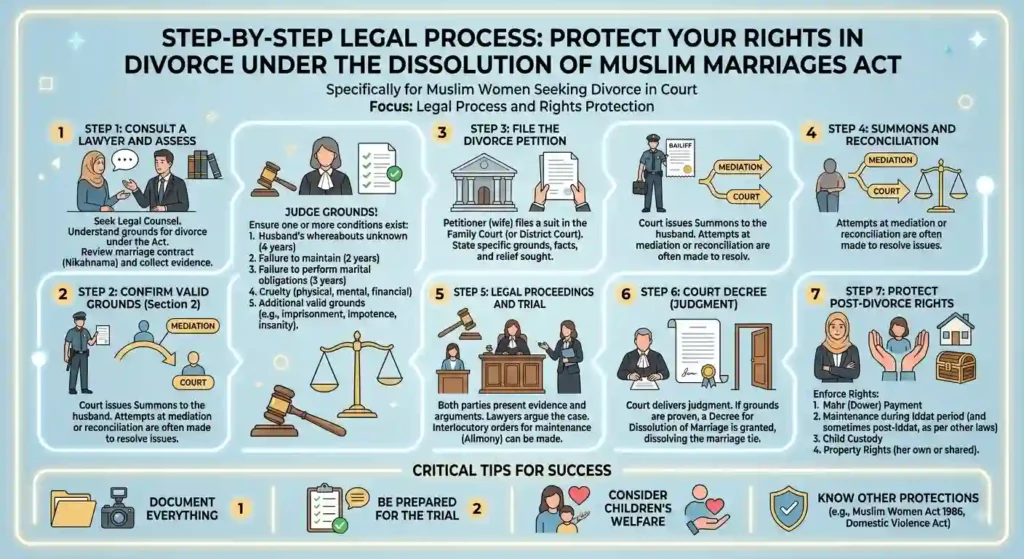
Section 2 of the 1939 Act contains the principal grounds available to a Muslim wife seeking dissolution. These grounds can operate individually or together, depending upon the evidence. For example, a husband missing for four years may create a statutory ground. Similarly, failure to maintain the wife for two years may support dissolution. Imprisonment for seven years or more can also qualify under the Act. Further, failure to perform marital obligations for three years may support relief. The statute also addresses impotence, insanity, and certain venereal diseases. A woman married before fifteen may invoke the repudiation ground after satisfying statutory conditions. Cruelty also forms an important ground under Section 2(viii), subject to its listed circumstances. Therefore, pleadings should connect each allegation with the precise statutory ground. Courts require evidence supporting material allegations. Proper legal drafting can prevent vague pleadings and unnecessary procedural objections.
Cruelty and Matrimonial Misconduct
Understand Cruelty as a Divorce Ground
Cruelty remains a significant ground for Muslim women seeking dissolution under the 1939 Act. Section 2(viii) covers several forms of harmful conduct by a husband. These include assault, making her life miserable through cruelty, associating with women of evil repute, and forcing immoral conduct. The provision also addresses disposal of property, obstruction of religious practice, and inequitable treatment among wives. Moreover, cruelty allegations may overlap with criminal conduct under the BNS. Section 85 addresses cruelty by a husband or his relative against a woman. However, the matrimonial court and criminal court perform different legal functions. Therefore, a divorce petition should establish the statutory matrimonial ground separately. Evidence may include messages, medical records, complaints, financial records, witness statements, and other admissible material. A lawyer should avoid exaggerated allegations because credibility affects the entire case. Consequently, careful evidence planning can strengthen both matrimonial and related proceedings.
Preserve Documentary and Digital Evidence
A petitioner should prepare a complete factual record before approaching the Family Court. Start with the marriage date, place, ceremony, and available marriage documents. Next, record the parties’ residences and the history of the marital relationship. Include relevant dates concerning separation, maintenance failure, cruelty, disappearance, or other statutory grounds. Preserve correspondence, bank records, medical documents, photographs, messages, and previous complaints. Furthermore, identify witnesses who can prove material facts directly. The Bharatiya Sakshya Adhiniyam, 2023 governs evidence under the current evidentiary framework. Electronic records therefore require careful preservation and proper presentation. Avoid deleting original messages or altering digital files before legal review. Police complaints can support certain allegations, but they do not automatically establish matrimonial grounds. Therefore, evidence should match each pleaded fact. A family lawyer can organise documents into a chronology and prepare appropriate annexures. This preparation improves clarity and reduces avoidable objections during proceedings.
Determine Proper Territorial Jurisdiction
Jurisdiction matters because the correct court determines where the divorce petition should proceed. Family Courts exercise jurisdiction over specified matrimonial proceedings under Section 7 of the Family Courts Act. Where no Family Court operates, the competent district or subordinate civil court may exercise jurisdiction. The petitioner should examine residence, marriage location, respondent residence, and statutory territorial requirements. Moreover, local State rules can influence filing procedure and court administration. In Chennai, parties should verify the competent Family Court or other designated matrimonial forum. A nearby police station may handle connected criminal complaints, but it cannot grant a divorce decree. Similarly, tribunals generally do not replace matrimonial courts for dissolution proceedings. Therefore, forum selection should precede filing and service. A lawyer can identify jurisdiction and avoid returning or transferring a defective petition. Correct territorial jurisdiction also assists with interim applications, evidence, child issues, and enforcement of orders.
Family Court Proceedings and Connected Remedies
Filing and Conducting the Divorce Case
The Family Court process usually begins with filing a properly drafted petition and supporting documents. The court then examines filing requirements before issuing process according to applicable procedure. The respondent receives notice and obtains an opportunity to respond. Subsequently, the court may explore settlement and reconciliation where appropriate. Section 9 of the Family Courts Act requires efforts toward settlement in suitable cases. However, settlement efforts do not remove a party’s right to pursue lawful dissolution. Proceedings may involve pleadings, interim applications, evidence, cross-examination, arguments, and judgment. The court may also consider connected maintenance, custody, visitation, and other matrimonial issues within jurisdiction. Therefore, parties should maintain consistent factual positions throughout the litigation. Delay can arise from service problems, adjournments, evidence disputes, or parallel proceedings. Legal representation helps manage these procedural stages efficiently. The Family Courts Act also provides appellate mechanisms against specified judgments and orders.
Protect Maintenance and Dower Rights
Financial protection requires attention to maintenance, dower, residence, litigation expenses, and child-related needs. A divorce petition should not overlook financial consequences created by prolonged matrimonial litigation. The Dissolution of Muslim Marriages Act expressly preserves rights to dower under Section 5. Additionally, BNSS Section 144 provides a statutory maintenance mechanism for eligible wives, children, and parents. However, entitlement depends upon statutory requirements and the particular facts. Therefore, parties should disclose relevant income, assets, liabilities, employment, and expenditure accurately. Bank statements, salary records, tax documents, property records, and business information can become important evidence. Courts may consider financial circumstances when deciding appropriate relief under applicable law. Furthermore, settlement agreements should clearly address payment schedules, arrears, dower, and future claims. A lawyer can identify overlapping remedies and prevent inconsistent applications. Financial planning therefore forms an essential part of divorce strategy, especially where children or substantial assets remain involved.
Address Child Custody and Visitation
Child custody requires a separate focus because the child’s welfare remains central to judicial decisions. Divorce under the 1939 Act does not automatically determine custody or visitation arrangements. Family Courts can consider connected child-related proceedings within their statutory jurisdiction. Parents should therefore present evidence concerning education, health, safety, stability, and daily care. Moreover, allegations between spouses should not overshadow the child’s best interests. Courts may make interim arrangements while the matrimonial case continues. A parent seeking custody should maintain school records, medical information, expense details, and evidence of involvement. Likewise, parents should comply with interim visitation or custody directions unless lawfully modified. Criminal allegations can affect custody decisions when they directly concern safety or welfare. However, unsupported accusations can undermine credibility. Legal support should therefore frame custody requests around welfare, stability, and practical arrangements. A carefully prepared application can protect parental rights while keeping the child’s interests paramount.
Address Connected Criminal Allegations
Domestic violence, dowry-related harassment, assault, intimidation, and other criminal conduct may accompany matrimonial disputes. Such allegations require separate legal assessment under current criminal laws. The BNS contains Section 85 concerning cruelty by a husband or his relative against a woman. BNSS governs criminal procedure, including police investigation and criminal court processes. Therefore, a matrimonial petition should not replace a necessary criminal complaint. Conversely, a criminal complaint should not automatically substitute for the statutory divorce remedy. Evidence should establish the ingredients of each alleged offence separately. A woman may approach the appropriate police station when cognisable offences arise. If police action becomes inadequate, applicable BNSS procedures may provide further remedies. Courts can also address connected matters through appropriate proceedings. Consequently, legal counsel should coordinate matrimonial and criminal strategies carefully. Parties should preserve complaint acknowledgements, medical evidence, messages, photographs, and witness information. Prompt advice can reduce procedural mistakes and protect important evidence.
Apply Current Procedural and Evidence Laws
The CPC may remain relevant to procedural matters where its provisions apply to matrimonial proceedings. However, Family Courts follow the Family Courts Act and applicable procedural rules. Section 10 addresses procedure before Family Courts, while Section 14 concerns reception of evidence. The BSA now provides the principal statutory framework for evidence where applicable. Therefore, lawyers should avoid relying automatically on outdated references to the Evidence Act. Similarly, criminal proceedings now follow BNSS rather than the former CrPC framework. These changes matter when matrimonial disputes involve police complaints, criminal cases, or evidentiary questions. A court may also consider previous orders from other proceedings. Consequently, parties should disclose pending litigation and avoid contradictory statements. Procedural strategy should match the specific forum and relief sought. A family lawyer can coordinate CPC principles, Family Court procedure, BSA requirements, and BNSS proceedings. This integrated approach reduces jurisdictional confusion and strengthens case management.
Protecting Rights Through Effective Legal Remedies
Responding to Divorce Proceedings
Defend Against Unfounded Allegations
A respondent facing a divorce petition should respond within the prescribed time and address every material allegation. Ignoring court notices can produce adverse procedural consequences. The written statement should distinguish admitted facts from disputed allegations clearly. Furthermore, the respondent should identify any jurisdictional, limitation, or maintainability objection supported by law. Financial claims, child arrangements, and related proceedings should receive separate attention. If criminal allegations exist, the respondent may require independent advice concerning police investigation or bail. The BNS and BNSS apply to relevant criminal allegations arising from matrimonial disputes. However, matrimonial defence should remain focused on the statutory divorce grounds. Documentary evidence can challenge inaccurate dates, financial claims, or alleged conduct. Witness preparation also requires consistency and factual accuracy. A lawyer can formulate objections, counterclaims where legally available, and settlement proposals. Early representation can prevent missed deadlines and protect procedural rights throughout the Family Court proceedings.
Consider Mediation and Lawful Settlement
Alternative dispute resolution can reduce conflict when both parties genuinely seek a lawful settlement. Family Courts must encourage settlement efforts under Section 9 of the Family Courts Act. Mediation may address maintenance, child arrangements, property issues, communication, and other practical concerns. However, mediation cannot compel a party to abandon statutory rights or accept unlawful terms. A settlement should clearly identify dower, financial payments, custody, visitation, pending cases, and implementation dates. Furthermore, parties should understand the legal effect of every undertaking before signing. Where serious violence or coercion exists, safety and independent legal advice become especially important. Courts may record or incorporate settlements according to applicable procedure. Therefore, parties should not rely on informal promises alone. A lawyer can review proposed terms and identify unresolved liabilities. Proper settlement drafting can prevent future disputes and unnecessary enforcement proceedings. Ultimately, consensual resolution works best when it remains voluntary, informed, lawful, and practically enforceable.
Pursue Appeals and Appropriate Remedies
Appeals and revisions may become available after a Family Court decision, depending upon the nature of the order. Section 19 of the Family Courts Act governs appeals from specified judgments and orders. However, not every interlocutory order automatically carries the same appellate route. Therefore, legal counsel should examine the exact order, statutory provision, limitation period, and competent forum. The High Court may exercise relevant appellate or revisional jurisdiction where law permits. Parties should obtain certified copies promptly and calculate limitation carefully. Moreover, an appeal does not always suspend the operation of the original order automatically. An appropriate stay application may therefore become necessary. Enforcement questions also require attention where financial or custody directions remain outstanding. Consequently, post-judgment strategy should begin immediately after receiving the order. A lawyer can assess merits, procedural grounds, evidence, and available appellate remedies. Timely action protects valuable rights and avoids preventable limitation problems.
Protect NRI Divorce and Cross-Border Interests
NRIs and spouses living outside India may face additional jurisdiction, service, evidence, and enforcement concerns. The divorce petition still requires a legally competent Indian forum with appropriate jurisdiction. International residence can complicate notice, appearance, documents, and coordination with foreign proceedings. Therefore, parties should disclose overseas addresses and pending foreign cases accurately. Power of attorney arrangements may assist with certain procedural tasks, subject to court requirements. Foreign-issued documents may require authentication, translation, or other formalities. Furthermore, foreign financial records can become relevant to maintenance or asset disputes. A lawyer should examine the place of marriage, parties’ residences, children’s location, and existing foreign litigation. Enforcement of Indian matrimonial orders abroad may involve additional legal processes. Consequently, early cross-border legal planning can reduce delay. NRI parties should obtain India-focused family law advice before making settlement commitments or filing proceedings.
Professional Family Law Assistance
Build a Complete Legal Strategy
Effective legal support begins with a detailed review of facts, documents, jurisdiction, and objectives. A family lawyer should identify every statutory ground available under the 1939 Act. The review should also examine maintenance, dower, custody, domestic violence, criminal allegations, and property disputes. Furthermore, counsel should map each issue to the correct court, police authority, or other forum. The strategy should avoid duplicative proceedings and inconsistent factual positions. Evidence should receive early attention because digital records and financial documents can disappear or become difficult to obtain. Legal drafting should use precise allegations linked to statutory requirements. Clients should also understand likely procedural stages, costs, timelines, and settlement possibilities. Therefore, professional assistance can provide both litigation planning and risk management. Legacy Family Court Law Firm can assist with divorce petitions, Family Court cases, maintenance, custody, and related legal remedies. Proper representation helps protect rights while pursuing a lawful and practical resolution.
Prepare Marriage and Identity Documents
Marriage records and identity documents form the foundation of a well-prepared dissolution petition. Collect the nikahnama, marriage registration certificate, identity documents, address proofs, and children’s records. If registration did not occur, alternative evidence may still establish the marriage according to applicable law. Furthermore, documents should reflect consistent names, dates, and addresses wherever possible. Discrepancies can create avoidable questions during filing and evidence. Where documents remain with the spouse, lawful discovery or production requests may become necessary. Digital copies should supplement rather than replace important originals. If records originate abroad, obtain appropriate authentication and translation before relying upon them. Courts may require certified copies for specific procedural purposes. Therefore, document preparation should begin before drafting the petition. A lawyer can identify missing records and advise on lawful methods for obtaining them. Proper documentation strengthens jurisdiction, identity, marriage, statutory grounds, financial claims, and connected applications.
Map Every Legal Issue and Forum
A divorce case can involve several legal issues beyond dissolution of marriage itself. These may include maintenance, dower, custody, visitation, domestic violence, criminal complaints, property disputes, and enforcement. Each issue may involve a different statutory remedy or forum. Therefore, parties should create an issue-wise legal roadmap before commencing multiple proceedings. Family Courts can address specified matrimonial matters, while Magistrates handle applicable criminal and maintenance proceedings. Police stations investigate cognisable offences according to BNSS requirements. High Courts may exercise constitutional or appellate jurisdiction where appropriate. Tribunals generally handle specialised statutory disputes rather than ordinary matrimonial dissolution. Consequently, forum selection should follow the legal issue rather than personal convenience alone. A coordinated strategy can prevent contradictory pleadings and unnecessary litigation. Legal counsel should also monitor limitation periods and interim orders across proceedings. This approach helps protect financial, parental, matrimonial, and personal rights throughout the dispute.
Protect Safety, Dignity and Evidence
Safety and dignity should remain priorities throughout contested matrimonial litigation. A spouse facing threats, violence, stalking, or coercion should consider immediate lawful protection measures. Criminal allegations require prompt attention under the BNS and BNSS framework. Evidence such as medical records, messages, photographs, call records, and witness information should be preserved. However, parties should avoid unlawful recording, retaliation, intimidation, or public accusations. Such conduct can create additional legal problems and weaken the underlying case. Where children remain involved, parents should minimise conflict around them and follow court directions. Financial records should also remain accurate because courts may examine income and expenditure claims. Furthermore, parties should communicate through appropriate legal channels when direct contact creates risk. A family lawyer can coordinate matrimonial, criminal, custody, maintenance, and protective remedies. Consequently, early legal intervention can preserve evidence and reduce avoidable escalation. The objective remains lawful protection, fair adjudication, and a sustainable resolution of family disputes.
Frequently Asked Questions
Can a Muslim woman seek divorce under the 1939 Act?
Yes. A Muslim wife can seek a decree on statutory grounds under Section 2. The correct ground must match facts, evidence, jurisdiction, and applicable court procedure. Legal advice can clarify.
Is cruelty a ground for dissolution?
Yes. Section 2(viii) recognises specified forms of cruelty. The petitioner should prove the relevant conduct through reliable documents, testimony, records, or other admissible evidence. Legal advice.
Where should the divorce petition be filed?
File before the competent Family Court where established, or another court having matrimonial jurisdiction. Territorial rules depend on residence, marriage location, and applicable law. Counsel should verify jurisdiction.
Can maintenance be claimed during divorce?
Yes. Maintenance may arise under applicable matrimonial and criminal-law provisions. BNSS Section 144 provides a maintenance mechanism subject to statutory requirements and facts. A lawyer can advise.
Can criminal cases accompany a divorce case?
Yes. Separate criminal proceedings may arise from cruelty, assault, threats, or other offences. BNS and BNSS govern applicable offences and criminal procedure. Counsel should assess evidence carefully.
Can NRIs seek divorce in India under this Act?
Yes, where an Indian court has proper jurisdiction. NRIs should address service, residence, foreign proceedings, evidence, and enforcement issues before filing or settling. Counsel can coordinate proceedings.
Read More
- Resolve Custody Disputes Under the Hindu Minority and Guardianship Act
- Fight Property Disputes Under the Hindu Succession Act
- Legal Support for Child Maintenance Under Section 125 CrPC
- Secure Inheritance Rights Under the Indian Succession Act
- Legal Help for High-Profile Divorce Cases Under the Hindu Marriage Act
- India Code – Dissolution of Muslim Marriages Act, 1939