


Resolve Custody Disputes – The Hindu Minority and Guardianship Act, 1956 governs guardianship among Hindus, subject to the child’s welfare. Section 6 identifies natural guardians, while Section 13 makes welfare paramount. Therefore, parental status alone cannot determine custody. Courts examine the child’s age, education, health, safety, emotional needs, and relationship with each parent. Moreover, courts consider the parent’s character, stability, financial capacity, and ability to provide care. The Guardians and Wards Act, 1890 also provides important procedures for custody and guardianship proceedings. Consequently, custody disputes require combined consideration of both statutes. Family Courts generally handle matrimonial and child-related disputes within their jurisdiction. Meanwhile, the child’s welfare remains the central consideration throughout proceedings. Parents should therefore obtain legal advice before filing custody petitions, visitation applications, or interim applications. Legacy Family Court Law Firm provides strategic custody representation for parents seeking practical and child-focused remedies.
Resolve Custody Disputes Under the Hindu Minority and Guardianship Act – Legacy Family Court Law Firm
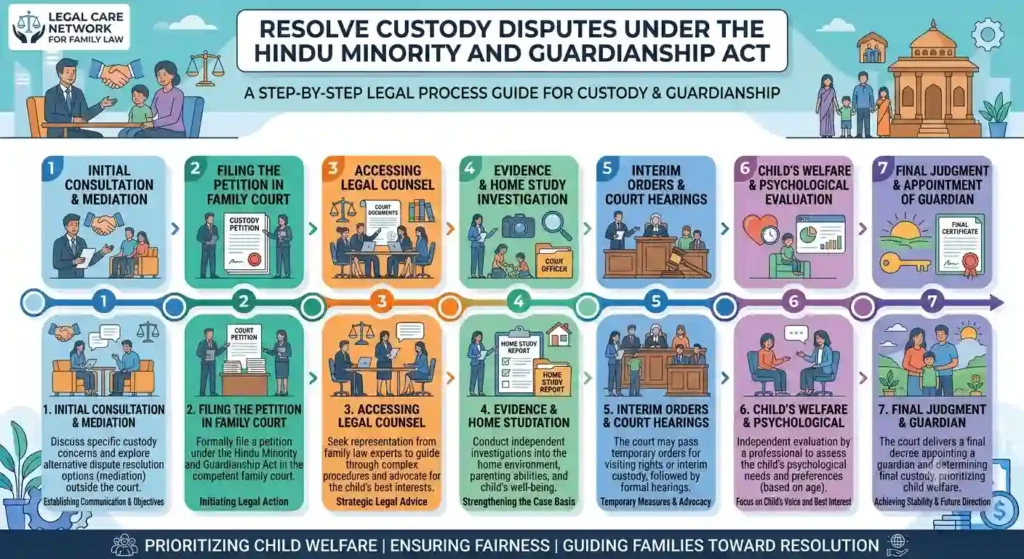
Welfare of the Child as the Paramount Consideration
Courts place the child’s welfare above competing parental claims during custody proceedings. Welfare includes physical safety, emotional security, education, healthcare, stability, and healthy development. Additionally, courts may consider the child’s preferences when age and maturity permit meaningful expression. Financial superiority alone does not establish a parent’s entitlement to custody. Instead, judges evaluate the overall circumstances surrounding the child’s upbringing. Therefore, parents should present evidence demonstrating responsible parenting rather than attacking the other parent unnecessarily. School records, medical documents, communication records, photographs, and financial documents may support relevant claims. Moreover, courts can modify arrangements when circumstances materially change after an earlier order. Custody therefore remains responsive to the child’s evolving needs. Legal counsel can help parents organise evidence and present focused submissions. Consequently, early preparation can improve the clarity of custody proceedings before Family Courts and other competent judicial forums.
Natural Guardians and Parental Rights
Section 6 of the Hindu Minority and Guardianship Act identifies natural guardians for Hindu minors. However, natural guardianship does not create an unconditional right to physical custody. Courts separately determine custody according to welfare considerations. The statutory framework also recognises circumstances involving illegitimacy and different parental relationships. Therefore, parents should distinguish guardianship rights from actual custody rights during litigation. Moreover, the child’s best interests can override a parent’s otherwise recognised guardianship position. Courts may also examine parental conduct, domestic circumstances, and the child’s existing relationship with both parents. Consequently, parents should avoid assuming that statutory guardianship automatically secures residential custody. Legal representation can clarify the distinction between natural guardianship, legal custody, physical custody, and visitation. Additionally, lawyers can identify whether proceedings require relief under the Hindu Minority and Guardianship Act, Guardians and Wards Act, Hindu Marriage Act, or another applicable law. Proper statutory selection can prevent procedural complications.
Joint Custody, Shared Parenting and Visitation
Indian courts can structure custody arrangements around the child’s welfare and practical circumstances. Depending upon the facts, arrangements may include sole custody, shared parenting, visitation, holiday access, or supervised contact. However, courts must consider whether each arrangement genuinely serves the child’s interests. Parents should therefore propose realistic schedules covering school days, weekends, holidays, travel, healthcare, and communication. Furthermore, courts may impose safeguards where conflict or safety concerns affect visitation. A parent seeking meaningful access should demonstrate reliability, cooperation, and respect for the child’s routine. Conversely, a parent seeking restrictions should provide credible evidence supporting those concerns. Courts generally benefit from practical proposals rather than broad allegations. Therefore, custody lawyers should prepare detailed parenting arrangements supported by relevant documents. Legacy Family Court Law Firm can assist with custody petitions, visitation applications, mediation, interim orders, and parenting-plan negotiations. Early agreement can reduce prolonged litigation and emotional stress.
Custody During Divorce and Matrimonial Proceedings
Custody disputes frequently arise alongside divorce, judicial separation, maintenance, or domestic-relations proceedings. The Hindu Marriage Act, 1955 permits courts to make appropriate provisions concerning minor children in relevant matrimonial proceedings. Meanwhile, independent guardianship proceedings may proceed under the Guardians and Wards Act. Therefore, lawyers must examine existing matrimonial cases before filing separate custody proceedings. Courts may issue interim arrangements while determining longer-term custody rights. Additionally, parents can seek temporary visitation or communication arrangements during litigation. A custody application should clearly explain the child’s circumstances, existing residence, education, healthcare, and relationship with both parents. Evidence should support every significant allegation concerning safety or welfare. Consequently, unsupported accusations can weaken an otherwise legitimate custody claim. Family Court lawyers can coordinate custody applications with divorce and maintenance proceedings. This approach helps avoid conflicting orders and ensures that the child’s welfare remains central across connected litigation.
Jurisdiction and Appropriate Family Court Forum
Territorial Jurisdiction in Custody Proceedings
Jurisdiction can determine where parents must file custody and guardianship proceedings. Under the Guardians and Wards Act, jurisdiction generally depends upon the minor’s ordinary residence. Therefore, lawyers should establish the child’s actual residential circumstances before initiating proceedings. Temporary stays, school locations, parental addresses, and relocation history may require careful examination. Family Courts exercise jurisdiction where legislation and local notifications confer appropriate authority. In Chennai, the competent Family Court may handle custody-related disputes within its assigned territorial jurisdiction. However, lawyers should verify current jurisdictional arrangements before filing. Moreover, transfer applications may become relevant when proceedings create genuine hardship or conflicting jurisdictional concerns. The Supreme Court and High Courts can exercise appropriate appellate, supervisory, or constitutional jurisdiction. Consequently, jurisdictional objections should receive attention at the earliest stage. Legacy Family Court Law Firm evaluates residence, existing proceedings, statutory jurisdiction, and appropriate forum before preparing custody petitions. Proper filing can reduce avoidable delays.
Interim Custody, Emergency Protection and Court Orders
Parents often require immediate arrangements before final custody adjudication concludes. Courts can consider interim custody, temporary visitation, communication access, and protective directions according to applicable law. Therefore, urgent applications should clearly explain the immediate risk or practical difficulty affecting the child. Allegations involving violence, abduction, neglect, substance misuse, or unsafe environments require credible supporting evidence. Additionally, courts may consider school continuity and the child’s existing living arrangements. Lawyers can seek appropriate interim relief while preparing the main custody case. Where necessary, police assistance may become relevant for implementing lawful court orders or protecting a child. However, parents should not attempt self-help recovery methods that could create criminal allegations. BNSS governs current criminal procedure where criminal conduct accompanies custody disputes. Consequently, legal counsel should coordinate family proceedings with police or criminal remedies where necessary. A focused interim strategy can protect the child without unnecessarily escalating parental conflict.
Enforcement, Modification and Appeal of Custody Orders
Custody orders require practical compliance because repeated violations can harm the child’s stability. A parent facing non-compliance should document missed access, denied communication, relocation, or other relevant conduct. Courts can consider enforcement and modification requests according to applicable circumstances. Moreover, custody arrangements may require alteration when employment, education, health, safety, or residence changes significantly. Parents should therefore avoid treating an old custody order as permanently unchangeable. Appellate or supervisory remedies may become available depending upon the order and applicable procedural law. The Code of Civil Procedure may influence procedural aspects where applicable, subject to special family-law provisions. Additionally, evidence supporting modification should demonstrate a genuine change affecting welfare. Courts generally focus on present circumstances rather than parental punishment. Consequently, lawyers should frame applications around the child’s current needs. Legacy Family Court Law Firm assists with enforcement, modification, appeals, transfer matters, and urgent custody applications before appropriate courts.
Evidence Required in Custody Litigation
Strong custody cases depend upon relevant evidence rather than emotional allegations. Parents should preserve school reports, medical records, attendance details, communication histories, photographs, travel records, and financial documents. Additionally, evidence concerning domestic violence, neglect, threats, or unsafe conditions should remain authentic and properly preserved. Digital evidence can become important where parents communicate through messaging applications or email. The Bharatiya Sakshya Adhiniyam, 2023 now governs evidence under India’s updated criminal-law framework where applicable. Family proceedings can also involve evidentiary principles under their governing statutes and procedural rules. Therefore, lawyers should assess admissibility and relevance before presenting digital material. Witnesses may include teachers, relatives, medical professionals, counsellors, or other persons with direct knowledge. However, unnecessary witnesses can complicate proceedings and intensify family conflict. Consequently, evidence should remain focused on welfare-related facts. Professional legal review helps identify relevant documents and develop a coherent custody presentation before the Family Court.
Child Preference and Interaction With the Court
A mature child’s preference can influence custody decisions, although it does not automatically determine the outcome. Courts may interact with children appropriately to understand their wishes and circumstances. Therefore, parents should never coach children to make statements favouring one parent. Such conduct can damage credibility and place emotional pressure upon the child. Moreover, courts can assess whether a stated preference results from genuine choice or parental influence. The child’s age, maturity, understanding, and emotional condition remain important considerations. Consequently, parents should encourage honest communication without rehearsing answers for court proceedings. Lawyers can explain courtroom procedures in age-appropriate language without manipulating the child’s evidence. Additionally, professional counselling may help where parental conflict causes significant emotional distress. The court’s objective remains protection of the child’s welfare rather than rewarding either parent. Legacy Family Court Law Firm adopts a child-centred strategy while protecting each parent’s legitimate legal rights throughout custody litigation and related proceedings.
Domestic Violence, Abuse and Child Safety
Allegations of domestic violence or abuse can substantially affect custody decisions. Courts must examine credible safety concerns when determining residential custody, visitation, or communication arrangements. Therefore, parents should document police complaints, medical records, protection orders, threatening messages, and other relevant evidence. The Protection of Women from Domestic Violence Act, 2005 may provide additional remedies where its requirements apply. Moreover, child abuse allegations may trigger separate criminal or child-protection proceedings. BNS provisions can become relevant when alleged conduct constitutes a criminal offence. BNSS provides the current procedural framework for corresponding criminal proceedings. Consequently, custody litigation should not obscure urgent safety requirements. Parents should seek appropriate legal protection rather than confronting an allegedly abusive party directly. Courts can consider supervised visitation or other safeguards where circumstances justify them. Legacy Family Court Law Firm coordinates family, protective, and criminal remedies to address serious child-safety concerns effectively.
Relocation, Foreign Travel and NRI Custody Disputes
Relocation disputes arise when one parent seeks to move the child to another city or country. Such decisions can affect education, visitation, family relationships, and long-term stability. Therefore, courts examine the proposed relocation’s genuine purpose and likely impact on the child. NRI custody disputes can involve immigration documents, passports, foreign residence, schooling, and international travel. Parents should not remove a child from India contrary to court directions or legal requirements. Moreover, existing custody orders may contain specific travel or passport restrictions. Courts can consider interim restraints where international movement creates genuine welfare concerns. Lawyers should examine jurisdiction, existing orders, travel plans, and enforceability before advising clients. Consequently, NRI parents require coordinated representation across Indian family proceedings and practical cross-border issues. Legacy Family Court Law Firm assists NRIs with custody petitions, visitation, travel disputes, mediation, representation, and court documentation. Early advice can prevent avoidable international complications.
Mediation and Negotiated Parenting Arrangements
Mediation can provide parents with practical custody arrangements without prolonged adversarial litigation. Family Courts may encourage settlement where negotiation can protect the child’s interests. Therefore, parents should consider structured mediation when communication remains possible and safety concerns do not prevent negotiation. A parenting agreement can address residence, visitation, holidays, education, healthcare, travel, expenses, and communication. Additionally, parents can establish procedures for resolving future disagreements. However, settlement should never pressure a vulnerable parent into accepting unsafe arrangements. Lawyers can review proposed terms and explain their legal consequences before consent. Courts may record appropriate settlements according to applicable law and procedure. Consequently, negotiated arrangements can reduce repeated hearings and protect children from prolonged parental conflict. Legacy Family Court Law Firm supports mediation, settlement drafting, parenting-plan negotiation, and consent arrangements. A carefully drafted agreement can provide greater predictability than informal promises between separated parents.
Legal Remedies Available in Custody Disputes
Parents may pursue several remedies depending upon their circumstances and existing proceedings. Common remedies include custody petitions, guardianship applications, interim custody, visitation, supervised access, modification, enforcement, transfer, appeal, and appropriate High Court relief. Therefore, lawyers should identify the precise remedy rather than filing multiple overlapping proceedings. The Guardians and Wards Act remains central to many guardianship and custody applications. The Hindu Minority and Guardianship Act provides substantive principles concerning Hindu guardianship. Additionally, matrimonial courts may exercise child-related powers under applicable matrimonial legislation. Criminal remedies can arise separately when conduct involves violence, threats, abduction, or other offences. Police intervention should remain connected to genuine legal concerns rather than custody retaliation. Consequently, every remedy requires fact-specific assessment. Legacy Family Court Law Firm evaluates jurisdiction, evidence, urgency, existing orders, and available forums before recommending action. This approach helps parents pursue proportionate and legally sustainable relief.
Role of Police Stations and Child Protection Authorities
Police authorities may become involved when custody disputes include allegations of violence, threats, unlawful confinement, or child abduction. Parents should approach the appropriate police station when genuine criminal concerns require immediate intervention. Tamil Nadu Police provides citizen-facing police services and access to police information. Child-related concerns may also involve the Child Welfare Committee or other competent child-protection authorities. Therefore, parents should distinguish ordinary custody disagreements from situations requiring protective intervention. Police cannot replace a Family Court’s custody determination merely because one parent demands immediate possession. However, lawful court orders may require appropriate assistance for implementation. Moreover, serious offences require investigation under applicable criminal law. Lawyers can assist with complaints, representations, documentation, and coordination between family and criminal proceedings. Consequently, parents should avoid repeated or exaggerated complaints intended solely to gain custody advantage. Legal counsel can help ensure that police involvement remains lawful, proportionate, and focused on genuine safety concerns.
Family Court Legal Support for Parents
Effective custody representation requires more than preparing a petition and attending hearings. Lawyers must understand the child’s circumstances, parental relationship, evidence, jurisdiction, and available remedies. Initially, counsel should review existing orders, matrimonial proceedings, residence details, and urgent safety concerns. Thereafter, lawyers can prepare pleadings, interim applications, evidence schedules, and settlement proposals. Additionally, counsel can represent parents during mediation, hearings, evidence stages, arguments, and appeals. Where criminal allegations arise, family lawyers should coordinate with appropriate criminal-law counsel. The updated BNS, BNSS, and BSA framework can affect connected criminal proceedings. Therefore, integrated legal strategy becomes important when family and criminal disputes overlap. Legacy Family Court Law Firm provides custody and guardianship assistance for fathers, mothers, grandparents, and NRIs. Our approach focuses on child welfare, lawful remedies, procedural compliance, and practical outcomes. Early consultation can help families choose the appropriate forum and avoid unnecessary litigation.
Protecting the Child While Resolving Parental Conflict
Custody litigation should protect children from becoming instruments in parental disputes. Parents should avoid negative campaigning, social-media accusations, threats, or repeated questioning of children. Instead, each parent should focus evidence and arguments on safety, stability, education, healthcare, and emotional welfare. Courts generally prefer arrangements supporting healthy development and appropriate relationships with both parents. However, restrictions may become necessary when credible safety risks exist. Therefore, parents should present evidence responsibly and avoid exaggerated allegations. Mediation can help where cooperation remains possible, while urgent judicial intervention remains appropriate for serious risks. Moreover, custody orders can evolve when circumstances materially change. Lawyers should consequently review arrangements periodically when major life changes occur. Legacy Family Court Law Firm helps parents pursue custody, visitation, guardianship, mediation, enforcement, modification, and protective remedies. Our legal strategy aims to secure lawful solutions while keeping the child’s welfare at the centre.
Frequently Asked Questions
1. Who gets custody of a Hindu minor?
No parent receives automatic custody solely through natural guardianship. Courts prioritise the child’s welfare, considering safety, education, health, stability, and emotional needs.
2. Which law governs Hindu child custody?
The Hindu Minority and Guardianship Act, 1956 and Guardians and Wards Act, 1890 commonly apply. Matrimonial laws may also provide child-related relief.
3. Can a father or mother seek visitation?
Yes. A parent can seek visitation or communication arrangements. Courts may structure access according to the child’s welfare, routine, safety, and relationship with both parents.
4. Can custody orders be changed later?
Yes. Courts can reconsider arrangements when circumstances materially change. The child’s present welfare remains central to modification, enforcement, and future custody decisions.
5. Can an NRI parent seek custody in India?
Yes. An NRI parent can pursue appropriate Indian custody remedies. Jurisdiction, residence, travel, immigration, schooling, and existing court orders require careful assessment.
6. What should I do during an urgent custody dispute?
Consult a family lawyer immediately, preserve relevant evidence, and seek appropriate interim relief. Avoid self-help recovery, threats, or actions that could create criminal proceedings.
Read More
- Fight Property Disputes Under the Hindu Succession Act
- Legal Support for Child Maintenance Under Section 125 CrPC
- Handle Complex Custody Battles Under the Guardians and Wards Act
- Secure Inheritance Rights Under the Indian Succession Act
- Legal Help for High-Profile Divorce Cases Under the Hindu Marriage Act
- National Legal Services Authority (NALSA)