

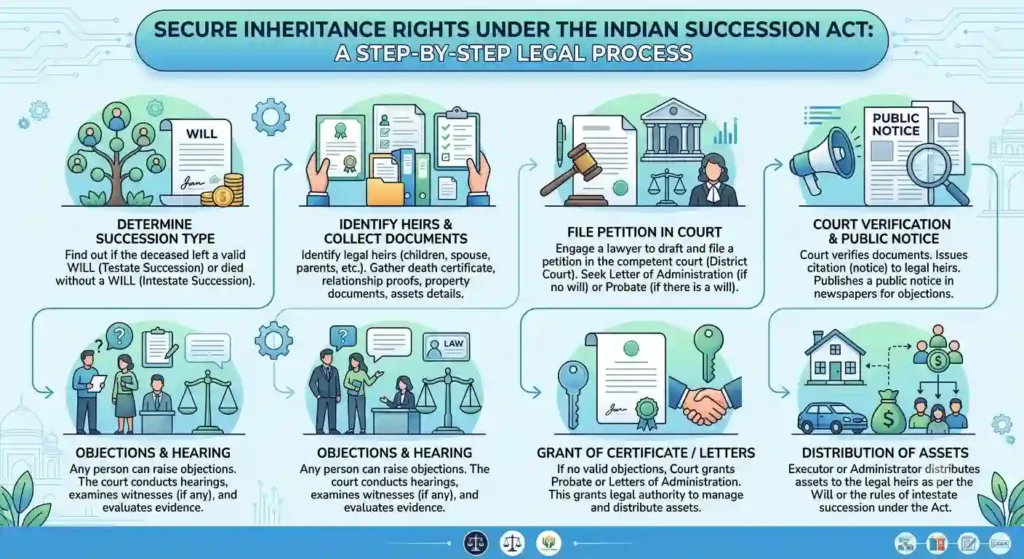
Secure Inheritance Rights – The Indian Succession Act, 1925 governs testamentary succession for specified communities and legal situations across India. Lawful inheritance protects beneficiaries, legal heirs, executors, and family members from avoidable disputes. Moreover, proper succession planning preserves family assets and reduces prolonged litigation. Courts regularly examine wills, succession certificates, probate petitions, and estate administration records. Legal guidance helps individuals understand statutory rights before property transfers occur. Beneficiaries should maintain ownership documents, identity records, and financial statements carefully. Consequently, inheritance claims become stronger before competent courts. Important authorities include Civil Courts, Family Courts where applicable, Revenue Departments, Registration Departments, Municipal Authorities, and Sub-Registrar Offices. Appeals may proceed before District Courts, High Courts, and the Supreme Court. Additionally, CPC governs civil procedures relating to succession disputes. Criminal acts involving forged wills, fabricated evidence, or criminal intimidation may attract BNS, BNSS, and BSA provisions. Nearby police stations become relevant whenever cognizable offences accompany inheritance disputes.
Secure Inheritance Rights Under the Indian Succession Act – Legacy Family Court Law Firm
Who Can Claim Inheritance Under the Indian Succession Act
Eligible beneficiaries may claim inheritance according to statutory provisions, valid wills, or lawful succession principles. Individuals should verify applicable personal laws before initiating legal proceedings. Furthermore, executors must administer estates according to testamentary intentions and judicial directions. Beneficiaries should preserve wills, death certificates, title deeds, and financial records. Professional legal advice minimizes procedural mistakes during succession proceedings. Courts examine documentary evidence carefully before granting relief. Consequently, organized documentation strengthens legitimate inheritance claims. Family members should identify all movable and immovable assets before initiating succession proceedings. Timely legal action prevents unauthorized transfers and fraudulent claims. Professional advocates also evaluate testamentary validity before commencing litigation. Proper succession planning reduces uncertainty while protecting family wealth. Effective legal representation improves outcomes before civil courts and appellate forums.
Persons Commonly Involved
- Legal heirs
- Beneficiaries
- Executors
- Administrators
- Surviving spouse
- Children
- Parents
- Other eligible relatives
Legal Framework Governing Succession and Estate Administration
Statutory Provisions and Judicial Oversight
The Indian Succession Act, 1925 establishes comprehensive rules governing testamentary succession and estate administration. CPC regulates civil proceedings involving succession disputes and probate matters. Furthermore, the Indian Evidence framework under BSA supports proof of wills and documentary evidence. Courts evaluate testamentary capacity, execution, attestation, and surrounding circumstances carefully. Legal practitioners review statutory requirements before initiating succession proceedings. Proper documentation significantly strengthens claims during contested litigation. District Courts commonly exercise jurisdiction over probate and succession matters. Thereafter, High Courts hear appeals according to statutory provisions. The Supreme Court resolves substantial legal questions whenever appropriate. Criminal allegations involving forged wills, fabricated evidence, criminal breach of trust, or intimidation may additionally attract BNS and BNSS procedures. Therefore, professional legal advice remains essential throughout inheritance proceedings.
| Legal Provision | Purpose | Competent Authority |
|---|---|---|
| Indian Succession Act, 1925 | Inheritance and estate administration | Civil Court |
| CPC | Civil procedure | Civil Courts |
| BSA | Documentary evidence | Trial Court |
| BNS & BNSS | Criminal offences, if applicable | Criminal Courts |
Essential Documents for Protecting Inheritance Rights
Strong documentation forms the foundation of successful inheritance claims. Beneficiaries should collect every relevant document before initiating legal proceedings. Moreover, original wills, death certificates, property records, bank statements, and identity documents require careful preservation. Registration records frequently strengthen ownership claims before courts. Revenue documents also establish valuable evidence regarding immovable properties. Legal professionals verify document authenticity before filing petitions. Consequently, procedural delays reduce significantly during litigation. Families should maintain digital copies alongside original records whenever possible. Financial asset statements support succession involving bank accounts, securities, and investments. Executors should preserve correspondence concerning estate administration. Proper documentation protects beneficiaries against fraudulent claims and unauthorized transfers. Organized records ultimately improve legal certainty while supporting efficient estate administration before competent authorities.
Important Estate Documents
- Original Will
- Death Certificate
- Property Title Deeds
- Encumbrance Certificate
- Identity Proof
- Bank Statements
- Revenue Records
- Family Relationship Documents
Common Inheritance Disputes and Legal Risks
Frequent Legal Issues Affecting Beneficiaries
Inheritance disputes frequently arise because of unclear wills, family disagreements, or disputed property ownership. Some beneficiaries challenge testamentary capacity or allege undue influence. Furthermore, forged documents often create prolonged civil and criminal litigation. Unauthorized property transfers may also threaten lawful inheritance rights. Professional legal reviews identify weaknesses before disputes escalate. Courts carefully examine documentary evidence, witness testimony, and statutory compliance. Consequently, legitimate beneficiaries strengthen their legal positions through timely action. Family settlements occasionally resolve disputes without prolonged litigation. Nevertheless, judicial intervention remains necessary whenever settlement efforts fail. Experienced advocates prepare effective pleadings supported by reliable evidence. Early legal advice reduces procedural complications while protecting valuable family assets. Consistent legal strategy ultimately safeguards inheritance rights before Civil Courts, High Courts, and the Supreme Court.
Common Succession Disputes
- Contested wills
- Probate disputes
- Succession certificate disputes
- Executor misconduct
- Property ownership conflicts
- Forged testamentary documents
- Estate administration disputes
- Illegal property transfers
Estate Administration and Legal Remedies
Probate, Succession Certificate, and Letters of Administration
Probate confirms the legal validity of a will through competent judicial proceedings. A succession certificate generally assists heirs claiming debts and securities of the deceased. Moreover, Letters of Administration authorize estate management when no executor exists or circumstances require judicial appointment. Beneficiaries should determine the correct legal remedy before filing proceedings. Professional legal advice reduces procedural errors and unnecessary delays. Courts examine testamentary documents, witness statements, and statutory compliance carefully. Consequently, complete documentation improves prospects for favorable orders. Executors should perform fiduciary duties honestly while protecting estate assets. Beneficiaries may challenge irregular administration through appropriate legal proceedings. Proper estate management also minimizes future disputes among legal heirs. Early legal intervention protects inheritance rights while ensuring efficient administration before competent civil courts.
Family Settlements and Alternative Dispute Resolution
Family settlements frequently resolve inheritance disputes without prolonged courtroom litigation. Parties should negotiate transparently while preserving lawful inheritance rights. Furthermore, professionally drafted settlement deeds reduce future disagreements regarding family properties. Mediation also promotes practical solutions while preserving family relationships. Legal advisors evaluate settlement terms before execution to ensure enforceability. Every beneficiary should understand legal consequences before signing any document. Consequently, informed decisions reduce unnecessary litigation costs. Registered settlement deeds generally provide stronger evidentiary value during future disputes. Families should preserve settlement records alongside ownership documents. Courts often recognize voluntary settlements satisfying legal requirements. Professional legal assistance ensures equitable distribution while preventing procedural irregularities. Effective settlements ultimately safeguard family harmony and valuable estate assets.
| Dispute Resolution Method | Purpose | Authority |
|---|---|---|
| Probate Petition | Validate Will | District Court |
| Succession Certificate | Claim debts and securities | Civil Court |
| Family Settlement | Resolve disputes amicably | Parties with Legal Counsel |
| Mediation | Avoid litigation | Court-Annexed Mediation Centre |
| Appeal | Challenge orders | High Court |
Civil Court Proceedings for Inheritance Disputes
Civil courts decide contested inheritance disputes according to statutory provisions and documentary evidence. Plaintiffs should file properly drafted pleadings supported by relevant records. Moreover, defendants receive opportunities to present written statements and supporting evidence. CPC governs procedural aspects throughout civil litigation. Courts examine witnesses, documents, and expert opinions before delivering judgments. Consequently, organized legal preparation strengthens every party’s position. Experienced advocates also identify procedural defects affecting disputed claims. Interim injunctions may prevent unauthorized property transfers during litigation. Parties should comply with every judicial direction throughout proceedings. Appeals remain available against adverse judgments before competent appellate courts. Professional representation improves litigation strategy while protecting lawful inheritance interests. Timely legal action ultimately secures effective judicial remedies under applicable succession laws.
Judicial Remedies and Professional Legal Representation
Protecting Beneficiaries Through Timely Legal Action
Beneficiaries should seek legal advice immediately after discovering threats to inheritance rights. Early intervention prevents unauthorized transfers and destruction of valuable evidence. Furthermore, professional advocates evaluate wills, property documents, and succession records comprehensively. Prompt legal notices often discourage unlawful possession or fraudulent transactions. Courts also grant interim relief where statutory requirements exist. Consequently, beneficiaries preserve valuable estate assets during pending litigation. Legal professionals prepare probate petitions, succession certificate applications, partition suits, and declaratory proceedings carefully. Documentary evidence remains essential for every inheritance claim. Organized legal strategies reduce procedural delays significantly. Every beneficiary should monitor limitation periods before commencing legal proceedings. Effective representation ultimately protects lawful inheritance rights before District Courts, High Courts, and the Supreme Court.
Courts, Authorities, and Government Departments in Succession Matters
Inheritance matters involve several statutory authorities and judicial forums depending upon dispute nature. Civil Courts exercise jurisdiction over probate, succession certificates, partition suits, and declaratory relief. District Courts commonly decide testamentary proceedings under the Indian Succession Act. High Courts hear statutory appeals and constitutional matters wherever maintainable. The Supreme Court determines substantial legal questions arising from inheritance litigation. Revenue Departments update land records following lawful succession. Registration Departments record property transfers supported by valid legal documents. Municipal authorities may process ownership mutations for urban properties. Additionally, Sub-Registrar Offices maintain registered wills and conveyance records where applicable. BNS, BNSS, and BSA provisions may apply when forged wills, fabricated evidence, criminal intimidation, cheating, or criminal breach of trust accompany succession disputes.
Strategic Legal Support for Inheritance Protection
Preventive Estate Planning and Inheritance Risk Management
Preventive legal planning secures inheritance rights before disputes arise. Families should prepare legally valid wills reflecting clear intentions and lawful asset distribution. Moreover, periodic legal reviews ensure testamentary documents remain consistent with changing family circumstances. Proper nomination, registration, and documentation reduce future litigation risks. Executors should understand fiduciary obligations before accepting responsibilities. Consequently, beneficiaries receive stronger legal protection during estate administration. Professional legal audits identify defects affecting wills, trusts, nominations, and property records. Families should preserve original documents within secure locations while maintaining authenticated copies. Regular title verification further strengthens ownership certainty. Legal professionals also advise on tax implications, partition arrangements, and succession planning. Continuous compliance with statutory requirements promotes smooth inheritance. Effective estate planning ultimately protects family wealth while minimizing disputes before competent judicial authorities.
Why Legacy Family Court Law Firm Is the Right Choice
Comprehensive Legal Assistance for Succession and Inheritance Matters
Legacy Family Court Law Firm provides dedicated legal representation for inheritance, succession, probate, partition, and estate administration matters. Experienced advocates advise clients before disputes arise and throughout litigation. Moreover, the firm evaluates wills, succession certificates, probate petitions, and property documents thoroughly. Clients receive practical legal solutions tailored to their individual circumstances. Professional drafting strengthens pleadings, settlement agreements, and testamentary documentation. The firm also represents beneficiaries before Civil Courts, District Courts, High Courts, and the Supreme Court wherever necessary. Consequently, clients protect valuable family assets through strategic legal action. Experienced lawyers coordinate with Revenue Departments, Registration Authorities, financial institutions, and local authorities during succession proceedings. Early legal intervention frequently prevents prolonged family disputes. Dedicated representation ensures lawful inheritance while safeguarding family relationships and property interests.
Frequently Asked Questions
Q1. Who can inherit property under the Indian Succession Act?
Eligible legal heirs, beneficiaries, executors, and administrators may inherit property according to valid wills or applicable succession provisions under the Act.
Q2. What is the purpose of probate?
Probate confirms a will’s legal validity and authorizes the executor to administer the deceased person’s estate according to testamentary intentions.
Q3. When is a succession certificate required?
A succession certificate generally helps legal heirs claim debts, bank deposits, securities, and other movable assets belonging to the deceased.
Q4. Can an inheritance dispute reach the High Court?
Yes. Parties may challenge appropriate civil court decisions before the High Court and, where legally permissible, before the Supreme Court.
Q5. What happens if someone forges a will?
Forgery, fabricated evidence, cheating, or criminal intimidation may attract proceedings under BNS, BNSS, BSA, and related criminal laws.
Q6. Why should beneficiaries engage an inheritance lawyer?
Experienced lawyers protect inheritance rights, prepare legal documents, represent clients before courts, negotiate settlements, and reduce litigation risks effectively.
Inheritance Protection Checklist
| Compliance Area | Recommended Action | Competent Authority |
|---|---|---|
| Valid Will | Prepare legally compliant will | Civil Court (if contested) |
| Probate | Obtain probate where required | District Court |
| Succession Certificate | Apply for debts and securities | Civil Court |
| Property Mutation | Update ownership records | Revenue Department |
| Registration | Register eligible property documents | Sub-Registrar Office |
| Appeals | Challenge adverse judgments | High Court |
| Final Appeal | Pursue statutory remedies | Supreme Court |
| Criminal Complaint | Report forgery or fraud | Jurisdictional Police Station |
Common Legal Issues
- Contested wills
- Probate disputes
- Succession certificate proceedings
- Partition suits
- Estate administration disputes
- Executor misconduct
- Property ownership conflicts
- Illegal property transfers
- Forged testamentary documents
- Family settlement disputes
- Mutation disputes
- Inheritance fraud
- Declaratory suits
- Permanent injunction proceedings
- Recovery of estate assets
Government Departments and Authorities
- Civil Courts
- District Courts
- High Courts
- Supreme Court of India
- Revenue Department
- Registration Department
- Sub-Registrar Office
- Municipal Authorities
- Local Revenue Officials
- Jurisdictional Police Station (where criminal offences arise)
Legal Remedies Available
- Probate petition.
- Succession certificate application.
- Letters of Administration.
- Partition suit.
- Declaration of ownership.
- Permanent injunction.
- Family settlement.
- Mediation proceedings.
- Appeals before higher courts.
- Criminal proceedings under BNS, BNSS, and BSA where forgery, fraud, or intimidation exists.
Conclusion
Securing inheritance rights requires timely legal planning, valid testamentary documentation, and effective judicial representation. Beneficiaries should preserve essential records, verify property ownership, and obtain professional legal advice before disputes escalate. Legacy Family Court Law Firm provides comprehensive legal support for probate, succession certificates, partition suits, estate administration, family settlements, and appellate proceedings, helping individuals and families protect lawful inheritance rights under the Indian Succession Act while ensuring efficient resolution before competent courts and authorities.
Read More
- Expert Legal Help for Domestic Violence Under the DV Act
- Resolve Family Disputes with the Family Courts Act
- Fight for Fair Alimony Under the Hindu Marriage Act
- Secure Child Visitation Rights Under the Guardians and Wards Act
- Comprehensive Legal Help for Divorce Under the Indian Divorce Act
- Department of Justice