

Expert Legal Help for Domestic Violence – Domestic violence remains a serious family law issue affecting women across India. Legacy Family Court Law Firm provides legal assistance for victims seeking protection under the Protection of Women from Domestic Violence Act, 2005. Moreover, domestic violence includes physical, emotional, verbal, sexual, and economic abuse. Additionally, victims can approach Magistrate Courts for immediate protection orders and financial relief. Therefore, legal guidance helps survivors understand their rights and available remedies. Lawyers assist with complaint preparation, evidence collection, and court representation. Furthermore, cases may involve police stations, Protection Officers, Family Courts, and High Courts. The Bharatiya Nagarik Suraksha Sanhita (BNSS) guides criminal procedures after the replacement of CrPC. Hence, professional legal support helps victims secure safety, dignity, and lawful protection.
Expert Legal Help for Domestic Violence Under the DV Act – Legacy Family Court Law Firm
Types of Domestic Violence Legal Issues Handled by Lawyers
Domestic violence cases involve different forms of abuse requiring proper legal assessment. Moreover, advocates analyse facts before selecting suitable remedies under applicable laws. Common domestic violence issues include:
- Physical assault and cruelty by family members.
- Emotional harassment and mental abuse.
- Dowry-related harassment and financial control.
- Threats, intimidation, and stalking.
- Denial of maintenance and basic necessities.
- Child-related safety concerns.
Additionally, lawyers help victims prepare applications under the DV Act before competent Magistrate Courts. Furthermore, legal professionals coordinate with Protection Officers and government authorities. Therefore, timely legal action can prevent further harm. Victims may also seek criminal remedies under relevant BNS provisions. Consequently, understanding available legal options strengthens protection strategies. Legal consultation ensures that victims receive appropriate support based on individual circumstances.
Domestic Violence Act 2005 and Court Procedures
Rights Available Under Protection of Women from Domestic Violence Act
The Domestic Violence Act provides multiple protections for women facing abuse within domestic relationships. Moreover, the law recognises physical, sexual, verbal, emotional, and economic abuse. Victims can request several reliefs through Magistrate Courts. Additionally, courts may grant orders protecting victims from further harassment. Important remedies include:
| Legal Remedy | Purpose |
|---|---|
| Protection Order | Prevent further violence or contact |
| Residence Order | Protect residence rights |
| Monetary Relief | Provide financial assistance |
| Custody Order | Protect children temporarily |
| Compensation Order | Address mental injury and suffering |
Furthermore, lawyers assist with filing applications, preparing documents, and presenting arguments. Therefore, proper legal representation improves the effectiveness of proceedings. Additionally, evidence under the Bharatiya Sakshya Adhiniyam (BSA) supports claims through documents and witness statements. Hence, victims receive structured legal protection through judicial remedies.
Filing Domestic Violence Complaints Before Appropriate Authorities
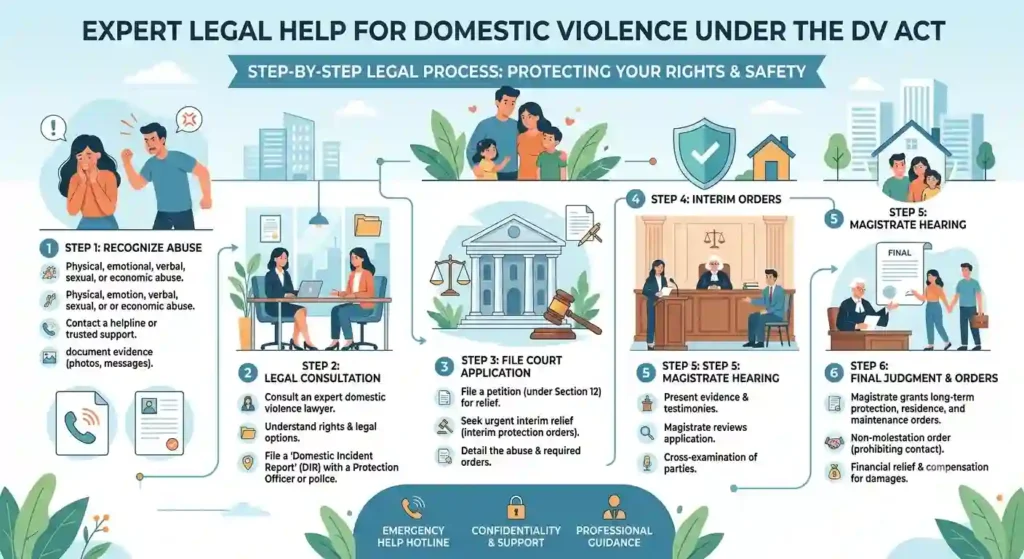
Domestic violence complaints require proper filing before authorised authorities. Moreover, victims can approach Protection Officers, police stations, or Magistrate Courts. Additionally, emergency situations may require immediate police assistance. The complaint process generally involves:
- Recording details of domestic violence incidents.
- Collecting medical and documentary evidence.
- Preparing DV Act applications.
- Filing petitions before Magistrate Courts.
- Attending hearings with legal representation.
Furthermore, advocates help victims understand jurisdiction requirements. Therefore, correct filing prevents unnecessary delays in legal proceedings. Additionally, police authorities may register criminal complaints involving serious offences. The BNSS provides procedures for investigation and criminal action. Hence, legal assistance ensures protection of victim rights during every stage. Consequently, professional support becomes important in complex domestic disputes.
Legal Forums and Remedies for Domestic Violence Cases
Court Jurisdiction and Family Law Proceedings
Role of Magistrate Courts and Family Courts
Domestic Violence Cases Before Indian Courts
Magistrate Courts hold authority to decide applications filed under the Domestic Violence Act. Moreover, Family Courts address connected matrimonial disputes involving marriage, maintenance, and custody issues. Additionally, High Courts hear appeals and constitutional challenges. Legal professionals represent clients before different judicial forums. Important forums include:
- Magistrate Courts under DV Act provisions.
- Family Courts for matrimonial disputes.
- High Courts for appeals and writ remedies.
- Supreme Court for significant legal issues.
Furthermore, courts consider evidence, relationship status, and circumstances while granting reliefs. Therefore, proper legal strategy helps parties present their cases effectively. Additionally, lawyers assist with interim applications for urgent protection. The Code of Civil Procedure (CPC) may guide certain civil proceedings. Hence, experienced advocates help clients navigate multiple legal processes. Consequently, judicial remedies provide protection and dispute resolution.
Police Support and Criminal Remedies in Domestic Violence Cases
Police authorities play an important role in domestic violence complaints involving criminal offences. Moreover, victims can approach nearby police stations for immediate assistance. Additionally, police investigate offences according to BNSS procedures. Criminal remedies may include:
- Filing criminal complaints for applicable offences.
- Requesting investigation by police authorities.
- Producing evidence before courts.
- Seeking prosecution against offenders.
- Obtaining protective judicial directions.
Furthermore, lawyers coordinate with police officers and prosecutors during proceedings. Therefore, legal support ensures proper handling of criminal complaints. Additionally, evidence collection remains essential for successful prosecution. The BSA provides rules regarding admissibility and evaluation of evidence. Hence, professional guidance protects victims from procedural difficulties. Consequently, victims can pursue both civil and criminal remedies under Indian law.
Domestic Violence Remedies, Maintenance and Child Protection
Financial and Residential Relief Under DV Act
Legal Assistance for Maintenance and Monetary Claims
Securing Financial Rights of Domestic Violence Victims
Domestic violence often creates financial insecurity for affected women and children. Moreover, the Domestic Violence Act provides monetary relief for necessary expenses and losses. Victims may seek maintenance, medical expenses, and financial support through Magistrate Courts. Additionally, lawyers assist clients in preparing income details, expense records, and supporting evidence. Courts consider the financial position of both parties before granting relief. Important financial remedies include:
- Monthly maintenance assistance.
- Medical treatment expenses.
- Loss of earnings compensation.
- Household expense support.
- Compensation for emotional suffering.
Furthermore, advocates coordinate maintenance claims with matrimonial proceedings. Therefore, victims receive guidance regarding suitable legal strategies. Additionally, CPC principles may support certain civil recovery proceedings. Lawyers also examine related maintenance provisions under applicable family laws. Hence, professional representation helps secure fair financial protection. Consequently, legal remedies support victims seeking stability after domestic abuse situations.
Residence Rights and Protection Orders Under DV Act
The right to residence provides important protection for women facing domestic violence. Moreover, the DV Act protects women from unlawful eviction from shared households. Additionally, courts may issue residence orders to ensure housing security. Legal assistance helps victims establish their residence rights through proper documentation. The remedies include:
| Order Type | Legal Protection |
|---|---|
| Residence Order | Prevents unlawful removal |
| Protection Order | Restricts abusive behaviour |
| Interim Order | Provides urgent temporary relief |
| Police Assistance | Ensures enforcement support |
Furthermore, lawyers prepare petitions requesting immediate judicial protection. Therefore, victims can approach courts without unnecessary delay. Additionally, advocates assist during enforcement proceedings when respondents violate court orders. The BNSS supports procedures for criminal consequences where applicable. Hence, legal representation strengthens enforcement of DV Act protections. Consequently, residence remedies provide safety and dignity to affected individuals.
Child Custody and Family Dispute Resolution
Domestic Violence Impact on Children and Guardianship
Child Custody Protection in Domestic Violence Cases
Domestic violence disputes often affect children living within abusive households. Moreover, courts prioritise child welfare while deciding custody-related issues. Additionally, Magistrate Courts may grant temporary custody orders under the DV Act. Lawyers assist parents in presenting safety concerns and supporting evidence. Child-related legal issues include:
- Temporary custody applications.
- Child visitation arrangements.
- Protection from abusive environments.
- School and medical welfare concerns.
- Long-term guardianship disputes.
Furthermore, Family Courts examine parental capabilities and child interests. Therefore, legal representation helps protect children during family disputes. Additionally, courts may modify arrangements based on changing circumstances. The Guardians and Wards Act principles may influence custody decisions. Hence, advocates provide comprehensive assistance in custody-related matters. Consequently, child protection remains a significant part of domestic violence litigation.
Mediation and Settlement Support in Family Disputes
Family disputes involving domestic violence sometimes require careful dispute resolution approaches. Moreover, courts may encourage mediation where appropriate and safe. However, serious abuse cases require priority protection measures. Legal professionals evaluate whether settlement discussions benefit clients. Mediation support includes:
- Negotiating practical solutions.
- Protecting legal rights.
- Discussing maintenance arrangements.
- Resolving communication issues.
- Developing parenting agreements.
Furthermore, Family Courts often provide counselling and mediation facilities. Therefore, professional legal advice remains essential before accepting settlements. Additionally, lawyers ensure agreements protect long-term interests. Victims should understand available remedies before making decisions. Hence, balanced legal guidance supports informed choices. Consequently, mediation can assist suitable cases while maintaining victim safety.
Special Legal Support for NRI Domestic Violence Cases
Domestic Violence Issues Involving Overseas Families
Legal Representation for NRIs and Cross-Border Family Matters
Handling International Domestic Violence Disputes
Domestic violence cases involving Non-Resident Indians require specialised legal attention. Moreover, cross-border family disputes involve additional jurisdiction and enforcement challenges. NRIs may require assistance with Indian court proceedings, property issues, and family disputes. Additionally, lawyers coordinate documentation and representation requirements. Common NRI domestic violence issues include:
- Abuse by overseas spouses.
- Matrimonial disputes involving Indian citizens.
- Maintenance claims across countries.
- Child custody conflicts.
- Return or relocation disputes.
Furthermore, advocates assist NRIs through authorised representation where legally permitted. Therefore, clients can address proceedings without unnecessary travel difficulties. Additionally, lawyers analyse applicable Indian laws and international considerations. The Supreme Court and High Courts have considered several NRI matrimonial disputes. Hence, professional guidance helps manage complex jurisdictional issues. Consequently, effective legal support protects family rights across borders.
Government Departments and Legal Aid Resources
Government authorities provide assistance mechanisms for domestic violence victims. Moreover, legal aid services support eligible individuals requiring representation. Important departments and resources include:
| Authority | Assistance Provided |
|---|---|
| Ministry of Women and Child Development | Women welfare programmes |
| State Legal Services Authority | Free legal aid services |
| District Legal Services Authority | Local legal assistance |
| Police Department | Complaint registration and protection |
| Family Courts | Matrimonial dispute resolution |
Furthermore, Protection Officers assist victims under the DV Act framework. Therefore, coordination with authorities improves access to justice. Additionally, lawyers guide clients regarding available government support systems. Legal awareness helps victims make timely decisions. Hence, professional assistance connects individuals with appropriate remedies. Consequently, government resources and legal representation work together for effective protection.
Advanced Domestic Violence Litigation and Legal Protection Strategies
Latest Legal Developments and Court Remedies
BNS, BNSS and BSA Impact on Domestic Violence Cases
Updated Criminal Law Support for Victims
Indian criminal laws underwent major changes after implementation of the Bharatiya Nyaya Sanhita, Bharatiya Nagarik Suraksha Sanhita, and Bharatiya Sakshya Adhiniyam. Moreover, these laws replaced the earlier IPC, CrPC, and Evidence Act framework. Domestic violence-related criminal complaints now follow updated investigation and evidence procedures. Additionally, lawyers analyse applicable BNS provisions while preparing criminal strategies. Important legal support areas include:
- Criminal complaint preparation.
- Police investigation assistance.
- Evidence collection guidance.
- Court representation.
- Appeal and revision proceedings.
Furthermore, BNSS procedures regulate investigation timelines and court processes. Therefore, victims and respondents require updated legal advice. Additionally, BSA provisions influence documentary and digital evidence presentation. Lawyers examine messages, medical records, photographs, and witness statements. Hence, proper evidence management strengthens domestic violence proceedings. Consequently, updated criminal law knowledge helps achieve effective legal outcomes.
Domestic Violence Evidence Collection and Court Presentation
Evidence plays an important role in domestic violence litigation before courts. Moreover, successful cases require proper documentation of abuse incidents. Lawyers assist clients in collecting relevant materials legally. Evidence may include:
- Medical examination records.
- Police complaints and reports.
- Communication records.
- Financial documents.
- Witness statements.
- Digital evidence.
Furthermore, the Bharatiya Sakshya Adhiniyam provides rules regarding admissibility of evidence. Therefore, proper presentation improves the credibility of legal claims. Additionally, advocates prepare affidavits, petitions, and written submissions. Courts evaluate evidence before granting protection or compensation orders. Hence, legal professionals ensure complete documentation throughout proceedings. Consequently, organised evidence management supports stronger domestic violence cases.
Legal Services Offered by Legacy Family Court Law Firm
Complete Domestic Violence Legal Assistance
Family Court Advocates for Domestic Violence Protection
Professional Representation for Victims and Families
Legacy Family Court Law Firm provides comprehensive legal assistance for domestic violence disputes. Moreover, experienced advocates handle protection applications, maintenance claims, custody matters, and related litigation. The firm supports clients through every stage of legal proceedings. Services include:
| Legal Service | Assistance Provided |
|---|---|
| DV Act Cases | Filing and representation |
| Maintenance Matters | Financial relief claims |
| Custody Issues | Child protection proceedings |
| Criminal Complaints | Police and court assistance |
| Appeals | Higher court representation |
Furthermore, lawyers analyse facts and recommend suitable legal remedies. Therefore, clients receive personalised strategies for complex family disputes. Additionally, the firm assists with documentation, negotiations, and hearings. Legal support focuses on protecting dignity, safety, and lawful rights. Hence, professional guidance helps clients navigate emotional and legal challenges. Consequently, Legacy Family Court Law Firm provides reliable representation in domestic violence matters.
Why Choose Experienced Domestic Violence Lawyers
Domestic violence cases involve emotional stress and complicated legal procedures. Moreover, professional legal assistance helps clients understand available options clearly. Experienced advocates provide strategic support before courts and authorities. Key benefits include:
- Understanding DV Act procedures.
- Preparing accurate legal documents.
- Representing clients before courts.
- Coordinating with government authorities.
- Protecting confidential information.
Furthermore, lawyers evaluate each case according to facts and applicable laws. Therefore, clients receive practical solutions rather than general advice. Additionally, legal professionals remain updated with BNS, BNSS, BSA, and family law developments. Hence, effective representation improves confidence during proceedings. Consequently, choosing experienced advocates helps secure appropriate domestic violence remedies.
Domestic Violence Legal Remedies and Support Guide
Practical Steps After Facing Domestic Violence
Immediate Legal Actions for Victims
Protecting Safety Through Legal Intervention
Victims facing domestic violence should consider immediate protective steps. Moreover, timely action can prevent escalation of abuse. Legal professionals recommend practical measures based on individual circumstances. Important steps include:
- Contacting emergency services when necessary.
- Reporting incidents to police stations.
- Seeking medical assistance after injuries.
- Consulting family law advocates.
- Filing DV Act applications.
Furthermore, victims should preserve available evidence safely. Therefore, documentation supports future legal proceedings. Additionally, lawyers help select appropriate forums and remedies. Courts provide protection through various orders under the DV Act. Hence, immediate legal guidance protects personal safety and legal interests. Consequently, informed action improves access to justice.
Long-Term Legal Protection and Family Dispute Resolution
Domestic violence cases require both immediate relief and long-term legal planning. Moreover, lawyers assist clients in resolving connected family disputes. Long-term solutions may involve:
- Maintenance arrangements.
- Divorce proceedings.
- Child custody protection.
- Property rights advice.
- Settlement negotiations.
Furthermore, Family Courts address many related matrimonial issues. Therefore, comprehensive legal planning avoids repeated disputes. Additionally, advocates review future risks and available remedies. Clients receive guidance regarding litigation, mediation, and appeals. Hence, experienced family law support provides stability after domestic violence incidents. Consequently, legal assistance helps families achieve safer and legally protected outcomes.
Frequently Asked Questions (FAQs)
1. What protection does the DV Act provide to women?
The DV Act provides protection orders, residence rights, monetary relief, custody support, and compensation remedies for women facing domestic violence.
2. Where can a domestic violence complaint be filed in India?
Victims can approach police stations, Protection Officers, or Magistrate Courts having jurisdiction over the domestic violence matter.
3. Can domestic violence cases include emotional and economic abuse?
Yes, the DV Act recognises physical, emotional, verbal, sexual, and economic abuse as forms of domestic violence.
4. Can NRIs file domestic violence cases in India?
Yes, NRIs can seek legal remedies in India when Indian laws apply to their matrimonial or domestic disputes.
5. What evidence supports domestic violence cases?
Medical records, messages, photographs, financial documents, complaints, and witness statements can support domestic violence claims.
6. Can lawyers help with DV Act and criminal proceedings together?
Yes, lawyers can assist with DV Act applications, criminal complaints, police procedures, and court representation simultaneously.
Read More
- Resolve Family Disputes with the Family Courts Act
- Fight for Fair Alimony Under the Hindu Marriage Act
- Secure Child Visitation Rights Under the Guardians and Wards Act
- Comprehensive Legal Help for Divorce Under the Indian Divorce Act
- Guardianship and Adoption Legal Help Under the Hindu Adoption and Maintenance Act
- Ministry of Women and Child Development (MWCD), Government of India