
Guardianship and Adoption Legal – Guardianship and adoption secure a child’s welfare while protecting legal rights of families and children. Legacy Family Court Law Firm provides comprehensive legal assistance under the Hindu Adoption and Maintenance Act, 1956, Guardians and Wards Act, 1890, Juvenile Justice (Care and Protection of Children) Act, 2015, CPC, BNS, BNSS, and BSA. Our advocates advise parents, guardians, relatives, adoptive families, NRIs, and blended families across India. Moreover, proper legal guidance prevents future inheritance disputes, custody conflicts, and procedural challenges. Every adoption demands statutory compliance, documentary verification, and judicial approval wherever applicable. Our legal team drafts petitions, verifies eligibility, prepares evidence, and represents clients before Family Courts, District Courts, High Courts, and the Supreme Court. Timely legal support ensures lawful and secure family relationships.
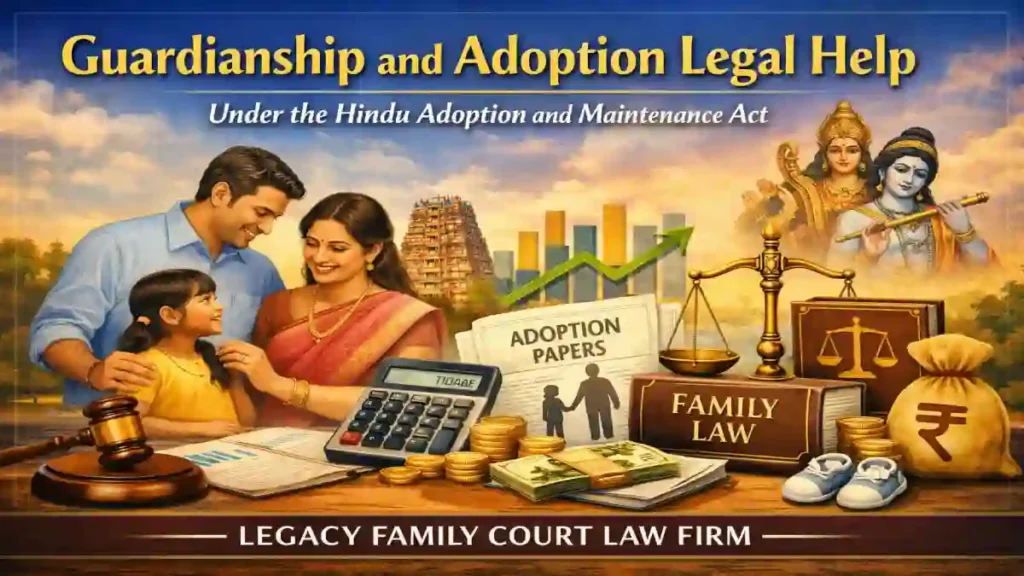
Guardianship and Adoption Legal Help Under the Hindu Adoption and Maintenance Act – Legacy Family Court Law Firm
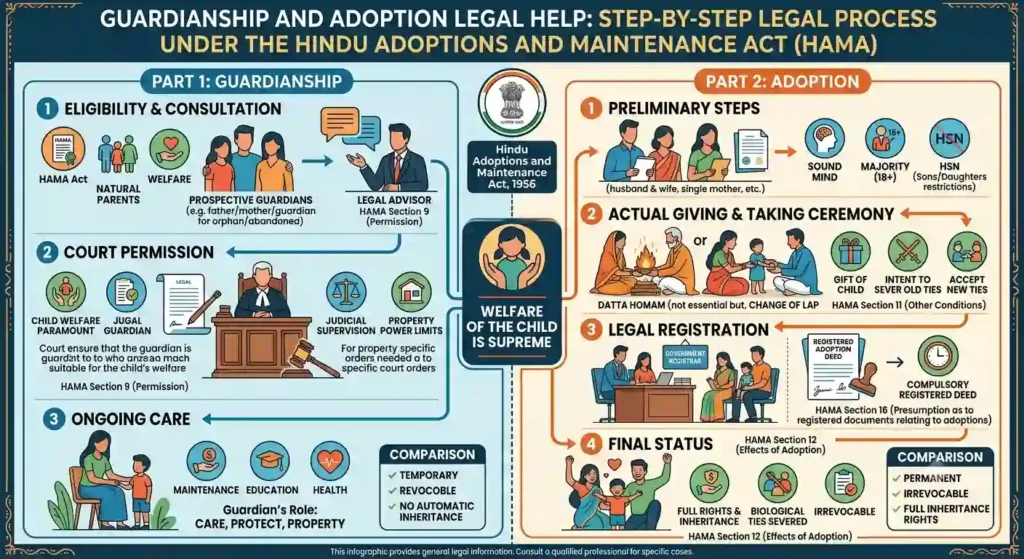
Eligibility and Legal Requirements for Adoption
The Hindu Adoption and Maintenance Act prescribes specific eligibility conditions for valid adoption. Therefore, prospective adoptive parents should understand statutory requirements before initiating proceedings. Married couples, single individuals, widows, widowers, and divorcees may qualify subject to legal conditions. Capacity, consent, age differences, and adoptable child eligibility require careful examination. Adoption creates permanent legal relationships including inheritance rights and parental responsibilities. Legal documentation remains essential throughout every procedural stage. Our advocates verify compliance, prepare affidavits, collect supporting records, and coordinate with competent authorities. Professional legal assistance minimizes procedural objections while protecting every stakeholder’s interests during adoption proceedings.
Essential Adoption Conditions
Legal compliance strengthens adoption validity. Consequently, applicants should satisfy every statutory requirement.
Key conditions include:
- Legal capacity.
- Valid consent.
- Child eligibility.
- Proper documentation.
- Age compliance.
- Religious applicability.
Professional verification prevents future legal challenges regarding adoption validity and inheritance rights.
Documents Required for Adoption
Complete documentation supports smooth legal proceedings.
| Document | Purpose |
|---|---|
| Identity Proof | Parent verification |
| Marriage Certificate | Relationship proof |
| Birth Certificate | Child verification |
| Medical Records | Health assessment |
Proper records simplify judicial scrutiny while reducing unnecessary procedural delays.
Legal Documents Checklist
Applicants should prepare:
- Identity proof.
- Address proof.
- Income proof.
- Marriage certificate.
- Child records.
- Medical certificates.
- Consent documents.
- Court affidavits.
Accurate documentation strengthens every adoption petition before competent courts.
Guardianship Disputes and Child Welfare
Guardianship disputes frequently arise after parental death, separation, remarriage, property disputes, or family disagreements. However, courts always prioritize the child’s welfare above competing claims. Family Courts examine financial stability, emotional well-being, education, healthcare, and moral development before deciding guardianship petitions. Relatives sometimes contest guardianship regarding property administration or caregiving responsibilities. Experienced advocates prepare detailed evidence supporting the child’s best interests. Judicial intervention ensures lawful guardianship while protecting minors from exploitation. Early legal advice prevents unnecessary litigation and promotes lasting family stability.
Common Guardianship Issues
Families frequently encounter:
- Custody conflicts.
- Property management.
- Guardian appointment.
- Visitation disputes.
- Child welfare concerns.
- Inheritance disagreements.
Strategic legal representation protects children’s welfare while resolving family disputes effectively.
Legal Remedies, Courts and Professional Representation
Courts and Authorities Governing Adoption Matters
Adoption and guardianship proceedings involve multiple judicial forums and statutory authorities. Accordingly, selecting the proper jurisdiction avoids procedural complications. Family Courts hear custody and guardianship matters. District Courts decide specific guardianship petitions. High Courts exercise supervisory and writ jurisdiction. The Supreme Court hears constitutional and appellate matters. Child Welfare Committees, District Child Protection Units, and Central Adoption Resource Authority supervise statutory adoption procedures. Proper legal guidance ensures compliance before every competent authority while safeguarding children’s legal interests.
Legal Remedies for Guardianship and Adoption Disputes
Several statutory remedies protect children and families during guardianship or adoption disputes. Therefore, immediate legal action preserves valuable rights. Aggrieved parties may file guardianship petitions, custody applications, visitation petitions, declaratory suits, appeals, or writ petitions depending upon circumstances. Courts may modify guardianship orders whenever children’s welfare requires intervention. Mediation often resolves family disputes without prolonged litigation. Skilled advocates prepare pleadings, documentary evidence, witness examinations, and appellate submissions. Comprehensive legal representation strengthens every stage of judicial proceedings while protecting children’s long-term interests.
Available Legal Remedies
Appropriate remedies include:
- Guardianship petition.
- Adoption petition.
- Custody application.
- Visitation rights.
- Appeal.
- Writ petition.
Timely legal action significantly improves successful resolution before competent judicial forums.
Criminal Protection and Child Safety Laws
Illegal adoption practices, child trafficking, forged documents, and child exploitation attract serious criminal consequences. Consequently, authorities investigate such offences under applicable legislation. The Bharatiya Nyaya Sanhita, 2023, Bharatiya Nagarik Suraksha Sanhita, 2023, Bharatiya Sakshya Adhiniyam, 2023, and Juvenile Justice Act govern investigation, prosecution, and evidentiary procedures wherever applicable. Police stations having territorial jurisdiction register criminal complaints involving child-related offences. Courts carefully examine documentary evidence, witness testimony, and expert reports. Immediate legal representation protects victims while ensuring lawful investigation and prosecution against offenders.
Why Choose Legacy Family Court Law Firm
Legacy Family Court Law Firm delivers compassionate legal representation supported by practical family law experience. Moreover, our advocates prioritize children’s welfare while protecting parental rights. We advise biological parents, adoptive families, guardians, grandparents, single parents, and NRIs throughout every legal stage. Our services include documentation, eligibility verification, court representation, mediation, appellate advocacy, guardianship litigation, adoption compliance, and legal counselling. Transparent communication and personalized strategies strengthen every case. Professional legal support minimizes delays while ensuring lawful family relationships under applicable Indian laws.
Our Family Law Services
Legal services include:
- Adoption petitions.
- Guardianship proceedings.
- Child custody.
- Visitation rights.
- Court representation.
- Legal notices.
- Appeals.
- Mediation.
- Documentation.
- Family counselling.
Our dedicated advocacy protects children’s welfare while securing legally sustainable family relationships.
Frequently Asked Questions
1. Who can adopt under the Hindu Adoption and Maintenance Act?
Eligible Hindus, including married couples, single individuals, widows, and widowers, may adopt after satisfying statutory conditions and documentation requirements.
2. Does adoption grant inheritance rights?
Yes. A legally adopted child receives rights comparable to a biological child under applicable succession and family laws.
3. Which court handles guardianship disputes?
Family Courts or competent District Courts generally decide guardianship matters depending upon jurisdiction and statutory provisions.
4. Can NRIs adopt a child in India?
Yes. NRIs may adopt subject to applicable Indian laws, CARA regulations, eligibility conditions, and judicial procedures.
5. What happens if someone conducts an illegal adoption?
Illegal adoption may attract criminal prosecution, investigation, penalties, and judicial action under applicable child protection and criminal laws.
6. Why should families engage an adoption lawyer?
Experienced lawyers ensure statutory compliance, prepare documents, represent clients before courts, and protect children’s long-term legal interests.
Read More
- Fight for Child Support Under Section 125 CrPC
- Resolve Family Property Disputes Under the Hindu Succession Act
- Guard Your Future with Prenuptial Agreements Under Indian Law
- Protect Your Rights in Divorce Cases Under the Dissolution of Muslim Marriages Act
- Fight Domestic Abuse Under the Protection of Women from Domestic Violence Act
- Central Adoption Resource Authority (CARA) – Ministry of Women and Child Development