


Protect Your Rights in Divorce – Divorce disputes often create emotional and financial uncertainty. Therefore, legal guidance becomes essential from the beginning. The Dissolution of Muslim Marriages Act, 1939 grants Muslim women specific rights to seek divorce through competent courts. Family Courts in Chennai regularly handle matters involving maintenance, child custody, domestic violence, residence rights, and property disputes. Legal proceedings may also involve provisions under the Code of Civil Procedure, 1908, Bharatiya Nagarik Suraksha Sanhita, 2023, Bharatiya Nyaya Sanhita, 2023, and Bharatiya Sakshya Adhiniyam, 2023. Courts examine evidence, witness statements, and supporting records carefully. A well-planned legal strategy protects personal rights and family interests. Our firm assists clients before Family Courts, District Courts, mediation centres, and related authorities. Early legal action often improves outcomes. Professional representation also reduces procedural errors and delays. Consequently, parties can pursue fair remedies while preserving their legal rights throughout proceedings.
Protect Your Rights in Divorce Cases Under the Dissolution of Muslim Marriages Act – Legacy Family Court Law Firm: Chennai Divorce Experts
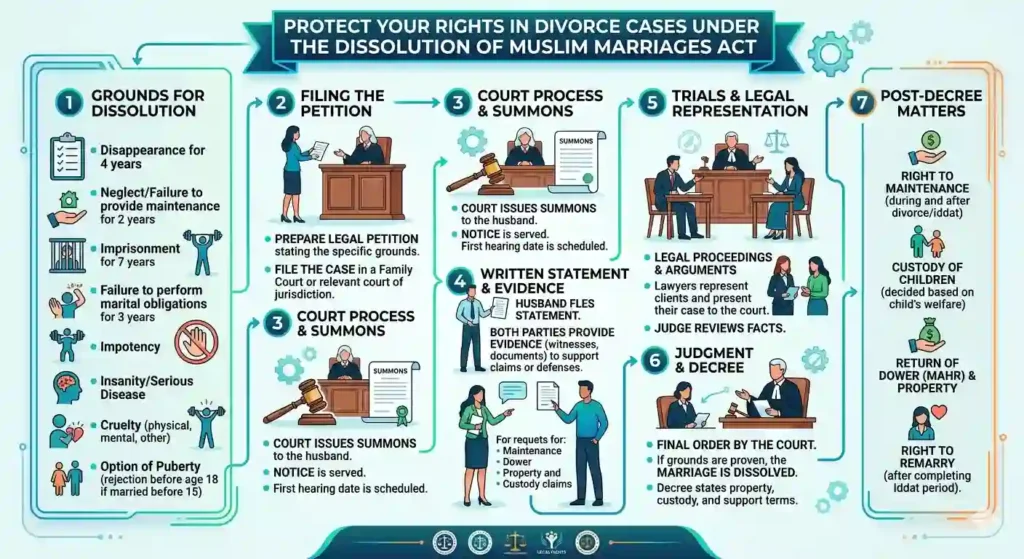
Understanding the Dissolution of Muslim Marriages Act
The Dissolution of Muslim Marriages Act provides statutory grounds for Muslim women seeking dissolution of marriage. Courts consider each case according to facts and evidence. Common grounds include desertion, cruelty, imprisonment, failure to maintain, impotence, insanity, and disappearance of the husband. Additionally, women may seek relief when marital obligations remain unfulfilled. Family Courts evaluate documents, witness testimony, and supporting records before granting relief. Proper pleadings significantly strengthen the case. Lawyers prepare petitions, affidavits, and evidence according to procedural requirements. The Act works alongside personal law principles and court procedures. Parties should understand jurisdiction before filing petitions. Chennai Family Courts possess authority over many matrimonial disputes arising within territorial limits. Therefore, obtaining legal advice at an early stage helps identify suitable remedies. Strategic case preparation often improves the chances of obtaining timely judicial relief.
Grounds Available for Divorce Relief
Several legal grounds permit dissolution under the Act. Courts assess each ground independently and examine supporting evidence carefully. Important grounds include:
- Husband missing for four years.
- Failure to provide maintenance.
- Imprisonment for a lengthy period.
- Cruel treatment by the husband.
- Mental illness affecting marital life.
- Failure to perform marital obligations.
- Impotence existing at marriage.
The petitioner must establish facts through admissible evidence. Therefore, records, communications, medical documents, and witness statements become valuable. Courts may encourage settlement discussions before trial. However, serious allegations require judicial determination. Lawyers help collect evidence lawfully and present it effectively. Proper legal drafting avoids unnecessary objections. Consequently, the court receives a clear picture of the dispute and applicable legal grounds.
Jurisdiction and Competent Courts
Jurisdiction plays a critical role in matrimonial litigation. A petition must reach the appropriate forum. Family Courts generally hear divorce, maintenance, custody, guardianship, and related matrimonial matters. Chennai litigants commonly approach Family Courts having territorial jurisdiction over residence or marriage-related connections. District Courts may handle certain ancillary proceedings where applicable. Mediation centres often assist parties before contested hearings begin. Moreover, courts encourage negotiated settlements whenever possible. Jurisdictional mistakes may cause delays and additional expenses. Therefore, legal review remains essential before filing. The court verifies residence details, marriage particulars, and supporting records. Lawyers ensure compliance with procedural requirements under applicable laws. Correct filing strengthens the case from the outset. Consequently, litigants avoid unnecessary procedural challenges and focus on obtaining substantive relief.
Evidence Required in Divorce Proceedings
Strong evidence supports successful matrimonial litigation. Courts rely upon legally admissible material while deciding disputed issues. Common evidence includes:
| Evidence Type | Purpose |
|---|---|
| Marriage Records | Prove marital relationship |
| Identity Documents | Establish parties’ details |
| Medical Records | Support health allegations |
| Financial Records | Prove maintenance issues |
| Messages and Emails | Establish conduct |
| Witness Testimony | Corroborate facts |
Additionally, evidence must satisfy standards under the Bharatiya Sakshya Adhiniyam, 2023. Electronic records require proper presentation. Lawyers assess relevance before filing documents. Courts reject unreliable material frequently. Therefore, litigants should preserve records carefully from the beginning. Organized documentation improves credibility and assists judicial evaluation. Effective evidence presentation often influences the final outcome significantly.
Key Legal Rights During Divorce Litigation
Divorce proceedings involve several rights beyond dissolution of marriage. Therefore, litigants should understand all available protections. Family Courts may consider maintenance, child welfare, residence concerns, and protection from harassment. Women facing domestic abuse may also seek remedies under applicable protective laws. Interim applications often provide urgent financial assistance during pending proceedings. Courts evaluate income, expenses, and family circumstances carefully. Legal representation helps present financial realities accurately. Furthermore, parties may seek injunctions against unlawful interference or intimidation. Police assistance may become necessary in specific circumstances involving threats or violence. Nearby police stations generally receive complaints relating to cognizable offences. Prompt action helps preserve evidence and personal safety. Consequently, litigants can protect their rights while pursuing long-term judicial remedies.
Maintenance, Custody and Financial Protection
Financial security remains a major concern after separation. Courts evaluate maintenance claims based upon needs and available resources. Child custody decisions focus primarily on welfare and best interests. Relevant considerations include education, healthcare, emotional stability, and living arrangements. Parents may also seek visitation rights and shared parenting arrangements. Additionally, courts examine income documents and expenditure records carefully. Timely disclosure strengthens credibility before the court. Financial remedies may include:
• Interim maintenance
• Permanent maintenance
• Child support
• Educational expenses
• Medical expenses
• Litigation costs
Lawyers help calculate realistic claims supported by evidence. Proper documentation assists judicial assessment substantially. Therefore, litigants should preserve salary records, bank statements, and expense proofs. Effective presentation increases the likelihood of obtaining appropriate financial relief.
Role of Mediation and Settlement
Mediation offers an opportunity to resolve disputes amicably. Family Courts frequently refer suitable cases for mediation. Neutral mediators facilitate constructive discussions between parties. Consequently, many disputes conclude without prolonged trials. Settlement may address divorce terms, maintenance, custody, visitation, and property arrangements. Parties retain greater control over outcomes during mediation. However, agreements must remain lawful and voluntary. Lawyers review proposed terms before execution. Mediation also reduces emotional strain and litigation costs. Successful settlements receive court recognition through appropriate orders. Nevertheless, contested matters proceed for judicial determination when settlement fails. Strategic participation in mediation often benefits both parties. Therefore, litigants should approach mediation with preparation and realistic expectations.
Legal Remedies Against Cruelty and Harassment
Cruelty frequently forms the basis of matrimonial litigation. Courts examine physical, emotional, verbal, and economic abuse allegations carefully. Victims may seek multiple remedies depending upon circumstances. Available legal support may include:
- Police complaints.
- Protection orders.
- Residence-related relief.
- Maintenance claims.
- Child protection measures.
- Compensation claims.
Authorities investigate allegations according to applicable law. Evidence remains essential for proving misconduct. Therefore, victims should preserve communications, photographs, medical reports, and witness details. Lawyers coordinate legal strategies across multiple proceedings when necessary. Courts prioritize safety and lawful protection measures. Consequently, timely legal intervention often prevents escalation of disputes and safeguards individual rights.
Interaction with BNS, BNSS and BSA
Modern matrimonial disputes sometimes involve criminal allegations. The Bharatiya Nyaya Sanhita, 2023 addresses several offences that may arise from marital conflicts. Investigations and procedural safeguards operate under the Bharatiya Nagarik Suraksha Sanhita, 2023. Evidence assessment follows the Bharatiya Sakshya Adhiniyam, 2023. Therefore, litigants should understand how civil and criminal proceedings interact. Family Court cases remain distinct from criminal investigations. However, facts may overlap significantly. Lawyers coordinate responses across forums to avoid inconsistencies. Proper legal advice reduces procedural risks. Courts examine each matter independently according to applicable standards. Consequently, strategic case management becomes crucial when multiple proceedings exist simultaneously.
Why Choose Legacy Family Court Law Firm
Family disputes require experience, strategy, and compassionate guidance. Legacy Family Court Law Firm assists clients across Chennai in divorce, maintenance, custody, guardianship, and matrimonial litigation. Our lawyers prepare petitions, evidence, and court submissions meticulously. Additionally, we represent clients before Family Courts, mediation centres, District Courts, and related authorities. Every case receives individualized attention and practical solutions. We focus on legal protection, procedural compliance, and timely action. Strong advocacy often improves outcomes significantly. Therefore, clients receive comprehensive support throughout litigation and settlement discussions. Our objective remains the protection of rights and long-term family interests. Professional legal guidance helps clients navigate complex proceedings confidently and effectively.
Frequently Asked Questions
FAQ 1: Can a Muslim woman file divorce without her husband’s consent?
Yes. The Dissolution of Muslim Marriages Act permits divorce through court on recognized legal grounds. Husband’s consent is not mandatory for judicial relief.
FAQ 2: Which court handles Muslim divorce cases in Chennai?
Family Courts generally handle divorce, maintenance, custody, and related matrimonial disputes. Jurisdiction depends on residence and relevant facts.
FAQ 3: Can maintenance be claimed during divorce proceedings?
Yes. Courts may grant interim and permanent maintenance after considering income, expenses, financial needs, and supporting evidence.
FAQ 4: What evidence helps prove cruelty?
Medical records, messages, emails, photographs, witness testimony, police complaints, and other relevant documents commonly support cruelty allegations.
FAQ 5: Is mediation compulsory before trial?
Many Family Courts encourage mediation first. However, unresolved disputes proceed to judicial adjudication according to applicable procedures.
FAQ 6: Can criminal complaints continue with divorce proceedings?
Yes. Criminal proceedings and Family Court cases may continue simultaneously. Courts evaluate each matter independently under applicable laws.
Read More
- Fight Domestic Abuse Under the Protection of Women from Domestic Violence Act
- Multiple FIRs in Matrimonial Disputes – Abuse of Process Explained
- Quashing Matrimonial FIRs in High Court After BNSS
- Arrest in Matrimonial Disputes – New Safeguards Under BNSS
- False Criminal Cases in Family Disputes – Legal Remedies After BNS
- Ministry of Law & Justice – Legislative Department