

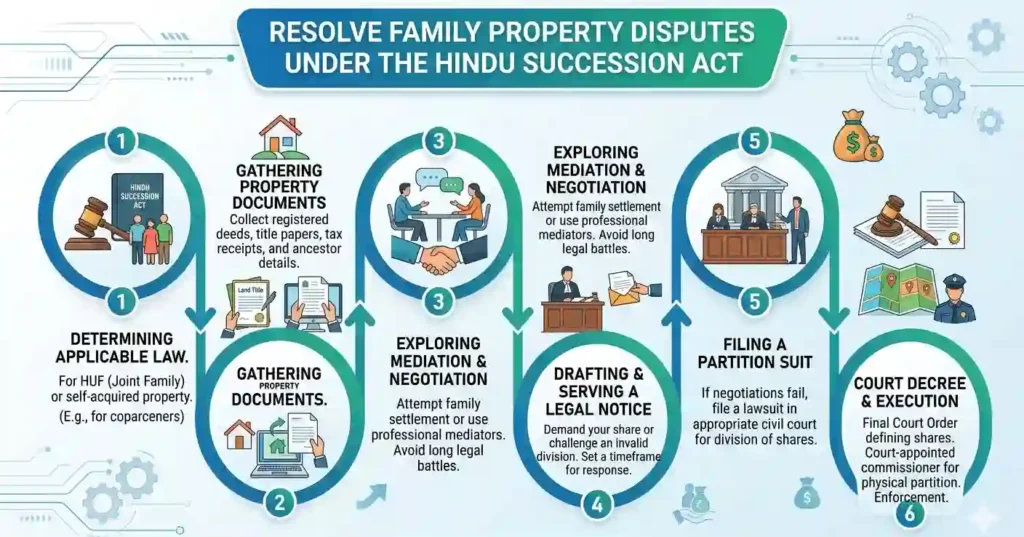
Resolve Family Property Disputes – Family property disputes often arise after the death of a property owner. Therefore, legal clarity becomes essential for protecting inheritance rights. Legacy Family Court Law Firm assists heirs, coparceners, widows, daughters, sons, and legal representatives. The Hindu Succession Act, 1956, as amended in 2005, governs succession rights among Hindus. Furthermore, daughters enjoy equal coparcenary rights in ancestral property. Courts examine title documents, revenue records, wills, and succession evidence carefully. Property disputes frequently involve partition claims, inheritance disagreements, forged documents, and unlawful possession. Legal proceedings may arise before Civil Courts, District Courts, High Courts, and appellate forums. Proper legal action prevents asset dissipation and ownership conflicts. Early legal advice often reduces prolonged litigation. Moreover, strategic representation strengthens claims and safeguards lawful entitlements. Legacy Family Court Law Firm provides comprehensive support for inheritance and succession disputes.
Resolve Family Property Disputes Under the Hindu Succession Act – Legacy Family Court Law Firm
Types of Family Property Disputes and Legal Issues
Property conflicts involve several legal and factual questions. Therefore, identifying the dispute category remains crucial. Legacy Family Court Law Firm evaluates ownership rights before initiating proceedings. Common disputes include ancestral property claims, self-acquired property succession, partition actions, and testamentary conflicts. Moreover, disputes may involve mutation records and illegal transfers. Typical legal issues include:
- Partition of ancestral property
- Daughter’s coparcenary rights
- Will validity disputes
- Succession certificate proceedings
- Legal heirship claims
- Property possession conflicts
- Fraudulent transfers
- Joint family property disputes
| Issue | Forum |
|---|---|
| Partition Suit | Civil Court |
| Probate Matter | District Court |
| Succession Certificate | Civil Court |
| Appeal | High Court |
Accurate classification helps determine jurisdiction and legal remedies. Consequently, clients receive focused and effective legal representation.
Rights of Heirs, Coparceners, and Legal Representatives
The Hindu Succession Act grants specific inheritance rights to eligible heirs. Therefore, understanding legal status becomes important. Class I heirs generally receive priority during intestate succession. Daughters, sons, widows, and mothers possess significant statutory rights. Furthermore, the 2005 amendment strengthened gender equality in ancestral property matters. Coparceners may seek partition and separate possession through competent courts. Legal representatives can continue pending proceedings after a party’s death. Courts examine documentary evidence before recognizing inheritance claims. Additionally, revenue records alone may not establish absolute ownership. Proper legal scrutiny prevents wrongful exclusion of lawful heirs. Succession disputes often involve complex family relationships and historical transactions. Consequently, experienced legal support becomes necessary for protecting inheritance interests and property rights.
Partition Suits and Property Division Remedies
Partition remains a common remedy in family property disputes. Therefore, co-owners may seek separate possession of their lawful shares. Legacy Family Court Law Firm prepares partition suits under CPC provisions. Courts determine ownership percentages through documentary and oral evidence. Furthermore, commissioners may inspect properties during proceedings. Common partition remedies include:
- Division by metes and bounds
- Separate possession orders
- Mesne profits claims
- Injunction relief
- Sale and distribution orders
Courts evaluate title deeds, genealogical records, and family settlements carefully. Additionally, mediation may resolve disputes without prolonged litigation. Proper pleadings significantly influence outcomes in partition actions. Legal representation ensures compliance with procedural requirements. Consequently, heirs can secure lawful shares through effective judicial remedies and strategic legal action.
Will Disputes and Testamentary Challenges
Many inheritance disputes involve contested wills and testamentary documents. Therefore, courts scrutinize execution and attestation requirements closely. Legacy Family Court Law Firm assists beneficiaries and objectors in probate matters. A valid will requires compliance with statutory formalities. Furthermore, suspicious circumstances may trigger judicial examination. Common grounds for challenge include:
| Ground | Legal Concern |
|---|---|
| Forgery | Authenticity |
| Undue Influence | Free Consent |
| Fraud | Legality |
| Lack of Capacity | Competency |
Courts assess witness testimony and documentary evidence under BSA principles. Additionally, handwriting experts may assist in disputed matters. Proper legal representation strengthens probate and succession proceedings. Consequently, rightful beneficiaries can protect inheritance rights against unlawful claims and defective testamentary instruments.
Courts, Authorities, and Legal Forums for Property Disputes
Jurisdiction and Relevant Legal Authorities
Jurisdiction plays a crucial role in property litigation. Therefore, parties must approach the correct forum. Legacy Family Court Law Firm evaluates territorial and pecuniary jurisdiction before filing proceedings. Property disputes commonly proceed before Civil Courts, District Courts, and High Courts. Furthermore, revenue authorities handle mutation and land record matters. Relevant authorities include:
- Sub-Registrar Offices
- Revenue Departments
- Tahsildar Offices
- District Collector Offices
- Civil Courts
- High Courts
Improper filing may delay dispute resolution significantly. Additionally, appellate remedies remain available against adverse decisions. Lawyers ensure procedural compliance and jurisdictional accuracy. Consequently, clients avoid unnecessary delays and litigation expenses while pursuing effective property remedies.
Evidence and Documentation in Succession Cases
Strong evidence often determines the success of inheritance claims. Therefore, proper documentation remains essential. Legacy Family Court Law Firm assists clients in gathering relevant records. Courts commonly examine:
- Title deeds
- Patta records
- Encumbrance certificates
- Legal heir certificates
- Birth certificates
- Death certificates
- Revenue records
- Family settlement documents
BSA governs admissibility and evidentiary value during proceedings. Furthermore, electronic records may support ownership claims. Courts expect parties to present authentic and relevant materials. Proper documentation strengthens succession, partition, and probate proceedings substantially. Consequently, legal preparation often improves outcomes and reduces procedural challenges. Professional guidance helps clients organize evidence effectively before litigation begins.
Police Assistance, Fraud Complaints, and Criminal Remedies
Certain property disputes involve fraud, forgery, criminal breach of trust, or intimidation. Therefore, criminal remedies may become necessary. Legacy Family Court Law Firm assists victims facing unlawful property activities. Complaints may be lodged at nearby police stations having territorial jurisdiction. Furthermore, BNS and BNSS provide remedies against criminal misconduct affecting property rights. Common criminal concerns include forged wills, fabricated documents, illegal dispossession, and cheating. Police investigations may uncover fraudulent transactions. Additionally, courts may grant protective orders during pending disputes. Civil and criminal remedies often operate simultaneously. Strategic legal action protects ownership rights effectively. Consequently, victims can pursue accountability while safeguarding inheritance interests and family assets.
Why Choose Legacy Family Court Law Firm
Property disputes require legal precision, practical strategy, and effective advocacy. Therefore, experienced representation becomes essential. Legacy Family Court Law Firm offers comprehensive succession and inheritance services. Our lawyers handle partition suits, probate matters, succession certificates, injunctions, and title disputes. Furthermore, clients receive personalized legal solutions based on specific circumstances. Services include:
- Legal consultation
- Property due diligence
- Court representation
- Documentation review
- Probate proceedings
- Settlement negotiations
Strong preparation often leads to favorable outcomes. Additionally, our team remains updated regarding succession laws and procedural developments. Every matter receives detailed legal evaluation and strategic planning. Consequently, clients gain confidence while pursuing rightful inheritance and property claims through lawful channels.
Legal Remedies Available Under the Hindu Succession Act
Key Remedies for Property Claimants
The Hindu Succession Act offers several remedies for aggrieved heirs and beneficiaries. Therefore, prompt legal action becomes important. Legacy Family Court Law Firm advises clients regarding suitable relief options. Available remedies include declaration of ownership, partition, injunctions, probate, succession certificates, and recovery of possession. Furthermore, appellate remedies remain available against erroneous decisions. Courts assess evidence and legal rights before granting relief. Mediation may also assist families seeking amicable settlements. Additionally, interim orders often protect disputed properties during litigation. Effective legal representation safeguards valuable inheritance rights. Consequently, claimants can resolve family property disputes efficiently while preserving long-term family interests and asset security.
FAQs
1. Can daughters claim equal rights in ancestral property?
Yes. The Hindu Succession Act grants daughters equal coparcenary rights in ancestral property, similar to sons.
2. What is a partition suit?
A partition suit seeks division of jointly owned property and grants separate possession of each owner’s lawful share.
3. How can I challenge a forged will?
You may file objections during probate proceedings and present evidence proving forgery, fraud, or undue influence.
4. Which court handles family property disputes?
Civil Courts generally handle partition, succession, and ownership disputes, subject to jurisdictional requirements.
5. Can criminal action accompany property litigation?
Yes. Fraud, forgery, cheating, and criminal intimidation may attract remedies under BNS and BNSS provisions.
6. What documents support inheritance claims?
Title deeds, legal heir certificates, death certificates, revenue records, wills, and family records commonly support claims.
Read More
- Guard Your Future with Prenuptial Agreements Under Indian Law
- Protect Your Rights in Divorce Cases Under the Dissolution of Muslim Marriages Act
- Fight Domestic Abuse Under the Protection of Women from Domestic Violence Act
- Multiple FIRs in Matrimonial Disputes – Abuse of Process Explained
- Quashing Matrimonial FIRs in High Court After BNSS
- Ministry of Law and Justice – Hindu Succession Act, 1956