

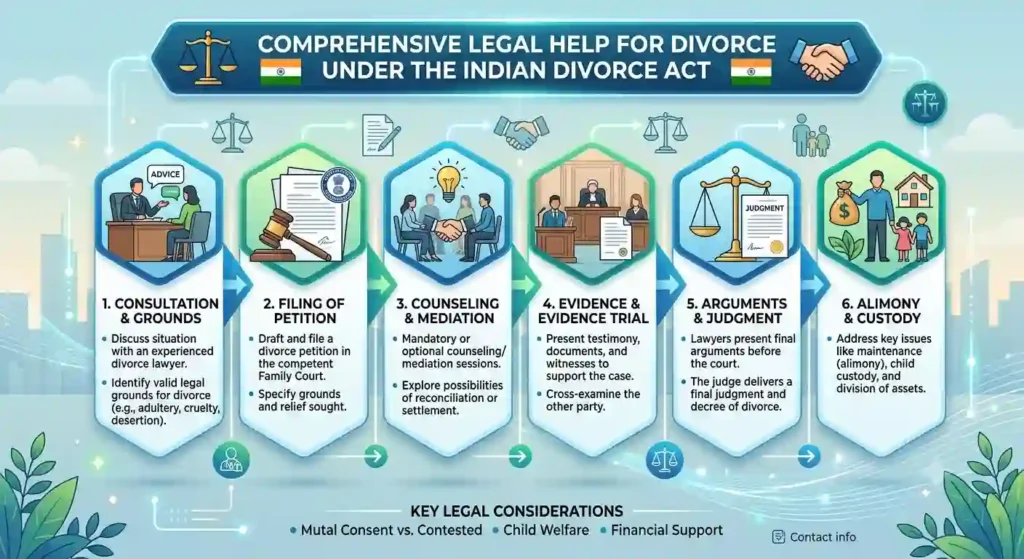
Comprehensive Legal Help for Divorce – Comprehensive divorce assistance under the Indian Divorce Act requires precise legal strategy and jurisdiction mapping. Legacy Family Court Law Firm assists clients through district family courts and high courts across Chennai jurisdiction. Additionally, we align procedures with CPC provisions for civil litigation and BNSS procedural safeguards for updated criminal-civil interface issues. Our legal team evaluates grounds such as cruelty, adultery, desertion, and conversion with structured evidence planning. Moreover, we integrate BSA compliance for admissibility of digital and documentary proof. Clients receive stepwise guidance covering petition drafting, filing, and representation.
Furthermore, we coordinate with local police stations when domestic violence allegations arise under allied statutes. We also ensure tribunal coordination where maintenance disputes overlap with family welfare boards. Importantly, we map jurisdiction under Indian Divorce Act Section provisions for proper forum selection. Our approach strengthens case readiness and reduces procedural delays. Consequently, clients gain structured representation with clear legal remedies and enforcement pathways through courts and execution petitions.
Comprehensive Legal Help for Divorce Under the Indian Divorce Act – Legacy Family Court Law Firm
Jurisdiction and Court Framework Under Indian Divorce Act
Jurisdiction plays a critical role in divorce proceedings under the Indian Divorce Act. Family Courts in Chennai and subordinate district courts handle most petitions efficiently. Moreover, High Court supervision ensures appellate remedies and writ jurisdiction when procedural errors occur. Legacy Family Court Law Firm evaluates territorial jurisdiction based on marriage location, residence, and cause of action.
Additionally, CPC provisions govern pleadings, interim relief, and evidence filing timelines. BNSS updates affect procedural coordination in cases involving concurrent criminal complaints. We also consider BSA standards for admissible electronic communications like emails and chats. Courts frequently examine jurisdiction objections raised by opposing parties. Therefore, strategic filing prevents dismissal or transfer delays.
| Forum | Role | Remedy |
|---|---|---|
| Family Court | Divorce decree | Custody, alimony |
| District Court | Interim relief | Injunction orders |
| High Court | Appeals | Writs, revisions |
| Furthermore, tribunal coordination with maintenance boards strengthens enforcement. Consequently, correct jurisdiction selection ensures faster resolution and stronger legal standing. |
Grounds and Legal Remedies for Divorce Under Indian Divorce Act
Legal Grounds for Divorce with Evidence Strategy
Divorce under the Indian Divorce Act requires legally recognized grounds supported by strong evidence. Common grounds include cruelty, adultery, desertion, and conversion to another religion. Legacy Family Court Law Firm structures evidence collection using BSA-compliant documentation and witness testimony. Moreover, we align pleadings under CPC Order VI rules for precise drafting.
Additionally, digital proof such as WhatsApp chats and emails must satisfy admissibility standards. BNSS provisions assist when parallel criminal complaints arise. Courts also evaluate financial dependency and child welfare factors. We ensure clients understand burden of proof requirements before filing.
Numbered legal grounds include:
- Cruelty and mental harassment
- Adultery and infidelity proof
- Desertion beyond statutory period
- Conversion affecting marital status
Furthermore, police station coordination becomes necessary in domestic violence-linked divorce cases. Consequently, structured evidence increases chances of favorable decree and interim relief orders.
Interim Relief and Maintenance Proceedings Strategy
Interim relief ensures financial stability during pending divorce proceedings under the Indian Divorce Act. Courts grant maintenance, residence rights, and custody protections based on urgency. Legacy Family Court Law Firm files interim applications under CPC provisions for urgent relief.
Moreover, BNSS-related criminal complaints may trigger additional protection orders. We coordinate with family courts and magistrate courts for parallel remedies. BSA-compliant income proof strengthens maintenance claims. Courts also evaluate lifestyle, dependency, and child needs before passing orders.
Key interim remedies include:
- Monthly maintenance for spouse and children
- Protection from eviction or harassment
- Temporary custody arrangements
Additionally, tribunals and family welfare committees may assist in mediation. Police stations nearby often enforce protection orders in urgent cases. Consequently, timely filing ensures financial security and legal protection throughout litigation.
Evidence Collection and Documentation Framework
Evidence forms the backbone of divorce litigation under the Indian Divorce Act. Legacy Family Court Law Firm emphasizes structured documentation aligned with BSA standards. Courts accept electronic records when authenticity and chain of custody remain intact.
Moreover, CPC rules govern affidavit filing and documentary submission timelines. BNSS provisions support evidence coordination in cross-complaint scenarios. We assist clients in organizing financial records, communication logs, and witness statements.
Evidence categories include:
| Type | Example | Purpose |
|---|---|---|
| Digital | Chats, emails | Proof of conduct |
| Financial | Bank records | Maintenance claims |
| Oral | Witness testimony | Corroboration |
| Additionally, forensic verification strengthens disputed electronic evidence. Courts scrutinize authenticity before admission. Therefore, proper documentation improves litigation outcomes significantly. |
Procedural Steps and Court Representation Strategy
Filing Process and Petition Drafting Under CPC
Filing divorce petitions under the Indian Divorce Act requires strict compliance with CPC procedures. Legacy Family Court Law Firm drafts petitions with precise jurisdictional facts and legal grounds. Moreover, we ensure proper verification and affidavit support for admissibility.
Additionally, court fees, jurisdiction mapping, and documentation play a vital role in acceptance. BNSS coordination becomes relevant when parallel FIRs exist. We structure pleadings to avoid rejection or procedural delays. Courts expect clarity in cause of action and relief sought.
Stepwise filing includes:
- Drafting petition with grounds
- Attaching supporting evidence
- Filing in family court registry
- Serving notice to respondent
Furthermore, police station coordination may be required for service assistance. Consequently, accurate drafting reduces objections and speeds up court admission.
Mediation, Settlement, and Alternative Dispute Resolution
Mediation offers faster resolution in divorce cases under the Indian Divorce Act. Family courts encourage settlement through mediation centers. Legacy Family Court Law Firm represents clients during structured negotiation sessions.
Moreover, CPC provisions support court-directed ADR mechanisms. BNSS-related disputes may also undergo parallel settlement discussions. We ensure client interests remain protected during compromise talks.
Settlement options include:
- Mutual consent divorce agreements
- Custody-sharing arrangements
- Alimony lump sum settlements
Additionally, tribunals and family welfare boards assist reconciliation efforts. Courts prefer settlement when child welfare remains stable. Therefore, ADR reduces litigation time and emotional stress significantly.
Enforcement of Decrees and Execution Proceedings
Execution of divorce decrees ensures legal rights enforcement after judgment. Legacy Family Court Law Firm files execution petitions under CPC provisions. Courts enforce custody, maintenance, and property division orders effectively.
Moreover, BNSS provisions assist when non-compliance leads to contempt or criminal implications. We coordinate with local authorities and police stations for enforcement assistance. BSA-compliant records support execution claims.
Enforcement steps include:
| Step | Action |
|---|---|
| Filing | Execution petition |
| Notice | To opposite party |
| Enforcement | Court order execution |
| Additionally, tribunals may assist in maintenance recovery. Consequently, execution ensures full realization of court-ordered rights. |
Legal Support Systems and Institutional Coordination
Police Assistance and Protection Orders in Divorce Cases
Police assistance becomes essential in divorce cases involving harassment or domestic violence. Legacy Family Court Law Firm coordinates with nearby police stations for protection enforcement. Moreover, protection orders under allied laws ensure safety during proceedings.
Additionally, BNSS provisions strengthen criminal complaint handling in matrimonial disputes. CPC procedures support civil relief simultaneously. We assist clients in filing complaints and obtaining immediate protection orders. Courts prioritize safety in urgent cases involving threats or violence.
Key protection measures include:
- Emergency police protection
- Residence safety orders
- Restraining orders against harassment
Furthermore, coordination between family courts and police ensures compliance. Consequently, clients receive immediate legal and physical protection.
Tribunals and Welfare Boards in Family Disputes
Tribunals and welfare boards support divorce-related disputes involving maintenance and custody. Legacy Family Court Law Firm engages with these bodies for supplementary relief. Moreover, family welfare committees facilitate reconciliation and counseling services.
Additionally, CPC allows parallel proceedings before competent forums. BNSS provisions apply when criminal allegations arise. We ensure clients benefit from all available institutional remedies.
Tribunal support includes:
- Maintenance assessment boards
- Child welfare committees
- Legal aid services
Furthermore, coordination improves resolution speed. Consequently, integrated support enhances case outcomes significantly.
Appeals and High Court Intervention Strategy
Appeals under the Indian Divorce Act allow correction of legal or procedural errors. Legacy Family Court Law Firm represents clients before High Courts effectively. Moreover, CPC appellate provisions govern filing timelines and grounds.
Additionally, writ jurisdiction applies when fundamental rights issues arise. BNSS-related criminal overlaps may influence appellate strategy. We prepare detailed case records and legal arguments for higher courts.
Appeal grounds include:
- Procedural irregularity
- Evidence misinterpretation
- Jurisdictional error
Furthermore, High Court intervention ensures justice correction. Consequently, appellate remedies strengthen legal protection and fairness.
FAQs
FAQ 1: What grounds apply under Indian Divorce Act?
Cruelty, adultery, desertion, and conversion qualify. Courts require strong evidence and legal proof for decree.
FAQ 2: Which court handles divorce cases in Chennai?
Family Courts handle cases primarily. High Court hears appeals and writ petitions under jurisdiction rules.
FAQ 3: Can police help in divorce disputes?
Yes, police assist in protection orders and domestic violence-related enforcement under applicable legal provisions.
FAQ 4: Is maintenance available during divorce?
Yes, courts grant interim and permanent maintenance based on income, dependency, and child welfare needs.
FAQ 5: What evidence is required in divorce cases?
Digital records, financial documents, and witness statements are essential under BSA admissibility rules.
FAQ 6: Can divorce cases be settled outside court?
Yes, mediation and mutual consent settlement are encouraged by family courts for faster resolution.
Read More
- Guardianship and Adoption Legal Help Under the Hindu Adoption and Maintenance Act
- Fight for Child Support Under Section 125 CrPC
- Resolve Family Property Disputes Under the Hindu Succession Act
- Fight Domestic Abuse Under the Protection of Women from Domestic Violence Act
- Guard Your Future with Prenuptial Agreements Under Indian Law
- Department of Justice – Family Courts Information