
Resolve Family Disputes – The Family Courts Act, 1984 promotes peaceful settlement of family disputes through specialized courts. It encourages reconciliation before prolonged litigation whenever possible. Families receive structured legal remedies for marriage, divorce, maintenance, custody, guardianship, legitimacy, property, and related matters. Moreover, trained judges focus on preserving relationships while protecting legal rights. The Act works alongside the Code of Civil Procedure, 1908 (CPC), Bharatiya Nagarik Suraksha Sanhita, 2023 (BNSS), Bharatiya Nyaya Sanhita, 2023 (BNS), and Bharatiya Sakshya Adhiniyam, 2023 (BSA) wherever applicable. Family Courts also coordinate with mediation centres, counselling units, Legal Services Authorities, Child Welfare authorities, and nearby police stations whenever facts require immediate intervention. Legacy Family Court Law Firm assists clients before Family Courts, High Courts, mediation centres, and appellate forums through strategic representation, negotiated settlements, and legally compliant documentation.
Resolve Family Disputes with the Family Courts Act – Legacy Family Court Law Firm
Objectives and Benefits of Family Courts
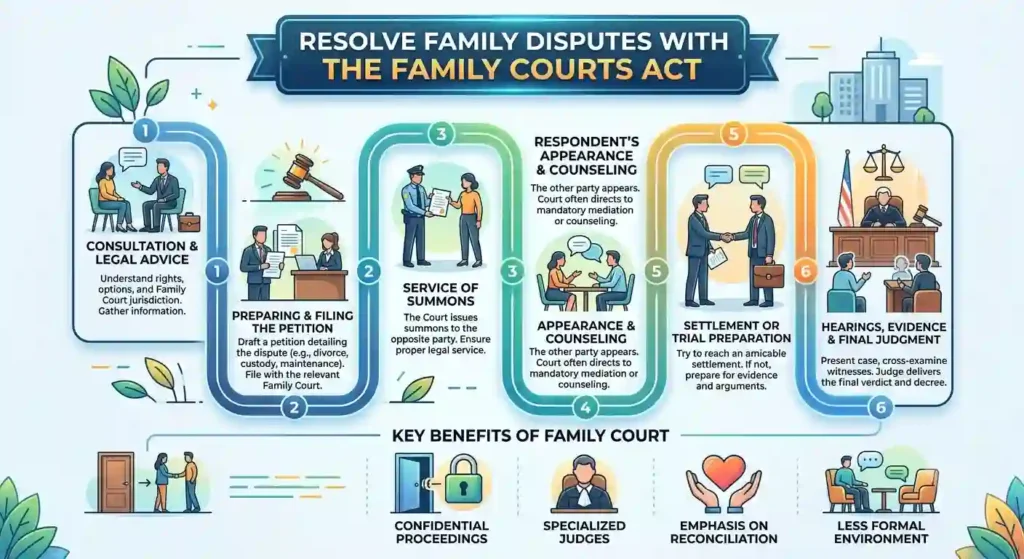
Family Courts reduce unnecessary conflict through structured procedures and settlement-oriented hearings. Consequently, parties often resolve disputes without lengthy trials. Judges encourage mediation whenever settlement appears achievable. Professional counsellors assist spouses, parents, and children throughout proceedings. Legal representation protects procedural fairness and statutory rights. The Act also minimizes emotional hardship affecting children and older family members. Important benefits include:
- Speedier dispute resolution.
- Confidential court proceedings.
- Child-focused decisions.
- Reduced procedural complexity.
- Court-assisted mediation.
- Enforceable judicial orders.
These advantages improve access to justice while ensuring lawful outcomes. Legacy Family Court Law Firm prepares petitions, written statements, evidence, interim applications, settlement agreements, appeals, and execution proceedings according to applicable statutes and judicial precedents.
Jurisdiction of Family Courts
Matters Heard by Family Courts
Types of Family Disputes Covered
Family Courts exercise jurisdiction over numerous civil family matters authorized by law. Therefore, litigants receive specialized adjudication instead of ordinary civil proceedings. Jurisdiction generally includes matrimonial disputes, maintenance claims, child custody, guardianship, restitution of conjugal rights, judicial separation, nullity of marriage, legitimacy declarations, adoption-related issues where applicable, and family property disputes connected with marital relationships. Courts also examine domestic settlement agreements and consent terms before recording lawful compromises. Common legal matters include:
| Legal Issue | Primary Forum | Possible Remedy |
|---|---|---|
| Divorce | Family Court | Decree of Divorce |
| Child Custody | Family Court | Custody Order |
| Maintenance | Family Court | Monthly Maintenance |
| Judicial Separation | Family Court | Separation Decree |
| Guardianship | Family Court | Guardian Appointment |
| Marriage Validity | Family Court | Declaration |
Legacy Family Court Law Firm evaluates jurisdiction before initiating proceedings to avoid unnecessary procedural objections.
Applicable Laws Alongside the Family Courts Act
Family disputes often involve multiple statutes beyond the Family Courts Act. Accordingly, lawyers analyze every legal issue before selecting appropriate remedies. Relevant laws include the Hindu Marriage Act, 1955, Special Marriage Act, 1954, Hindu Adoption and Maintenance Act, 1956, Hindu Minority and Guardianship Act, 1956, Guardians and Wards Act, 1890, Protection of Women from Domestic Violence Act, 2005, Muslim personal laws, Indian Divorce Act, Parsi Marriage and Divorce Act, CPC, BNSS, BNS, and BSA. Certain criminal allegations, including cruelty or dowry-related offences, proceed before competent criminal courts while connected matrimonial proceedings continue before Family Courts. Proper legal strategy prevents conflicting orders and safeguards client interests throughout every stage of litigation.
Legal Remedies for Family Disputes
Choosing the Right Legal Solution
Settlement Before Litigation
Importance of Mediation and Counselling
Mediation frequently resolves emotionally sensitive disputes without contested trials. Therefore, Family Courts actively encourage negotiated settlements whenever legally permissible. Neutral mediators facilitate constructive discussions between parties while preserving confidentiality. Counselling also helps spouses evaluate reconciliation before irreversible decisions. Successful mediation reduces litigation expenses, emotional stress, and prolonged uncertainty. Settlement terms may address maintenance, custody, visitation, education expenses, residence, and future obligations. Courts examine every settlement carefully before granting approval. Legacy Family Court Law Firm represents clients during mediation, protects statutory rights, reviews settlement clauses, and ensures enforceable agreements comply with applicable laws. Where mediation fails, experienced advocates immediately continue contested proceedings through effective pleadings, evidence, cross-examination, and final arguments before the competent Family Court.
Family Court Litigation and Legal Representation
Effective Legal Strategies for Family Disputes
Filing Petitions Before Family Courts
Procedure for Starting Family Court Proceedings
Family Court proceedings require accurate pleadings, supporting documents, and proper jurisdiction selection. Therefore, professional legal assistance helps avoid technical objections and delays. A petitioner must prepare relevant facts, legal grounds, supporting evidence, and requested remedies before filing. The Family Court examines pleadings according to applicable procedural rules, including principles under the Code of Civil Procedure, 1908 (CPC). Additionally, courts may conduct counselling sessions and mediation attempts before proceeding with contested hearings. Important filing stages include:
- Consultation with family law advocates.
- Collection of marriage and financial documents.
- Drafting petitions and applications.
- Filing before the competent Family Court.
- Participating in mediation and hearings.
- Obtaining final judicial orders.
Legacy Family Court Law Firm assists individuals, NRIs, and families with divorce petitions, maintenance applications, custody matters, guardianship proceedings, domestic violence-related remedies, and appellate strategies before higher courts.
Evidence and Documentation Requirements
Family disputes often depend on documentary and electronic evidence presented before courts. Therefore, proper evidence management significantly influences case outcomes. The Bharatiya Sakshya Adhiniyam, 2023 (BSA) governs modern evidence principles after replacing previous evidence legislation. Lawyers examine marriage certificates, communication records, financial documents, medical records, photographs, digital messages, and witness statements. Additionally, electronic evidence requires proper authentication and legal compliance. Family Courts consider relevant evidence while deciding custody, maintenance, divorce, and other disputes. Important documents usually include:
- Marriage registration certificates.
- Identity and residence proofs.
- Income and employment records.
- Bank statements.
- Child education documents.
- Medical reports.
- Digital communication records.
Consequently, systematic documentation strengthens legal arguments. Legacy Family Court Law Firm helps clients prepare evidence bundles, affidavits, applications, and submissions according to current legal requirements.
Criminal Issues Connected With Family Disputes
Family Disputes Involving Police Complaints
Role of Police Stations and Criminal Proceedings
Certain matrimonial disputes involve allegations requiring police intervention and criminal remedies. Therefore, parties must understand the difference between civil Family Court proceedings and criminal investigations. Allegations relating to cruelty, harassment, domestic violence, intimidation, or other offences may involve police stations and criminal courts. The Bharatiya Nyaya Sanhita, 2023 (BNS) defines several criminal offences, while the Bharatiya Nagarik Suraksha Sanhita, 2023 (BNSS) regulates investigation and criminal procedure. Police authorities may register complaints, conduct investigations, and submit reports before competent criminal courts. However, Family Courts separately decide matrimonial and family issues within their jurisdiction. Legal remedies may include anticipatory bail, bail applications, quashing petitions, protection orders, and negotiated settlements where legally appropriate. Legacy Family Court Law Firm provides coordinated assistance before police stations, Magistrate Courts, Sessions Courts, High Courts, and Family Courts.
Protection Against False Matrimonial Allegations
False allegations can create serious personal, professional, and financial consequences. Therefore, individuals facing wrongful complaints require immediate legal assessment and evidence-based defence strategies. Advocates review complaint contents, investigation records, digital evidence, witness statements, and procedural compliance. Additionally, courts examine whether allegations disclose genuine offences or misuse legal provisions. Available remedies may include:
- Anticipatory bail under BNSS provisions.
- Defence before criminal courts.
- Petition for quashing proceedings before High Courts.
- Applications challenging improper investigation.
- Compensation claims where legally sustainable.
Furthermore, maintaining respectful communication and preserving evidence helps establish credibility. Legacy Family Court Law Firm assists spouses, parents, and relatives facing complex matrimonial criminal allegations while ensuring compliance with court directions and legal procedures.
Family Court Appeals and Enforcement Remedies
Challenging Orders and Protecting Rights
Appeals Against Family Court Decisions
High Court Remedies and Appellate Proceedings
Family Court decisions may require appellate review when parties identify legal errors or serious procedural issues. Therefore, eligible parties can approach appropriate appellate forums according to applicable statutes. Usually, appeals from Family Courts are considered by the concerned High Court under provisions of the Family Courts Act. However, specific appeal rights depend upon the nature of the order and governing legislation. Lawyers evaluate limitation periods, grounds of challenge, supporting evidence, and possible outcomes before filing appeals. Common appellate grounds include:
- Incorrect interpretation of law.
- Failure to consider important evidence.
- Procedural irregularities.
- Violation of natural justice principles.
- Improper assessment of facts.
Legacy Family Court Law Firm represents clients before High Courts, Family Courts, mediation authorities, and related forums with detailed legal preparation.
Enforcement of Family Court Orders
Obtaining a favourable order is only one stage of family litigation. Therefore, enforcement procedures become essential when parties fail to follow court directions. Family Court orders regarding maintenance, custody, visitation, and settlements require compliance through lawful mechanisms. Courts may initiate execution proceedings against defaulting parties according to applicable procedural provisions. Maintenance defaults may involve additional remedies under BNSS provisions. Furthermore, custody violations can require urgent applications protecting the welfare of children. Effective enforcement requires proper documentation, timely applications, and continuous legal monitoring. Legacy Family Court Law Firm assists clients with execution petitions, compliance applications, modification requests, and enforcement strategies before appropriate courts. Consequently, clients receive complete support from initial dispute assessment until final implementation of judicial remedies.
Comprehensive Family Law Support for Individuals and Families
Choosing Experienced Family Court Advocates
Professional Assistance for Complex Family Matters
Legal Support for Diverse Family Disputes
Family disputes involve emotional, financial, and legal challenges requiring careful handling. Therefore, experienced family lawyers provide balanced solutions through negotiation and litigation. Legacy Family Court Law Firm supports clients facing divorce, maintenance, custody, domestic violence, property disputes, and matrimonial conflicts. Additionally, advocates assist NRIs dealing with Indian family law proceedings, international marriages, overseas settlements, and jurisdiction concerns. Effective legal support includes case evaluation, document preparation, mediation representation, court appearances, and appeal assistance. Family lawyers also coordinate with relevant authorities, including police stations, Legal Services Authorities, registration departments, and courts. Important legal services include:
- Divorce and matrimonial litigation.
- Mutual consent divorce assistance.
- Child custody representation.
- Maintenance claim support.
- Domestic violence remedies.
- Family settlement drafting.
- Court order enforcement.
Moreover, professional guidance helps families understand available remedies and make informed legal decisions during difficult situations.
Family Court Services for NRIs and Overseas Families
Non-resident Indians frequently face complex family disputes involving different countries and legal systems. Therefore, NRI family matters require specialized knowledge of Indian jurisdiction and international legal procedures. Issues may involve divorce petitions, child custody conflicts, maintenance claims, property disputes, and enforcement of foreign judgments. Additionally, lawyers examine residence status, marriage location, applicable personal laws, and court jurisdiction before initiating proceedings. Family Courts in India may hear matters when legal requirements are satisfied. Important considerations include:
| NRI Family Issue | Legal Assistance |
|---|---|
| Overseas Divorce | Indian Legal Advice |
| Child Custody | Custody Representation |
| Property Conflict | Civil Remedies |
| Maintenance Claim | Family Court Proceedings |
| Foreign Order Issues | Recognition Advice |
Legacy Family Court Law Firm assists NRIs through virtual consultations, document review, court representation, and coordinated legal strategies.
Technology, Evidence and Modern Family Court Practices
Digital Evidence in Family Litigation
Using Technology During Family Disputes
Electronic Records and Digital Proof
Modern family disputes increasingly involve electronic communications and digital records. Therefore, lawyers must understand technology-based evidence under the Bharatiya Sakshya Adhiniyam, 2023 (BSA). Courts may consider emails, messages, call records, photographs, videos, and online transactions when legally admissible. Additionally, proper collection and preservation of digital evidence prevents challenges during hearings. Family lawyers evaluate authenticity, relevance, and connection with disputed facts before submitting electronic materials. Digital evidence may support claims involving financial disputes, harassment allegations, communication issues, or child welfare concerns. However, unlawful collection methods can create legal complications. Legacy Family Court Law Firm advises clients regarding evidence preservation, privacy concerns, admissibility requirements, and court presentation methods. Consequently, technology becomes a useful legal tool when applied responsibly within established judicial procedures.
Role of Mediation Centres and Legal Authorities
Family Courts collaborate with mediation centres and legal service institutions to encourage peaceful dispute resolution. Therefore, parties receive opportunities to settle issues before lengthy litigation. The National Legal Services Authority (NALSA) and State Legal Services Authorities provide legal assistance for eligible persons. Additionally, court-connected mediation centres help spouses discuss settlement options confidentially. These institutions support access to justice through affordable legal mechanisms. Key authorities involved include:
- Family Courts.
- Mediation Centres.
- Legal Services Authorities.
- High Courts.
- Police authorities.
- Child welfare institutions.
Furthermore, these forums promote fairness while reducing unnecessary disputes. Legacy Family Court Law Firm guides clients through mediation, legal aid procedures, court proceedings, and settlement documentation.
Future Protection Through Family Legal Planning
Preventing Future Family Conflicts
Importance of Legal Awareness
Creating Strong Family Agreements
Legal planning helps families prevent avoidable disputes and protect future interests. Therefore, properly drafted agreements provide clarity regarding responsibilities, financial arrangements, and personal rights. Family settlements, maintenance agreements, custody arrangements, and property-related documents require careful legal review. Additionally, written agreements reduce misunderstanding between family members. Lawyers examine applicable personal laws, statutory requirements, and judicial principles before preparing documents. Important preventive measures include:
- Reviewing marriage-related agreements.
- Maintaining financial records.
- Documenting family settlements.
- Understanding inheritance rights.
- Seeking timely legal advice.
Moreover, early legal consultation helps individuals identify risks before conflicts become complicated litigation. Legacy Family Court Law Firm provides preventive legal guidance alongside courtroom representation for long-term family protection.
Conclusion: Achieve Peaceful Resolution Through Family Courts
Family Courts provide a specialized platform for resolving sensitive disputes through law, mediation, and fair procedures. Therefore, individuals should seek experienced legal guidance before taking major decisions involving marriage, children, maintenance, or family property. The Family Courts Act creates a structured system combining judicial remedies with reconciliation efforts. Additionally, updated laws including BNS, BNSS, BSA, and CPC influence modern family dispute resolution. Effective representation ensures proper documentation, strategic arguments, and protection of legal rights. Legacy Family Court Law Firm assists clients before Family Courts, High Courts, mediation forums, police authorities, and related legal institutions. Consequently, families can pursue lawful solutions while reducing uncertainty and conflict. Professional legal support remains essential for achieving practical, timely, and legally secure outcomes.
Frequently Asked Questions (FAQs)
1. What matters are handled by Family Courts?
Family Courts handle divorce, maintenance, custody, guardianship, matrimonial disputes, and related family issues under the Family Courts Act.
2. Can Family Courts provide mediation services?
Yes, Family Courts encourage mediation and counselling to help parties resolve disputes through peaceful settlements.
3. Which laws apply to family disputes in India?
Family disputes may involve the Family Courts Act, CPC, BNS, BNSS, BSA, personal laws, and special family statutes.
4. Can NRIs approach Indian Family Courts?
Yes, NRIs can approach Indian Family Courts when jurisdiction requirements and applicable legal conditions are satisfied.
5. How can Family Court orders be enforced?
Parties can file execution proceedings and seek appropriate remedies when court orders regarding maintenance or custody are violated.
6. Why hire a Family Court lawyer?
A Family Court lawyer provides legal advice, prepares documents, represents clients, manages evidence, and protects rights during proceedings.
Read More
- Fight for Fair Alimony Under the Hindu Marriage Act
- Secure Child Visitation Rights Under the Guardians and Wards Act
- Comprehensive Legal Help for Divorce Under the Indian Divorce Act
- Guardianship and Adoption Legal Help Under the Hindu Adoption and Maintenance Act
- Fight for Child Support Under Section 125 CrPC
- Ministry of Law and Justice, Government of India