


Fight Property Disputes – Property disputes often affect family relationships, financial security, and long-term ownership rights. Therefore, immediate legal advice helps protect lawful interests and prevents avoidable litigation. The Hindu Succession Act, 1956, as amended in 2005, governs intestate succession among Hindus, Buddhists, Jains, and Sikhs. Daughters now enjoy equal coparcenary rights alongside sons in ancestral property. Moreover, disputes frequently arise over ancestral property, self-acquired assets, partition, wills, mutation, succession certificates, family settlements, and inheritance claims. Courts decide these matters based upon statutory provisions and admissible evidence. The Code of Civil Procedure, 1908 (CPC) regulates civil proceedings, while the Bharatiya Sakshya Adhiniyam, 2023 (BSA) governs evidentiary standards. Legacy Family Court Law Firm assists individuals, families, women, older citizens, and NRIs through negotiation, mediation, litigation, and appellate proceedings before competent courts across India.
Fight Property Disputes Under the Hindu Succession Act – Legacy Family Court Law Firm
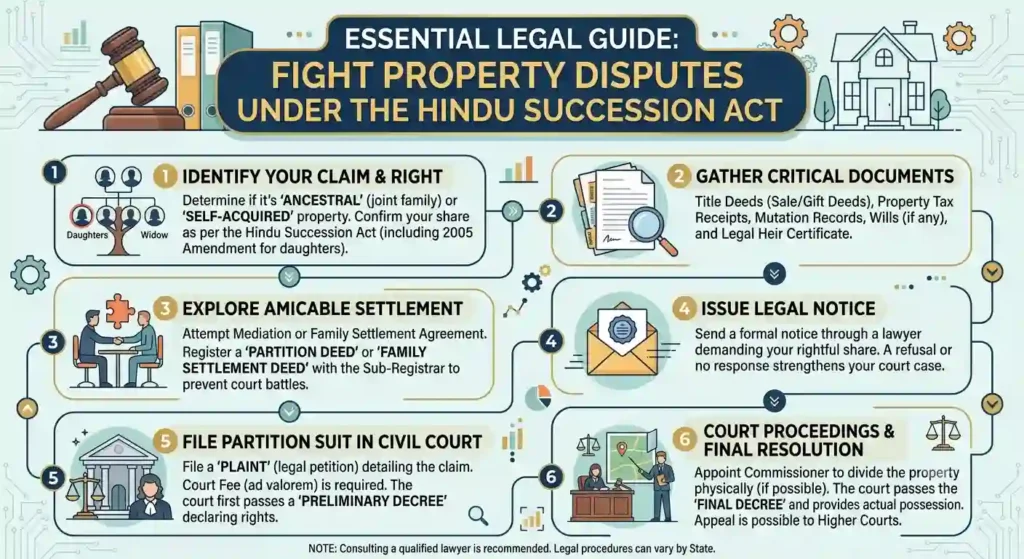
Common Property Disputes Among Families
Inheritance disputes arise from competing ownership claims and conflicting family expectations. Consequently, timely legal intervention minimizes uncertainty and protects valuable property rights. Common disputes include partition suits, ancestral property claims, self-acquired property disputes, coparcenary rights, succession certificate proceedings, probate disputes, forged wills, family settlement disagreements, gift deed challenges, mutation disputes, illegal possession, adverse possession claims, joint family property issues, and disputes involving NRI-owned assets. Several matters also concern women’s inheritance rights after the Hindu Succession (Amendment) Act, 2005. Experienced advocates review title deeds, revenue records, wills, family trees, and documentary evidence before recommending suitable legal remedies. Proper legal planning frequently reduces litigation costs while preserving family relationships wherever amicable settlement remains possible.
Legal Framework Governing Succession and Partition
Courts and Applicable Laws
Jurisdiction and Legal Principles
Property disputes proceed before civil courts according to territorial and pecuniary jurisdiction. Therefore, identifying the proper forum strengthens litigation strategy from the beginning. Civil Courts decide partition suits, declaration suits, injunction applications, possession claims, and recovery proceedings under the CPC. Family settlements may also involve mediation before court-annexed mediation centres. Revenue authorities handle mutation and land record updates without deciding title disputes. Furthermore, allegations involving forged documents, criminal intimidation, cheating, or trespass may attract the Bharatiya Nyaya Sanhita, 2023 (BNS) and procedural safeguards under the Bharatiya Nagarik Suraksha Sanhita, 2023 (BNSS). Nearby Police Stations investigate cognizable criminal offences connected with fraudulent property transactions. Legacy Family Court Law Firm represents clients before Trial Courts, District Courts, High Courts, and the Supreme Court while protecting inheritance rights through effective legal advocacy.
Legal Remedies for Property Disputes
Protecting Ownership and Inheritance Rights
Civil Remedies Available Under Indian Law
Property disputes require carefully planned legal action supported by documentary evidence. Therefore, parties should evaluate every available statutory remedy before initiating litigation. Legacy Family Court Law Firm examines title deeds, sale deeds, partition deeds, wills, gift deeds, revenue records, encumbrance certificates, and family settlements before recommending legal strategy. Appropriate remedies include partition suits, declaration suits, permanent injunctions, recovery of possession, cancellation of fraudulent documents, mesne profits, probate proceedings, succession certificate petitions, and specific performance where legally applicable. Courts also encourage mediation when settlement remains practical. Early legal intervention preserves valuable evidence while reducing unnecessary litigation costs. Moreover, experienced advocates protect inheritance rights through effective pleadings, interim applications, cross-examination, and appellate representation before competent civil courts.
Important Authorities, Courts, and Government Departments
Several authorities play important roles during property disputes depending upon the issues involved. Consequently, litigants should approach the appropriate authority without unnecessary delay. Relevant authorities include:
- Jurisdictional Civil Court.
- District Court.
- High Court.
- Supreme Court of India.
- Sub-Registrar Office.
- Revenue Department.
- Tahsildar Office.
- Municipal Authority.
- Police Station for criminal complaints.
- Court-annexed Mediation Centre.
The following table summarizes their primary functions:
| Authority / Forum | Primary Function |
|---|---|
| Civil Court | Partition and declaration suits |
| District Court | Appeals and civil jurisdiction |
| High Court | Appeals and writ jurisdiction |
| Supreme Court | Final appellate remedies |
| Sub-Registrar | Registration of property documents |
| Revenue Department | Mutation and land records |
| Police Station | Criminal investigation involving property offences |
Proper legal representation before these authorities protects ownership rights while ensuring procedural compliance throughout litigation.
Evidence and Documentation in Property Litigation
Essential Records for Successful Claims
Strong documentary evidence significantly improves success in inheritance and partition proceedings. Furthermore, organized records simplify hearings and reduce unnecessary procedural objections. Parties should preserve the following documents:
- Sale deeds.
- Title deeds.
- Gift deeds.
- Partition deeds.
- Registered wills.
- Death certificates.
- Legal heir certificates.
- Encumbrance certificates.
- Patta and revenue records.
- Tax receipts.
- Family tree records.
- Identity documents.
Courts examine oral, documentary, and electronic evidence according to the Bharatiya Sakshya Adhiniyam, 2023. Where fraudulent transfers occur, parties may also pursue criminal remedies under the Bharatiya Nyaya Sanhita, 2023. Experienced advocates prepare pleadings, interim applications, written submissions, evidence affidavits, and appellate documents while protecting clients from unlawful dispossession and fraudulent property transactions.
Resolving Property Disputes with Legacy Family Court Law Firm
Strategic Legal Representation for Families and NRIs
Practical Litigation and Settlement Strategies
Why Professional Legal Guidance Matters
Property disputes often involve emotional issues alongside complex legal questions. Therefore, experienced legal representation improves decision-making throughout every litigation stage. Legacy Family Court Law Firm advises individuals, families, women, older citizens, companies holding inherited assets, trusts, NGOs, and NRIs on inheritance and partition matters. The firm evaluates ownership records, succession documents, revenue entries, family settlements, wills, and historical title records before recommending legal action. Moreover, advocates identify jurisdictional issues, limitation periods, evidentiary gaps, and interim relief options. Clients receive representation during mediation, civil trials, appeals, execution proceedings, and connected criminal complaints involving fraudulent property transfers. Early legal planning frequently prevents avoidable disputes while protecting valuable family assets. Professional advocacy also strengthens settlement negotiations and preserves long-term legal rights across generations.
Best Practices to Prevent Property Disputes
Families should adopt preventive legal measures to reduce future inheritance conflicts. Furthermore, timely documentation strengthens ownership claims before competent courts and authorities. Consider the following practices:
- Register property documents promptly.
- Prepare legally valid wills.
- Maintain updated revenue records.
- Execute family settlements carefully.
- Preserve original title documents.
- Verify encumbrance status regularly.
- Record property tax payments.
- Update legal heir records.
- Conduct due diligence before transfers.
- Obtain legal opinions before transactions.
These practices reduce litigation risks while improving evidentiary support. Regular legal review also identifies defects before disputes become expensive. Consequently, families protect ownership rights and minimize future uncertainty through proper planning and statutory compliance.
Conclusion: Secure Your Inheritance Rights
Property disputes under the Hindu Succession Act require prompt legal action supported by reliable evidence and effective advocacy. Therefore, parties should seek professional guidance before signing documents or initiating proceedings. Legacy Family Court Law Firm provides comprehensive legal services relating to partition suits, inheritance claims, probate proceedings, succession certificates, declaration suits, injunctions, execution proceedings, mediation, appeals, and NRI property disputes. The firm represents clients before Civil Courts, District Courts, High Courts, the Supreme Court, Revenue Authorities, and Sub-Registrar Offices. Furthermore, advocates assist in matters involving forged documents, illegal possession, trespass, and fraudulent transfers under BNS, BNSS, BSA, and CPC where applicable. Early legal intervention safeguards family assets while improving the prospects of successful dispute resolution through settlement or judicial determination.
Frequently Asked Questions
1. Who inherits property under the Hindu Succession Act?
Legal heirs inherit intestate property according to statutory succession rules. Class I heirs generally receive priority over other categories.
2. Can daughters claim equal rights in ancestral property?
Yes. The Hindu Succession (Amendment) Act, 2005 grants daughters equal coparcenary rights similar to sons in ancestral property.
3. Which court decides partition suits?
The jurisdictional Civil Court generally decides partition, declaration, injunction, and possession suits according to the CPC.
4. What documents support an inheritance claim?
Title deeds, wills, legal heir certificates, death certificates, revenue records, tax receipts, encumbrance certificates, and family records strengthen claims.
5. Can criminal action accompany a property dispute?
Yes. Fraud, forgery, trespass, criminal intimidation, or cheating may attract proceedings under the BNS with investigation under the BNSS.
6. How can Legacy Family Court Law Firm help?
The firm provides legal opinions, mediation, litigation, appeals, probate, succession, partition representation, NRI property assistance, and document review services.
Read More
- Legal Support for Child Maintenance Under Section 125 CrPC
- Handle Complex Custody Battles Under the Guardians and Wards Act
- Legal Help for High-Profile Divorce Cases Under the Hindu Marriage Act
- Secure Inheritance Rights Under the Indian Succession Act
- Expert Legal Help for Domestic Violence Under the DV Act
- National Legal Services Authority (NALSA)