

Effective Legal Solutions for Dowry – Section 498A IPC remains relevant to offences governed by the earlier legal regime. For new offences, Section 85 BNS addresses cruelty by a husband or his relatives. Section 86 BNS defines the circumstances constituting cruelty under Section 85. These provisions cover serious conduct threatening a woman’s health, safety, or life. They also cover harassment connected with unlawful demands for property or valuable security. Therefore, dowry-related cruelty requires careful factual and legal assessment. The punishment under Section 85 can extend to three years with fine. Moreover, lawyers must identify the applicable law according to the alleged offence date. Legacy Family Court Law Firm examines complaints, evidence, dates, and relationships before advising clients. Consequently, precise statutory identification prevents incorrect pleadings and unnecessary procedural complications.
Effective Legal Solutions for Dowry Cases Under Section 498A – Legacy Family Court Law Firm
Meaning of Cruelty and Dowry Harassment
Section 86 BNS provides two principal categories for understanding cruelty allegations. First, wilful conduct must create serious danger to life, limb, or physical or mental health. Second, harassment may involve unlawful property demands. Such harassment can target the woman or persons connected with her. Therefore, every marital disagreement does not automatically establish statutory cruelty. Courts examine allegations alongside surrounding circumstances and supporting evidence. Moreover, specific incidents generally provide stronger foundations than vague accusations. Messages, financial records, medical documents, witness statements, and prior complaints can establish relevant circumstances. Consequently, complainants should present chronological facts without exaggeration or irrelevant allegations. Accused persons should similarly preserve evidence supporting their defence. Legacy Family Court Law Firm evaluates both prosecution and defence strategies according to available evidence. Appropriate legal advice can prevent procedural errors and protect legitimate matrimonial rights.
Dowry Prohibition and Related Offences
Understanding Dowry-Related Conduct
Dowry allegations can involve multiple legal provisions beyond cruelty under Section 85 BNS. The Dowry Prohibition Act, 1961 separately regulates giving, taking, and demanding dowry. Therefore, lawyers must examine whether allegations disclose independent offences under that legislation. Dowry death provisions may also arise where statutory conditions concerning death and prior harassment exist. Additionally, domestic violence proceedings can provide separate civil protection and monetary remedies. However, every matrimonial dispute does not justify combining every possible criminal allegation. Courts expect allegations to connect with legally recognised ingredients of each offence. Therefore, factual precision remains essential when drafting complaints and petitions. Marriage records, gift lists, bank transactions, messages, and witness statements can assist factual analysis. Moreover, settlement discussions should not obscure serious allegations requiring lawful investigation. Legacy Family Court Law Firm provides comprehensive advice concerning overlapping matrimonial and criminal proceedings.
Evidence Required in Dowry Complaints
Strong evidence can significantly improve the clarity and credibility of a dowry-related complaint. Complainants should preserve communications, payment records, photographs, medical reports, and relevant witness information. Furthermore, contemporaneous complaints can help establish chronology and surrounding circumstances. However, delayed complaints do not automatically become legally invalid. Courts examine explanations for delay alongside the complete factual record. Accused persons should preserve contrary communications, financial records, travel details, and independent witness evidence. Therefore, both sides should avoid deleting potentially relevant digital material. The Bharatiya Sakshya Adhiniyam, 2023 recognises electronic and digital records as evidence subject to statutory requirements. Consequently, parties should preserve original devices and reliable electronic records wherever appropriate. Legal counsel can assess admissibility, relevance, authenticity, and evidentiary weight before trial. Proper evidence management can substantially influence investigation, bail, discharge, and trial strategies.
Electronic Evidence and Digital Records
Modern dowry disputes frequently involve WhatsApp messages, emails, recordings, photographs, and social-media communications. The Bharatiya Sakshya Adhiniyam expressly recognises electronic and digital records. Section 61 gives electronic records legal effect, subject to statutory requirements. Section 63 provides conditions governing admissibility of specified electronic records. Therefore, parties should preserve complete conversations rather than isolated screenshots alone. Metadata, device information, backups, and original files can become relevant during evidentiary challenges. Moreover, edited recordings can create serious authenticity disputes during criminal proceedings. Lawyers should therefore examine digital evidence before relying upon it in complaints or defences. Courts may scrutinise the manner of creation, storage, transmission, and production. Consequently, professional evidence review can prevent avoidable objections during trial. Legacy Family Court Law Firm assists clients with legally appropriate preservation and presentation strategies.
Police Complaints, Investigation and Criminal Procedure
Filing Complaints and FIR Proceedings
Police Complaint Strategy
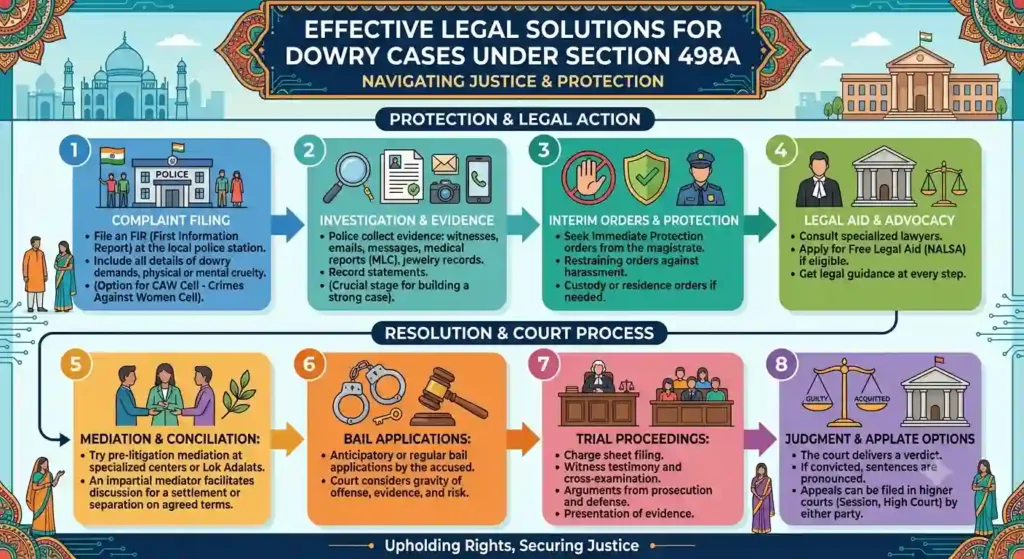
Section 173 BNSS governs information concerning cognizable offences and permits electronic communication. Therefore, complainants should provide clear facts identifying alleged cruelty, dowry demands, dates, locations, and persons involved. Police authorities may investigate allegations according to statutory procedure and available evidence. However, complainants should avoid speculative accusations against persons without factual connection. Similarly, accused persons should obtain legal advice before submitting detailed statements or documents. A police station’s geographical location does not alone determine every jurisdictional question. Courts may examine territorial jurisdiction based upon relevant acts, consequences, and statutory provisions. Consequently, lawyers should identify the correct police station and competent Magistrate carefully. Chennai residents can seek assistance concerning complaints filed at appropriate nearby police stations. Legacy Family Court Law Firm can advise clients regarding complaint drafting, investigation, and procedural safeguards.
Arrest and Anticipatory Bail
Section 85 BNS carries imprisonment extending to three years and fine. Arrest decisions therefore require consideration under the BNSS framework and applicable judicial principles. Section 35 BNSS contains conditions governing arrest in specified cognizable offences. Consequently, an accused person should seek prompt legal advice after receiving police communication. Anticipatory bail may provide an important remedy where arrest apprehension exists. The competent Sessions Court or High Court may consider an appropriate anticipatory bail application. However, courts examine allegations, cooperation, evidence, antecedents, and circumstances individually. Therefore, applicants should provide accurate information and disclose relevant proceedings. Complainants can also challenge procedural irregularities through appropriate legal remedies. Legacy Family Court Law Firm prepares bail strategies based upon case-specific facts and available documents. Early representation can help protect liberty while ensuring lawful investigation.
Jurisdiction, Courts and Matrimonial Proceedings
Chennai Jurisdiction and Courts
Dowry cases may involve police investigation, Magistrate proceedings, matrimonial litigation, and connected family disputes. Therefore, lawyers must map every proceeding before choosing an overall litigation strategy. Criminal cases ordinarily proceed before the competent Magistrate after investigation and filing of the police report. Matrimonial proceedings may proceed before Family Courts where statutory jurisdiction exists. Civil claims can involve appropriate courts depending upon the subject and relief sought. Moreover, High Courts may exercise jurisdiction in appropriate cases involving criminal or matrimonial proceedings. The CPC may apply to relevant civil proceedings, subject to specific statutory provisions. Consequently, parties should avoid treating every matrimonial dispute as a single proceeding. Legacy Family Court Law Firm coordinates criminal, matrimonial, maintenance, custody, and property-related strategies. Proper jurisdictional planning can reduce duplication and inconsistent positions across different courts.
Family Court and Related Remedies
Family Courts can address several matrimonial disputes involving divorce, maintenance, custody, and related family issues. However, criminal cruelty allegations generally follow criminal procedure rather than ordinary Family Court procedure. Therefore, parties should understand the separate purposes of criminal and family proceedings. A matrimonial dispute may involve simultaneous proceedings before different competent forums. Courts can consider relevant evidence while determining statutory reliefs available under applicable laws. Maintenance claims may arise under personal laws and criminal procedure provisions. Protection orders may also arise under the Protection of Women from Domestic Violence Act. Consequently, comprehensive advice should consider financial support, residence, custody, and safety concerns. Legacy Family Court Law Firm assists clients in coordinating connected proceedings before appropriate forums. Strategic consistency remains important when multiple petitions involve overlapping factual allegations.
Defence, Settlement and Long-Term Legal Remedies
Defending False or Excessive Allegations
Legal Defence Against False Cases
An accused person facing an allegedly false dowry case should respond through lawful legal remedies. First, counsel should obtain the complaint, FIR, notices, and supporting documents. Next, lawyers should identify inconsistencies, omissions, contradictions, and unsupported allegations. Financial records can sometimes demonstrate facts inconsistent with particular accusations. Similarly, independent witnesses may provide evidence concerning disputed incidents or locations. Therefore, defence preparation should begin before investigation reaches an advanced stage. Courts can consider appropriate bail, discharge, quashing, or trial remedies depending upon circumstances. High Courts may exercise inherent or constitutional powers in appropriate cases. However, quashing requires careful legal analysis and cannot rest solely upon disputed factual claims. Consequently, lawyers should distinguish genuine legal defects from matters requiring trial evidence. Legacy Family Court Law Firm develops defence strategies based upon documents, chronology, statutory ingredients, and judicial remedies.
Quashing and Other High Court Remedies
High Courts can consider appropriate petitions where criminal proceedings suffer from recognised legal defects. Such remedies may become relevant where allegations fail to disclose essential offence ingredients. They may also arise where proceedings demonstrate clear legal abuse or jurisdictional defects. However, courts generally exercise extraordinary powers cautiously in criminal matrimonial disputes. Therefore, applicants should establish a strong legal foundation supported by the record. The BNSS now governs criminal procedure for proceedings under the current criminal-law framework. India Code records the BNS, BNSS, and BSA as the principal 2023 criminal-law enactments. Moreover, evidence under the BSA can become important when assessing digital and documentary records. Counsel should select remedies after examining the FIR, investigation materials, and surrounding circumstances. Legacy Family Court Law Firm can evaluate quashing, bail, discharge, revision, appeal, and writ options. Early legal review can prevent inappropriate or premature litigation.
Settlement, Mediation and Matrimonial Resolution
Negotiated Settlement and Mediation
Some matrimonial disputes can resolve through lawful negotiation, mediation, or court-assisted settlement. However, settlement should never result from coercion, intimidation, or unlawful pressure. Therefore, parties should understand every proceeding and legal consequence before signing settlement terms. Matrimonial settlements may address divorce, maintenance, property, custody, and withdrawal of appropriate proceedings. Criminal allegations require careful consideration because not every offence can be privately terminated. Courts may examine whether statutory requirements permit lawful closure or quashing. Consequently, settlement terms should reflect realistic legal remedies and enforceable obligations. Mediation can help parties discuss financial and family issues in a controlled environment. Lawyers should protect clients against ambiguous clauses, incomplete disclosures, and future disputes. Legacy Family Court Law Firm can assist with negotiation, mediation, consent terms, and court procedures. Properly structured settlements can reduce prolonged litigation while preserving legally protected interests.
Remedies for Women and Families
Women facing dowry cruelty can consider several remedies according to their circumstances. These may include police complaints, protection orders, maintenance claims, residence relief, and matrimonial proceedings. Furthermore, medical assistance and emergency protection may become necessary where immediate danger exists. Legal counsel can help identify suitable authorities and coordinate multiple proceedings. However, clients should provide complete and truthful information before initiating criminal action. Evidence should establish relevant facts without unnecessary allegations against uninvolved relatives. Similarly, family members supporting an affected woman should preserve documents and communications. Courts can provide remedies under criminal, matrimonial, domestic violence, and maintenance laws where statutory requirements exist. Consequently, legal strategy should focus on safety, evidence, financial security, and sustainable relief. Legacy Family Court Law Firm provides representation before police authorities, Magistrates, Family Courts, Sessions Courts, and High Courts. Our approach combines legal protection with practical matrimonial dispute resolution.
Remedies for Husbands and Relatives
Persons accused in dowry cases also possess important procedural and substantive legal rights. They can seek bail, challenge unlawful investigation, contest allegations, and present defence evidence. Therefore, accused relatives should obtain independent legal advice before making admissions or signing documents. Older parents and distant relatives may require separate factual assessment concerning their alleged involvement. Courts examine individual allegations rather than assuming identical liability for every family member. Moreover, documentary and electronic evidence can expose contradictions within exaggerated accusations. The BSA provides a statutory framework for electronic evidence and documentary proof. Consequently, defence counsel should preserve relevant records before they disappear or become inaccessible. Appropriate remedies may include anticipatory bail, regular bail, discharge, quashing, revision, or appeal. Legacy Family Court Law Firm provides strategic representation while respecting lawful investigation and court processes.
Legal Support from Legacy Family Court Law Firm
Legacy Family Court Law Firm provides comprehensive assistance in dowry and matrimonial criminal disputes. Our lawyers assess complaints, FIRs, notices, evidence, and applicable statutory provisions before recommending remedies. We represent clients before police authorities, Magistrates, Sessions Courts, Family Courts, and High Courts. Furthermore, we assist with anticipatory bail, regular bail, quashing petitions, discharge applications, and appeals. Our team also handles maintenance, domestic violence, custody, divorce, and matrimonial settlement proceedings. Digital evidence receives careful review under the Bharatiya Sakshya Adhiniyam, 2023. Criminal procedure receives analysis under the BNSS, while offences receive classification under the BNS. Therefore, clients receive coordinated advice instead of isolated representation. Every case requires individual assessment because facts, jurisdiction, evidence, and procedural history differ. Timely legal assistance can protect rights and improve informed decision-making.
Frequently Asked Questions
1. Does Section 498A IPC still apply in India?
For new offences, Section 85 BNS applies. Section 498A IPC remains relevant to cases governed by the earlier legal framework.
2. What is the new law replacing Section 498A IPC?
Sections 85 and 86 BNS address cruelty by a husband or relative. Section 86 defines cruelty, including specified unlawful-demand harassment.
3. Can an accused obtain anticipatory bail in a dowry case?
Yes, anticipatory bail may be available where arrest is apprehended. Courts consider allegations, evidence, cooperation, antecedents, and individual circumstances.
4. Can false dowry allegations be challenged?
Yes. Depending on the facts, remedies can include bail, discharge, quashing, revision, or appeal before competent courts.
5. Can digital messages prove dowry harassment?
Yes. The BSA recognises electronic records, subject to statutory admissibility requirements. Complete and authentic digital evidence remains particularly important.
6. Can matrimonial and criminal proceedings run simultaneously?
Yes. Criminal proceedings and matrimonial disputes can proceed before different competent forums. Lawyers should coordinate pleadings, evidence, settlement, and litigation strategy.
Read More
- Legal Support for Christian Divorce Cases Under the Indian Divorce Act
- Protect Your Rights in Divorce Under the Dissolution of Muslim Marriages Act
- Resolve Custody Disputes Under the Hindu Minority and Guardianship Act
- Legal Support for Child Maintenance Under Section 125 CrPC
- Fight Property Disputes Under the Hindu Succession Act
- Department of Legal Affairs, Ministry of Law and Justice