


Anticipatory Bail in Matrimonial Cases – Anticipatory bail protects a person from arrest before custody occurs. Matrimonial disputes often trigger criminal complaints involving cruelty, dowry harassment, intimidation, and related allegations. Many accused spouses seek immediate legal protection after receiving complaint information. Under the earlier Criminal Procedure Code, Section 438 governed anticipatory bail applications. The Bharatiya Nagarik Suraksha Sanhita now regulates the same remedy through updated provisions. Courts continue to examine facts, conduct, evidence, and investigation requirements before granting relief. Moreover, judges balance personal liberty with investigative interests during hearings. Matrimonial litigation frequently involves complaints under BNS provisions replacing former IPC offences. Family disputes may also create proceedings before Family Courts, Magistrate Courts, and High Courts. Therefore, understanding anticipatory bail remains essential for husbands, wives, relatives, older citizens, and non-resident Indians facing criminal allegations arising from marriage-related conflicts.
Anticipatory Bail in Matrimonial Cases – BNSS vs Old CrPC – Legacy Family Court Law Firm
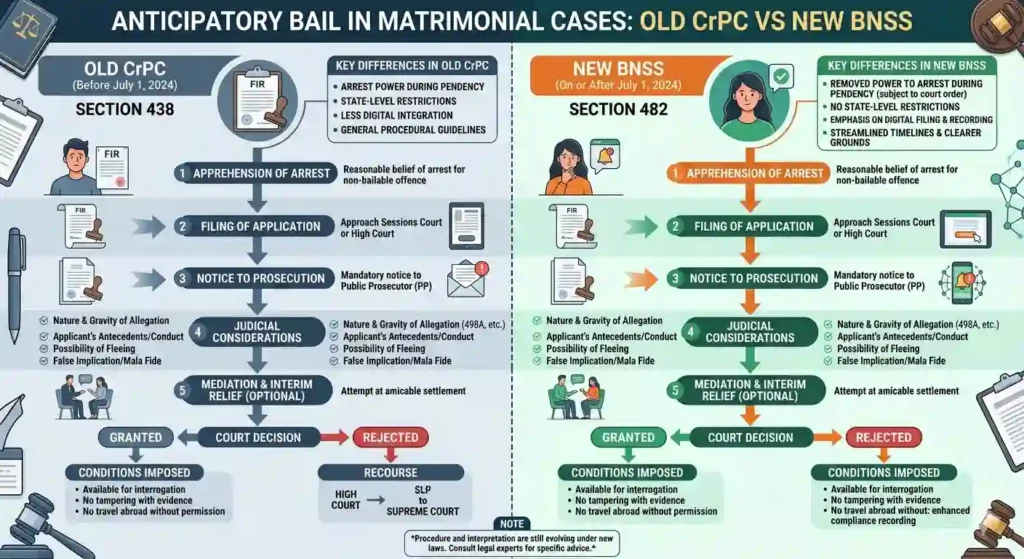
BNSS and the Evolution from Old CrPC
The BNSS replaced the Criminal Procedure Code and modernized procedural criminal law. Anticipatory bail principles largely continue under the new framework. However, practitioners now interpret applications using BNSS terminology and procedural requirements. Courts still evaluate the accusation’s seriousness, criminal history, cooperation, and investigation needs. Furthermore, judicial precedents under the earlier law remain influential. Litigants often compare BNSS provisions with former CrPC standards when seeking protection. Legal counsel usually examines FIR contents, complaint records, witness statements, and documentary evidence. Matrimonial cases commonly involve allegations concerning dowry demands, domestic violence, emotional abuse, or financial disputes. Consequently, applicants should prepare comprehensive pleadings before approaching competent courts. Proper legal strategy often strengthens liberty protections while supporting lawful investigation. Effective representation also reduces procedural delays during anticipatory bail hearings.
Key Legal Framework Governing Matrimonial Bail Cases
Matrimonial disputes engage several statutes and legal forums simultaneously. Criminal allegations may arise under BNS provisions relating to cruelty, intimidation, hurt, misappropriation, or harassment. Evidence assessment follows principles under the Bharatiya Sakshya Adhiniyam. Additionally, procedural safeguards operate through BNSS provisions governing arrest and bail. Family Court proceedings often continue independently regarding divorce, maintenance, child custody, or restitution claims. Domestic violence complaints may proceed before competent Magistrates. Therefore, courts review the entire factual background before granting anticipatory bail. Lawyers frequently analyze pending civil and criminal litigation to demonstrate misuse or genuine concern. Authorities also consider investigation progress and witness protection requirements. Strong documentation often improves credibility before the court. A coordinated legal approach helps litigants manage multiple proceedings effectively.
When Anticipatory Bail Becomes Necessary
Anticipatory bail becomes important when arrest appears reasonably likely. Matrimonial complaints sometimes name several relatives besides the spouse. Older parents, married sisters, and distant relatives may face allegations. Consequently, immediate legal consultation becomes essential after complaint awareness. Applicants generally collect complaint copies, communication records, financial documents, and supporting evidence. Courts examine whether allegations show specific acts or vague accusations. Furthermore, judges consider cooperation willingness and absence of criminal antecedents. Many matrimonial disputes involve settlement discussions alongside criminal proceedings. Therefore, anticipatory bail often preserves liberty during negotiations. The remedy does not determine guilt or innocence. Instead, it protects personal freedom while investigation continues lawfully. Proper preparation frequently improves the chances of obtaining favorable interim protection.
Difference Between Arrest Protection and Regular Bail
Anticipatory bail differs significantly from regular bail. Anticipatory bail operates before arrest occurs. Regular bail applies after arrest or custody. Therefore, timing creates the principal distinction. Courts hearing anticipatory bail applications assess potential arrest risks and surrounding circumstances. Applicants usually request protection immediately after learning about a complaint or FIR. Furthermore, anticipatory bail orders often include cooperation conditions. Regular bail hearings focus more directly on continued detention issues. Matrimonial disputes frequently generate urgency because arrest concerns affect employment and family responsibilities. Judicial discretion remains important under both remedies. However, anticipatory bail serves as a preventive safeguard. Early legal action often minimizes disruption and preserves constitutional liberty interests during investigations.
Important Features of Anticipatory Bail Under BNSS
BNSS retains the fundamental objective of protecting personal liberty. Courts continue evaluating relevant factors before granting relief. Important considerations include:
- Nature of allegations.
- Criminal background.
- Investigation requirements.
- Possibility of absconding.
- Cooperation with authorities.
Additionally, judges may impose reasonable conditions. Such conditions often require attendance before investigators when summoned. Applicants may also face restrictions against influencing witnesses. Matrimonial cases receive careful scrutiny because family disputes can produce competing narratives. Therefore, courts examine complaint details with caution. Legal representation plays a significant role during hearings. Well-supported applications often assist judges in understanding the complete factual matrix. Timely filings also reduce uncertainty and procedural complications. Consequently, applicants should seek professional legal guidance immediately after learning about possible criminal proceedings.
Comparison Table: BNSS vs Old CrPC
| Particular | Old CrPC | BNSS |
|---|---|---|
| Governing Law | Criminal Procedure Code | Bharatiya Nagarik Suraksha Sanhita |
| Anticipatory Bail Concept | Available | Available |
| Judicial Discretion | Yes | Yes |
| Conditions on Relief | Permitted | Permitted |
| Focus on Liberty | Strong | Strong |
| Matrimonial Applications | Common | Common |
| High Court Jurisdiction | Available | Available |
| Sessions Court Jurisdiction | Available | Available |
The transition primarily modernized procedural legislation. Therefore, established judicial principles continue influencing anticipatory bail decisions. Courts still prioritize fairness, liberty, and effective investigation. Applicants should understand procedural updates before initiating legal action.
Matrimonial Offences Commonly Triggering Bail Applications
Several matrimonial allegations frequently lead to anticipatory bail petitions. Common examples include:
• Cruelty-related allegations under BNS provisions.
• Dowry harassment complaints.
• Criminal intimidation allegations.
• Breach of trust claims involving property.
• Physical assault allegations.
• Financial dispute complaints.
Furthermore, complaints may include multiple family members. Courts therefore evaluate whether allegations specify individual roles. General accusations sometimes receive closer scrutiny during hearings. Investigators also assess available evidence and witness statements. Legal counsel often highlights inconsistencies where appropriate. Strong factual presentation assists courts in reaching balanced decisions. Consequently, applicants should preserve relevant communications, financial records, and documentary evidence from the beginning of the dispute.
Jurisdiction of Courts in Matrimonial Bail Matters
Applicants generally approach the Sessions Court or High Court for anticipatory bail. Jurisdiction depends upon procedural requirements and case circumstances. Therefore, legal advice becomes important before filing. Family Courts usually address matrimonial reliefs such as divorce and maintenance. However, criminal protection applications proceed before criminal courts. Police stations register complaints and FIRs within territorial jurisdiction. Investigating officers conduct evidence collection and witness examination. Furthermore, High Courts exercise supervisory jurisdiction in appropriate situations. Applicants often seek urgent interim relief where arrest concerns exist. Proper drafting and jurisdiction selection improve procedural efficiency. Consequently, litigants should understand the distinct functions of family, criminal, and appellate forums.
Role of Police During Matrimonial Investigations
Police authorities investigate complaints according to statutory procedures. Investigating officers gather documents, statements, electronic records, and other evidence. Anticipatory bail does not stop lawful investigation. Instead, it regulates arrest-related concerns while cooperation continues. Therefore, applicants must comply with lawful directions. Courts often consider cooperative conduct favorably. Furthermore, investigators assess whether allegations require custodial interrogation. Matrimonial disputes frequently involve extensive documentary material rather than physical evidence alone. Accordingly, courts sometimes examine whether custody genuinely assists investigation. Balanced judicial review protects both liberty and investigative objectives. Applicants should avoid non-cooperation because such conduct may affect future proceedings. Responsible participation often supports a stronger legal position.
Legal Remedies Available in Matrimonial Criminal Disputes
Several remedies may operate simultaneously in matrimonial conflicts. Available legal options include:
- Anticipatory bail applications.
- Regular bail petitions.
- FIR quashing petitions.
- Revision proceedings.
- Appeal remedies.
- Settlement proceedings.
Additionally, parties may pursue divorce, maintenance, custody, and domestic violence remedies. Different forums handle different causes of action. Therefore, strategic coordination becomes essential. Lawyers often develop comprehensive litigation plans covering all pending proceedings. Effective case management reduces conflicting positions and procedural risks. Courts appreciate accurate disclosure of parallel litigation. Consequently, litigants should maintain organized records and seek timely legal advice regarding available remedies.
Rights of NRIs and Overseas Family Members
Non-resident Indians frequently face matrimonial complaints despite residing abroad. Such cases often involve jurisdictional and procedural complexities. Therefore, early legal assessment becomes particularly important. Overseas relatives may seek anticipatory bail if allegations create arrest concerns during India visits. Courts evaluate the same legal factors applied to domestic applicants. Furthermore, travel records, communication history, and financial documentation often become relevant evidence. Legal representation through authorized mechanisms may assist procedural compliance. Investigating agencies can also examine cross-border factual issues. Proper planning helps NRIs avoid unnecessary complications. Consequently, timely action remains critical whenever matrimonial allegations emerge against overseas family members.
Best Practices Before Filing an Anticipatory Bail Petition
Applicants should adopt a structured approach before approaching the court. Important steps include:
• Obtain complaint details.
• Preserve electronic evidence.
• Collect financial documents.
• Identify relevant witnesses.
• Prepare factual chronology.
• Consult experienced counsel.
Furthermore, applicants should avoid emotional communications that may create evidentiary concerns. Courts value consistency and credibility during hearings. Proper preparation often strengthens legal arguments significantly. Lawyers generally review parallel civil and family proceedings before drafting applications. Consequently, organized documentation can improve procedural efficiency and reduce unnecessary delays.
Conclusion
Anticipatory bail remains a vital safeguard in matrimonial criminal litigation. The shift from the old CrPC to BNSS preserved core liberty protections. Courts continue balancing personal freedom with investigative requirements. Therefore, applicants must understand procedural rights and responsibilities. Matrimonial disputes frequently involve multiple legal forums, statutes, and remedies. Effective representation often helps litigants navigate these complexities. Furthermore, timely legal action reduces uncertainty and protects constitutional interests. Family Courts, Sessions Courts, High Courts, police authorities, and investigating agencies each perform distinct functions. Applicants should maintain transparency, cooperation, and strong documentation throughout proceedings. Consequently, a carefully prepared anticipatory bail strategy often provides meaningful protection while supporting lawful investigation and judicial fairness.
FAQs
FAQ 1: Can anticipatory bail be granted before FIR registration?
Yes. Courts may consider genuine apprehension of arrest if supporting facts establish a reasonable threat of criminal action.
FAQ 2: Does anticipatory bail end matrimonial proceedings?
No. It only protects against arrest conditions. Investigation and other matrimonial proceedings continue independently.
FAQ 3: Can parents-in-law seek anticipatory bail?
Yes. Parents-in-law may apply if allegations create a reasonable apprehension of arrest during investigation.
FAQ 4: Which court grants anticipatory bail?
Generally, Sessions Courts and High Courts hear anticipatory bail applications under the BNSS framework.
FAQ 5: Does anticipatory bail stop police investigation?
No. Investigation continues lawfully. Applicants must cooperate with investigators and comply with court conditions.
FAQ 6: Can an NRI obtain anticipatory bail?
Yes. NRIs may seek anticipatory bail when matrimonial allegations create arrest concerns during travel or residence.
Read More
- Arrest in Matrimonial Disputes – New Safeguards Under BNSS
- False Criminal Cases in Family Disputes – Legal Remedies After BNS
- Criminal Breach of Trust in Matrimonial Disputes – BNS vs IPC Explained
- Cruelty to Wife: BNS Provisions Compared With IPC Section 498A
- Monetary Relief Without Evidence – Grounds for Appeal Explained
- Department of Justice