

Residence Orders Under DV Act – Residence orders under the Domestic Violence Act protect women against unlawful dispossession from shared households and matrimonial residences. Therefore, Magistrate Courts grant urgent housing protection during domestic violence proceedings involving abuse, intimidation, and economic deprivation allegations. Section 19 of the Domestic Violence Act empowers courts issuing residence-related protection and restraining directions. Moreover, courts may prohibit respondents from alienating, disturbing, or entering shared household premises during pending proceedings. Family Courts, Magistrate Courts, Sessions Courts, and High Courts frequently adjudicate residence order disputes and appellate challenges. Nearby police stations assist enforcement when respondents violate judicial directions or threaten aggrieved persons unlawfully. Important governing laws include Domestic Violence Act, BNS, BNSS, BSA, CPC, and constitutional protections safeguarding residential rights.
Residence Orders Under DV Act – Scope of Appellate Interference – Legacy Family Court Law Firm
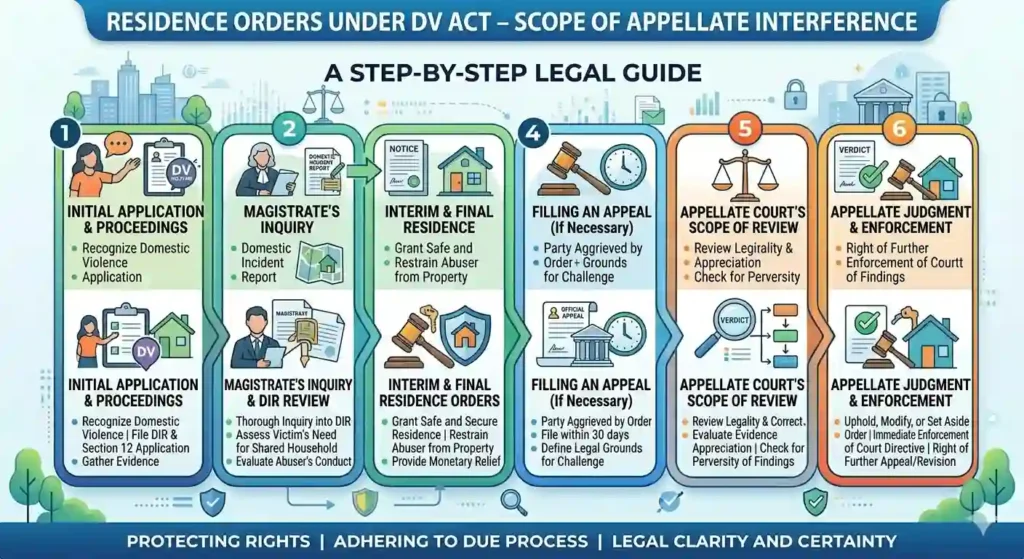
Important residence remedies include:
- Shared household protection
- Eviction restraint orders
- Alternate accommodation directions
- Possession restoration remedies
| Governing Law | Purpose | Relevant Forum |
|---|---|---|
| Domestic Violence Act | Residence protection | Magistrate Court |
| BNSS | Enforcement procedures | Criminal Court |
| BNS | Punishment for violations | Police Authorities |
Legacy Family Court Law Firm: Chennai Divorce Experts provides strategic representation involving residence order litigation and appeals.
Meaning of Shared Household Under Domestic Violence Law
Shared household interpretation significantly affects residence rights and appellate outcomes under domestic violence litigation proceedings nationwide. Courts generally recognize matrimonial homes, jointly occupied residences, and domestic relationship properties as protected shared households. Furthermore, judicial precedents clarify residence rights irrespective of ownership title held by respondents or relatives. Several disputes arise involving in-laws claiming exclusive ownership over disputed residential premises. Important shared household considerations include:
- Domestic relationship existence
- Joint residence history
- Matrimonial occupation evidence
- Dependency circumstances
- Safety and welfare concerns
| Shared Household Issue | Judicial Consideration | Legal Outcome |
|---|---|---|
| Matrimonial Residence | Continuous occupation | Residence protection |
| In-Laws Ownership Claim | Domestic relationship proof | Conditional residence rights |
| Alternate Accommodation | Financial capability | Substitute residence direction |
Consequently, detailed factual pleadings and documentary evidence substantially influence residence order determinations and appellate scrutiny proceedings.
Scope of Residence Orders Under Section 19
Section 19 empowers Magistrates issuing wide-ranging residential protection directions ensuring victim safety and housing security effectively. Courts may restrain dispossession, direct alternate accommodation, and prohibit respondents disturbing peaceful residential occupation rights. Moreover, Magistrates occasionally direct police assistance implementing residence-related judicial orders and emergency protection measures. Important residence directions include:
- Restricting unlawful dispossession
- Preventing property alienation
- Directing alternate accommodation
- Restoring residential access
- Regulating respondent entry
Nearby police stations frequently assist enforcement when respondents violate residence protections or threaten aggrieved women unlawfully. Additionally, Protection Officers coordinate shelter arrangements and compliance monitoring during ongoing domestic violence proceedings. Legacy Family Court Law Firm: Chennai Divorce Experts assists clients securing emergency residence protection and enforcement remedies.
Grounds for Challenging Residence Orders in Appeal
Respondents frequently challenge residence orders alleging jurisdictional errors, procedural irregularities, and insufficient evidence before appellate courts. Sessions Courts examine legality, proportionality, and evidentiary support underlying impugned residence directions carefully during appellate proceedings. Furthermore, appellate courts review whether Magistrates exceeded statutory powers or ignored material documentary evidence improperly. Important appellate grounds include:
- Lack of domestic relationship proof
- Absence of shared household evidence
- Jurisdictional irregularities
- Procedural violations
- Excessive interim directions
| Appellate Ground | Judicial Review Focus | Possible Outcome |
|---|---|---|
| Jurisdiction Error | Statutory compliance | Order modification |
| Evidence Deficiency | Record appreciation | Appeal allowance |
| Procedural Irregularity | Natural justice compliance | Remand proceedings |
Therefore, strategic appellate drafting and documentary analysis significantly influence judicial interference during appeal hearings.
Powers of Appellate Courts in Residence Order Cases
Sessions Courts exercise appellate jurisdiction under Section 29 of the Domestic Violence Act against Magistrate orders. Appellate Courts evaluate factual findings, procedural fairness, and legal correctness underlying challenged residence directions carefully. Moreover, appellate judges may modify, affirm, stay, or remand residence-related judicial orders during proceedings. Important appellate powers include:
- Interim stay directions
- Order modification powers
- Remand proceeding authority
- Evidence reassessment jurisdiction
- Procedural correction authority
| Appellate Power | Objective | Relevant Forum |
|---|---|---|
| Interim Stay | Prevent immediate hardship | Sessions Court |
| Order Modification | Balance competing rights | Appellate Court |
| Remand Direction | Fresh adjudication | Magistrate Court |
Consequently, appellate scrutiny ensures statutory compliance and balanced protection of competing residential and proprietary interests.
Interim Residence Orders and Judicial Discretion
Courts frequently grant interim residence orders during urgent domestic violence proceedings involving immediate safety concerns and dispossession threats. Judicial discretion depends upon prima facie evidence, urgency, financial dependence, and residential necessity circumstances presented during hearings. Furthermore, appellate courts rarely interfere unless discretion appears arbitrary, perverse, or unsupported by evidentiary materials. Important judicial considerations include:
- Immediate shelter necessity
- Financial dependency evidence
- Safety and welfare risks
- Alternative accommodation availability
- Conduct of litigating parties
| Judicial Factor | Court Consideration | Possible Relief |
|---|---|---|
| Urgent Safety Risk | Immediate intervention | Interim protection |
| Financial Dependence | Economic vulnerability | Alternate accommodation |
| Existing Occupation | Residential continuity | Possession protection |
Legacy Family Court Law Firm: Chennai Divorce Experts represents clients during interim hearings and urgent appellate proceedings efficiently.
Residence Orders Against In-Laws and Relatives
Residence disputes frequently involve in-laws contesting occupation rights within jointly owned or ancestral residential properties. Courts examine domestic relationship evidence and residential dependency before granting protective residence directions against relatives. Moreover, appellate forums carefully balance ownership rights against statutory protection objectives under domestic violence legislation. Important disputed issues include:
- Exclusive ownership allegations
- Joint family property claims
- Older citizen protection concerns
- Matrimonial occupation evidence
- Separate residence availability
| Dispute Issue | Judicial Approach | Legal Outcome |
|---|---|---|
| Ancestral Property Claim | Shared household analysis | Conditional protection |
| Older Citizen Rights | Welfare balancing | Limited residence direction |
| Separate Residence Availability | Necessity evaluation | Alternate accommodation |
Therefore, fact-specific analysis significantly influences appellate interference regarding residence claims against extended family members.
Role of Electronic Evidence Under Bharatiya Sakshya Adhiniyam
Electronic evidence increasingly influences domestic violence appeals involving residence rights, intimidation allegations, and occupancy disputes nationwide. Courts regularly examine WhatsApp messages, emails, photographs, and CCTV footage during appellate appreciation of evidentiary records. Bharatiya Sakshya Adhiniyam recognizes admissible electronic records satisfying statutory certification and authenticity requirements. Important electronic evidence includes:
- Mobile communications
- Residential photographs
- CCTV recordings
- Email exchanges
- Online financial records
| Electronic Evidence | Litigation Purpose | Relevant Law |
|---|---|---|
| WhatsApp Chats | Threat and harassment proof | BSA |
| CCTV Footage | Occupation verification | BSA |
| Bank Records | Financial dependency proof | BSA |
Consequently, advocates preserve electronic records carefully during domestic violence litigation and appellate preparation stages.
Scope of Appellate Interference in Residence Order Litigation
Appellate interference remains limited where Magistrate Courts exercise judicial discretion based upon proper evidentiary appreciation and statutory compliance. Therefore, Sessions Courts generally avoid substituting factual findings unless glaring legal or procedural irregularities emerge during scrutiny. Courts consistently emphasize victim protection, residential dignity, and welfare considerations during appellate review proceedings. Moreover, appellate judges balance constitutional property rights alongside statutory domestic violence protections and residential entitlements. Important appellate review principles include:
- Limited factual interference
- Respect for judicial discretion
- Procedural fairness assessment
- Statutory compliance verification
- Welfare-oriented interpretation
| Appellate Principle | Judicial Objective | Practical Impact |
|---|---|---|
| Limited Interference | Preserve trial discretion | Faster relief continuity |
| Procedural Scrutiny | Ensure fairness | Balanced adjudication |
| Welfare Consideration | Protect aggrieved women | Humanitarian approach |
Legacy Family Court Law Firm: Chennai Divorce Experts provides appellate advocacy and strategic domestic violence litigation support.
High Court Powers in Residence Order Challenges
High Courts exercise revisional and constitutional jurisdiction regarding illegal, arbitrary, or jurisdictionally defective residence-related appellate orders. Litigants frequently invoke Articles 226 and 227 challenging procedural irregularities and substantial injustice during domestic violence proceedings. Furthermore, High Courts intervene cautiously respecting statutory appellate mechanisms and factual findings recorded by subordinate courts. Important High Court remedies include:
- Revision petitions
- Writ petitions
- Supervisory jurisdiction proceedings
- Interim protection applications
- Constitutional challenge remedies
| High Court Remedy | Purpose | Relevant Jurisdiction |
|---|---|---|
| Revision Petition | Correct legal irregularity | Revisional Jurisdiction |
| Writ Petition | Constitutional protection | Article 226 |
| Supervisory Review | Judicial oversight | Article 227 |
Therefore, strategic constitutional litigation occasionally becomes necessary during complex residence order disputes and enforcement controversies.
Enforcement of Residence Orders and Police Assistance
Effective enforcement remains essential ensuring meaningful protection under residence orders issued by competent domestic violence courts. Police authorities assist implementation when respondents obstruct occupation rights or violate judicial restraints unlawfully. Furthermore, Protection Officers monitor compliance and coordinate emergency interventions during continuing harassment or intimidation situations. Important enforcement remedies include:
- Police protection requests
- Contempt-related applications
- Violation complaints
- Emergency intervention petitions
- Shelter assistance coordination
| Enforcement Issue | Legal Remedy | Relevant Authority |
|---|---|---|
| Order Violation | Criminal complaint | Police Station |
| Residential Obstruction | Police protection | Magistrate Court |
| Continued Harassment | Enforcement petition | Domestic Violence Court |
Nearby women police stations frequently coordinate urgent implementation and victim safety protection measures during residence-related disputes.
Interaction Between Residence Orders and Matrimonial Litigation
Residence orders often intersect with divorce proceedings, maintenance disputes, child custody litigation, and matrimonial property disagreements. Family Courts and Domestic Violence Courts occasionally address overlapping factual allegations involving cruelty, desertion, and economic abuse claims. Moreover, appellate forums evaluate consistency between concurrent judicial findings affecting residence and matrimonial rights. Important interconnected proceedings include:
- Divorce petitions
- Maintenance proceedings
- Child custody litigation
- Restitution petitions
- Domestic violence complaints
| Matrimonial Proceeding | Impact on Residence Rights | Relevant Forum |
|---|---|---|
| Divorce Petition | Residential continuity consideration | Family Court |
| Maintenance Claim | Alternate accommodation funding | Magistrate Court |
| Custody Litigation | Child welfare assessment | Family Court |
Consequently, coordinated litigation strategy significantly strengthens legal protection and procedural consistency across parallel proceedings.
Defending False Residence Claims and Misuse Allegations
Respondents occasionally allege misuse of domestic violence proceedings for securing residential control or strategic matrimonial advantages improperly. Courts therefore scrutinize documentary evidence, residential history, and conduct of litigants carefully before granting extensive residence protections. Furthermore, appellate forums may interfere where findings appear unsupported, malicious, or legally unsustainable upon judicial scrutiny. Important defense strategies include:
- Ownership documentation production
- Separate residence proof
- Financial independence evidence
- Prior litigation history analysis
- Contradictory statement identification
| Defense Strategy | Litigation Objective | Possible Outcome |
|---|---|---|
| Ownership Evidence | Challenge shared household claim | Appeal success |
| Separate Residence Proof | Reduce necessity claim | Order modification |
| Contradictory Records | Impeach credibility | Evidentiary advantage |
Legacy Family Court Law Firm: Chennai Divorce Experts handles contested residence litigation and appellate defense proceedings strategically.
Future Trends in Residence Order Litigation and Appellate Review
Indian domestic violence jurisprudence increasingly emphasizes victim-centered interpretation alongside balanced property rights protection principles nationwide. Courts presently encourage faster interim relief, digital filings, and technology-driven evidentiary evaluation during domestic violence proceedings. Moreover, electronic evidence and online communication records now substantially influence residence-related judicial findings and appellate scrutiny. Emerging legal trends include:
- Virtual domestic violence hearings
- AI-assisted evidence review
- Digital complaint systems
- Enhanced victim protection frameworks
- Technology-driven appellate management
| Emerging Development | Practical Impact | Legal Significance |
|---|---|---|
| Virtual Hearings | Faster judicial access | Improved accessibility |
| Digital Evidence Systems | Better factual analysis | Enhanced accuracy |
| Online Filing Platforms | Procedural convenience | Reduced delays |
Consequently, litigants should obtain updated legal guidance reflecting evolving domestic violence jurisprudence and appellate standards. Legacy Family Court Law Firm: Chennai Divorce Experts remains committed toward effective residence order advocacy and appellate representation.
FAQs on Residence Orders Under DV Act – Scope of Appellate Interference
Q1. Which court hears appeals against residence orders under the DV Act?
Sessions Courts hear appeals under Section 29 of the Domestic Violence Act against Magistrate residence orders.
Q2. Can appellate courts stay residence orders immediately?
Yes. Appellate Courts may grant interim stay orders where serious hardship or legal irregularities appear evident.
Q3. What evidence supports shared household claims?
Residential records, photographs, utility bills, witness statements, and electronic communications commonly support shared household claims.
Q4. Can in-laws challenge residence orders before appellate courts?
Yes. In-laws may challenge residence directions alleging ownership rights, procedural irregularities, or absence of domestic relationships.
Q5. Do police assist enforcement of residence orders?
Yes. Police authorities and Protection Officers assist implementation when respondents violate judicial residence protections unlawfully.
Q6. Can High Courts interfere with appellate residence orders?
Yes. High Courts may exercise revisional or constitutional jurisdiction against arbitrary or legally defective appellate orders.
Read More
- Misuse of Matrimonial Laws: High Court Powers Under BNSS
- Appeal Against Domestic Violence Orders – Procedure Under BNSS
- Domestic Violence Proceedings After BNS & BNSS – What Has Changed?
- Parental Alienation in Custody Disputes – Legal Remedies Available
- Child’s Preference in Custody Appeals – How Courts Evaluate
- National Commission for Women (NCW)