

Domestic Violence Proceedings – Domestic violence remains one of the most sensitive and serious legal issues in India. For many years, victims relied on laws such as the Protection of Women from Domestic Violence Act, 2005 and provisions under the Indian Penal Code (IPC) and Criminal Procedure Code (CrPC) to seek justice and protection. However, India recently introduced major criminal law reforms through the Bharatiya Nyaya Sanhita (BNS), 2023 and the Bharatiya Nagarik Suraksha Sanhita (BNSS), 2023. These laws replaced the IPC and CrPC and brought important procedural and structural changes to criminal proceedings.
As a result, many individuals and families now ask an important question: what has changed in domestic violence proceedings after BNS and BNSS?
At Legacy Family Court Law Firm, we help clients understand how these new laws affect domestic violence complaints, criminal proceedings, maintenance claims, police procedures, bail matters, and family disputes. Understanding these legal changes is essential because they directly affect victims, accused persons, families, and ongoing court cases.
Domestic Violence Proceedings After BNS & BNSS – What Has Changed? – Legacy Family Court Law Firm: Chennai Divorce Experts
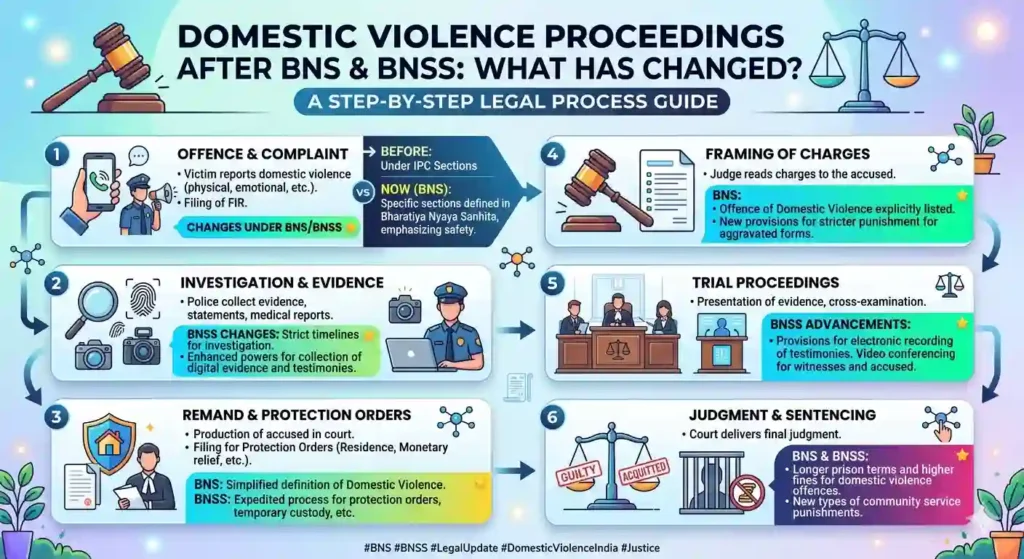
Understanding BNS and BNSS
The Bharatiya Nyaya Sanhita (BNS), 2023 replaced the Indian Penal Code, 1860. Similarly, the Bharatiya Nagarik Suraksha Sanhita (BNSS), 2023 replaced the Code of Criminal Procedure, 1973.
The government introduced these laws to modernize the criminal justice system, simplify procedures, improve efficiency, and incorporate technology into investigations and court proceedings.
Although the Protection of Women from Domestic Violence Act, 2005 still continues separately, domestic violence cases often involve criminal complaints, police action, arrest procedures, bail applications, maintenance proceedings, and evidence collection. Therefore, the changes under BNS and BNSS significantly impact how these matters are handled.
Domestic Violence Law Still Continues
One important point must be clearly understood. The Protection of Women from Domestic Violence Act, 2005 has not been repealed. Victims can still seek:
- protection orders,
- residence orders,
- maintenance,
- custody orders,
- compensation, and
- emergency relief.
However, criminal proceedings connected to domestic violence now follow the framework of BNS and BNSS instead of IPC and CrPC provisions.
Therefore, while the core protection rights remain intact, the procedural system has changed in several ways.
Replacement of IPC Provisions with BNS
Earlier, domestic violence-related criminal complaints were often filed under IPC provisions such as:
- Section 498A for cruelty by husband or relatives,
- assault provisions,
- criminal intimidation,
- hurt,
- wrongful restraint, and
- dowry harassment.
Now, corresponding offences are governed under the Bharatiya Nyaya Sanhita.
Although many offences remain similar in substance, the numbering and structure have changed. Therefore, lawyers, police officers, and litigants must carefully understand the updated provisions while filing complaints or defending cases.
This transition has created confusion for many people because older case references still mention IPC sections, while new FIRs now refer to BNS provisions.
Greater Use of Digital Technology
One major change under BNSS is the increased use of technology in criminal proceedings. This directly affects domestic violence cases as well.
Electronic FIRs and Complaints
Victims can now benefit from more digital-friendly procedures. In many situations, electronic communication and online complaint systems may assist victims who cannot physically visit police stations immediately.
This becomes especially important in domestic violence matters where victims may face fear, restrictions, or immediate threats inside the household.
Electronic Summons and Notices
BNSS encourages the use of electronic communication for notices and summons. Consequently, court procedures may become faster and more transparent.
Digital Evidence
Modern domestic violence cases often involve:
- WhatsApp chats,
- emails,
- audio recordings,
- CCTV footage,
- photographs,
- call records, and
- social media messages.
BNSS gives stronger recognition to electronic evidence and modern investigation methods. Therefore, digital records now play an even bigger role in proving abuse, threats, harassment, or financial control.
Faster Investigation and Trial Procedures
Another important goal of BNSS is reducing delays in criminal cases. Domestic violence victims often suffer emotionally and financially when proceedings continue for years.
The new framework aims to:
- speed up investigations,
- improve coordination between police and courts,
- reduce unnecessary delays, and
- encourage timely hearings.
Although practical implementation may still take time, the legal structure now focuses more strongly on efficiency.
This can benefit victims seeking urgent protection as well as accused persons seeking speedy resolution.
Changes in Arrest Procedures
Arrest procedures under BNSS have also received attention. In family disputes and domestic violence matters, arrest often becomes a highly sensitive issue.
Courts in India have repeatedly emphasized that automatic arrests should be avoided in matrimonial disputes unless genuinely necessary.
Under the updated framework:
- police officers must follow procedural safeguards,
- reasons for arrest may require better documentation,
- unnecessary arrests may face stricter scrutiny, and
- notice procedures may be used in certain cases.
Therefore, the balance between victim protection and prevention of misuse has become an important focus.
Impact on Bail Proceedings
Bail remains a major concern in domestic violence-related criminal cases. Under BNSS, bail procedures continue but procedural mechanisms have been reorganized.
Courts now increasingly consider:
- seriousness of allegations,
- safety of the victim,
- possibility of intimidation,
- evidence tampering risks,
- family circumstances, and
- chances of settlement.
At the same time, courts also recognize that matrimonial disputes sometimes involve emotional and exaggerated allegations. Therefore, judicial scrutiny continues to play a major role.
Stronger Focus on Victim Rights
Modern criminal reforms increasingly emphasize victim rights and dignity. Domestic violence survivors often face emotional trauma, financial dependency, and social pressure.
BNSS promotes:
- better victim communication,
- faster procedural access,
- use of technology,
- improved transparency, and
- structured investigation processes.
Victims may also receive better updates regarding case status, hearings, and procedural developments.
This shift attempts to make the justice system more accessible and victim-friendly.
Mediation and Settlement Possibilities
Family disputes are unique because emotional relationships are deeply involved. In many domestic violence-related matters, courts encourage mediation when appropriate and safe.
However, serious physical violence and life-threatening abuse cannot always be resolved through settlement alone.
After BNS and BNSS, mediation continues to remain important in suitable matrimonial disputes. Courts may encourage:
- counseling,
- negotiated settlements,
- maintenance agreements,
- child custody arrangements, and
- mutual divorce discussions.
Still, victim safety remains the highest priority.
Importance of Documentation in Domestic Violence Cases
Under the new legal framework, proper evidence collection has become even more important.
Victims should maintain:
- medical records,
- screenshots,
- threatening messages,
- photographs of injuries,
- bank records,
- witness details, and
- complaint copies.
Similarly, accused persons should also preserve relevant communications and records to protect themselves against false or exaggerated allegations.
Because digital evidence now carries greater importance, proper preservation of electronic data can significantly affect the outcome of a case.
Impact on Maintenance and Financial Relief
Domestic violence proceedings frequently involve financial disputes. Victims may seek:
- interim maintenance,
- child support,
- residence expenses,
- medical costs, and
- compensation.
Although maintenance laws continue under separate statutes, criminal procedural reforms may influence how quickly interim applications are heard and enforced.
Courts are increasingly focusing on timely financial relief because delayed maintenance often causes severe hardship.
Protection Orders Continue to Be Important
Protection orders remain one of the strongest remedies available to domestic violence survivors.
Courts can still restrain the respondent from:
- committing violence,
- contacting the victim,
- entering workplaces,
- disposing of assets,
- threatening witnesses, or
- disturbing children.
The procedural modernization under BNSS may help streamline enforcement and communication of such orders.
Concerns About Misuse and False Complaints
Domestic violence laws protect vulnerable individuals, but concerns regarding misuse also continue to exist.
Indian courts have repeatedly acknowledged that false or exaggerated complaints can damage families and innocent individuals. Therefore, procedural safeguards remain important.
The new criminal law structure attempts to balance:
- victim protection,
- due process rights,
- fair investigation, and
- judicial oversight.
Courts continue to examine evidence carefully before taking strong actions such as arrest or prolonged custody.
Role of Family Courts After BNS and BNSS
Family courts continue to play a central role in resolving matrimonial and domestic disputes.
Even after the new criminal laws:
- divorce proceedings,
- child custody matters,
- maintenance claims,
- restitution petitions, and
- family settlements
remain under family court jurisdiction.
However, criminal complaints linked to domestic violence now proceed through the updated BNS and BNSS framework.
Therefore, many families simultaneously face both family court litigation and criminal proceedings.
Challenges During the Transition Period
Since BNS and BNSS are relatively new laws, practical challenges still exist.
Many people face confusion regarding:
- old and new section numbers,
- procedural differences,
- filing formats,
- police practices, and
- transitional case handling.
Lawyers, police departments, and courts are also adapting to the new legal system. Consequently, professional legal guidance has become even more important during this transition phase.
Importance of Legal Representation
Domestic violence proceedings are emotionally and legally complex. The introduction of BNS and BNSS has added another layer of procedural change.
At Legacy Family Court Law Firm, we help clients:
- understand their legal rights,
- file or defend domestic violence cases,
- seek protection orders,
- handle criminal proceedings,
- apply for bail,
- pursue maintenance claims, and
- navigate family court disputes.
Experienced legal representation helps avoid procedural mistakes and protects long-term interests.
Frequently Asked Questions
The Bharatiya Nyaya Sanhita (BNS), 2023 replaced the Indian Penal Code, while the Bharatiya Nagarik Suraksha Sanhita (BNSS), 2023 replaced the Criminal Procedure Code. Domestic violence proceedings continue under the Protection of Women from Domestic Violence Act, 2005, but related criminal complaints now follow the new BNS and BNSS framework. These laws introduce updated procedures, stronger use of technology, electronic evidence handling, and modernized investigation methods. Therefore, victims, accused persons, lawyers, and courts must adapt to new procedural rules and revised offence structures in domestic violence-related criminal proceedings.
No. The Protection of Women from Domestic Violence Act, 2005 remains fully valid and enforceable. Victims can still seek protection orders, maintenance, compensation, residence rights, child custody relief, and emergency assistance from courts. However, criminal offences connected to domestic violence now operate through corresponding provisions under BNS instead of the old IPC sections.
Digital evidence has become more important under BNSS. Courts and investigators now increasingly rely on WhatsApp chats, emails, audio recordings, CCTV footage, screenshots, social media messages, and electronic communication to examine allegations of abuse, harassment, threats, and financial control within domestic relationships.
Yes. BNSS promotes procedural safeguards and discourages unnecessary arrests in family disputes. Courts now carefully examine evidence, seriousness of allegations, victim safety, and risks of misuse before granting or denying bail.
Because BNS and BNSS introduced major procedural changes, experienced legal guidance helps individuals properly file complaints, defend allegations, protect rights, understand new provisions, and avoid procedural mistakes during domestic violence proceedings.
Conclusion
The introduction of the Bharatiya Nyaya Sanhita (BNS) and Bharatiya Nagarik Suraksha Sanhita (BNSS) marks a major transformation in India’s criminal justice system. While the Protection of Women from Domestic Violence Act, 2005 continues to protect victims, the procedural and criminal law framework surrounding domestic violence cases has evolved significantly.
The new laws focus on modernization, technology, faster proceedings, digital evidence, procedural efficiency, and victim rights. At the same time, courts continue to balance due process protections and concerns regarding misuse.
For victims, accused individuals, families, NGOs, and NRIs, understanding these legal changes is extremely important. Domestic violence matters involve not only legal rights but also emotional, financial, and social consequences.
At Legacy Family Court Law Firm, we remain committed to guiding clients through every stage of domestic violence proceedings with clarity, compassion, and strong legal support. With proper legal advice and timely action, individuals can better protect their rights and navigate the changing legal landscape after BNS and BNSS.
Read More
- Parental Alienation in Custody Disputes – Legal Remedies Available
- Child’s Preference in Custody Appeals – How Courts Evaluate
- International Child Custody Disputes – Supreme Court Jurisprudence
- Denial of Visitation Rights – Legal Remedies Before High Court
- Habeas Corpus in Child Custody Matters – When Is It Applicable?
- Legislative Department – Ministry of Law and Justice