


Inheritance Rights for Christians – Inheritance matters often bring not only legal questions but also emotional stress for families. When a loved one passes away, the division of property must be handled with clarity, fairness, and respect. For Christians in India, inheritance is governed mainly by the Indian Succession Act, 1925, a law that aims to ensure just and orderly distribution of assets.
At Legacy Family Court Law Firm: Chennai Divorce Experts, we believe that every person deserves clear legal guidance during such sensitive moments. Therefore, in this article, we explain the rules, rights, and processes in simple words so that you can understand your position confidently.
Inheritance Rights for Christians Under the Indian Succession Act – Legacy Family Court Law Firm
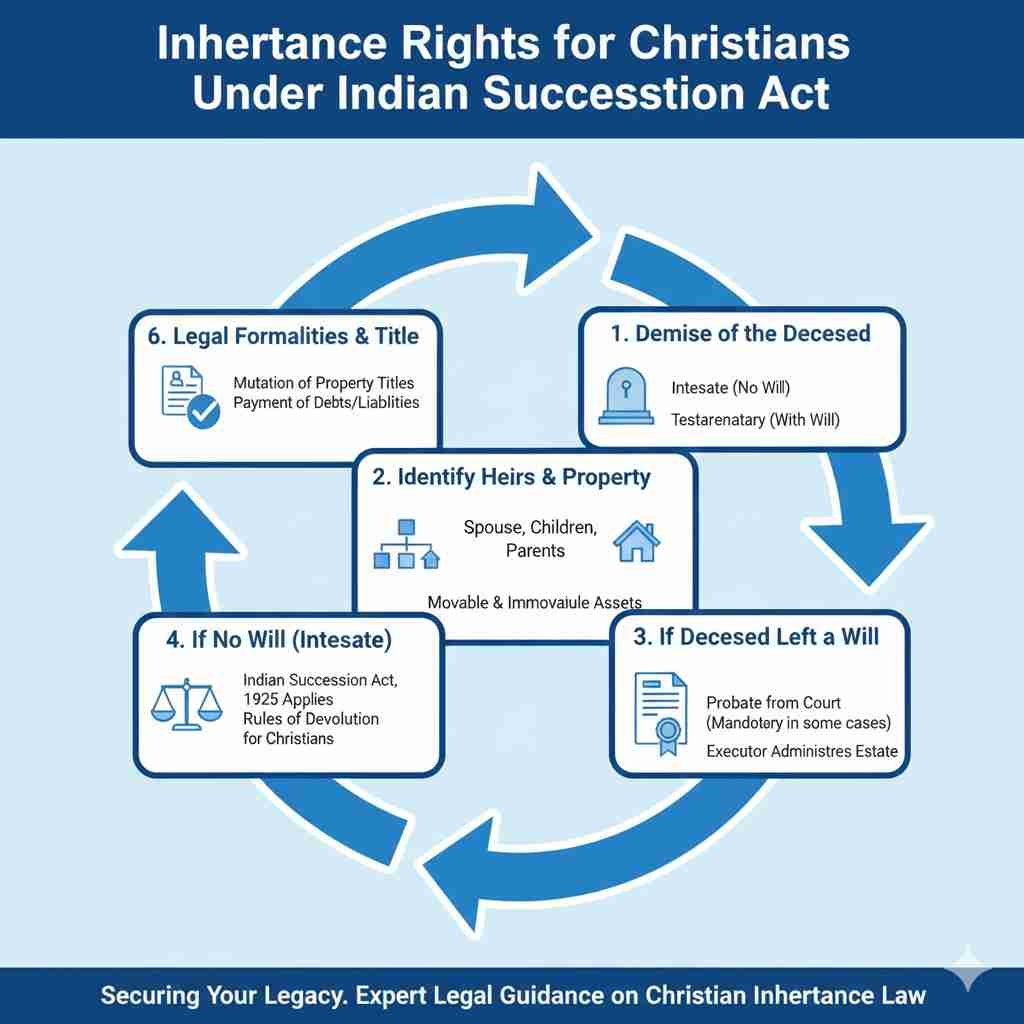
1. Understanding the Indian Succession Act for Christians
The Indian Succession Act applies to Indian Christians for matters of intestate succession (when a person dies without a will) and testamentary succession (when a person leaves a valid will).
While the law might seem complex at first, it becomes easier when we break it down step by step. Christian inheritance law is based on principles of fairness and equal distribution among close family members.
2. What Happens If There Is No Will?
When a Christian individual dies without a will, the law decides how their property should be shared. This type of inheritance is called intestate succession.
Surprisingly, the rules for Christian inheritance are quite structured. They ensure that spouses and children receive the primary share. Let us explore the main points.
3. Rights of the Christian Widow or Widower
The surviving spouse receives a significant share of the estate. Moreover, the law ensures the spouse is not left without financial support.
If the deceased leaves behind a spouse and children:
- The spouse gets one-third (1/3) of the property.
- The children share the remaining two-thirds (2/3) equally.
If the deceased has no children but leaves parents:
- The spouse gets half (1/2) of the property.
- The other half (1/2) goes to the parents.
If there are no parents or children:
- The spouse gets the entire estate.
These rules highlight the importance the law places on protecting the surviving spouse.
4. Rights of Christian Children
Another essential aspect is the equal treatment of children. Christian inheritance law does not discriminate based on gender.
Key points:
- Sons and daughters inherit equally.
- The law treats adopted children as legal heirs if the adoption is valid.
- Children born outside marriage may have rights if paternity is legally established.
This ensures that every child gets a fair share of the estate.
5. Rights of Parents
Parents come next in the order of inheritance if the deceased has no children. Their rights depend on whether the surviving spouse is alive.
- If both spouse and parents survive, parents share half of the estate.
- If the deceased is unmarried and childless, parents inherit the entire estate.
This reflects the law’s recognition of parental dependency.
6. Rights of Siblings and Extended Family
If the deceased has neither spouse, children, nor parents, the property moves to:
- Brothers and sisters,
- Then to nephews and nieces,
- And later to more distant relatives.
The law follows a structured hierarchy so that property never remains unclaimed.
7. What Happens When There Is a Valid Will?
When a person leaves a valid will, the distribution of property happens according to their written wishes. Christian law allows full freedom regarding how assets may be distributed.
However, for the will to be accepted, it must meet certain conditions:
- The person making the will must be of sound mind.
- The will should be in writing.
- It must be signed by the testator.
- It must be attested by two witnesses.
At Legacy Family Court Law Firm, we often guide families through verifying, probating, and executing wills, ensuring the process is smooth and legally sound.
8. Concept of Probate for Christian Wills
Unlike some other communities, Christians must obtain a probate from a competent court for a will to take effect.
Probate is necessary when:
- The property lies in Chennai, Mumbai, or Kolkata,
- Or when the beneficiaries require an authenticated legal order.
A probate certifies that:
- The will is genuine,
- The executor is authorized to distribute the assets.
Our lawyers assist clients through the entire probate process, which can otherwise become stressful and time-consuming.
9. Common Disputes in Christian Inheritance Cases
Despite clear legal rules, disputes can still arise. Many disagreements stem from misunderstandings or poor documentation.
Common disputes include:
- Conflicts over the validity of a will
- Claims of unequal distribution
- Challenges raised by distant relatives
- Disputes over jointly owned property
- Questions regarding adopted or stepchildren
In such situations, it is important to act quickly. Our firm specializes in resolving these issues through negotiation, mediation, or litigation when necessary.
10. Importance of Creating a Will
Creating a will is one of the most responsible decisions a person can make. It prevents conflict and ensures that assets reach the intended beneficiaries.
Advantages of writing a will:
- Avoids family disputes
- Protects the spouse and children
- Allows distribution according to personal wishes
- Simplifies court procedures
- Ensures peace of mind for everyone involved
We often encourage clients to prepare wills early and review them regularly.
11. Role of a Family Court Lawyer in Inheritance Matters
Inheritance cases often intersect with family law issues, especially when relationships are strained. Our role as family court lawyers includes:
- Explaining inheritance rights
- Drafting wills
- Initiating probate proceedings
- Representing clients in disputes
- Protecting rights of vulnerable family members
- Advising NRIs on Indian inheritance procedures
Because inheritance can affect the emotional fabric of a family, our approach is always compassionate and balanced.
12. Support for NRIs in Christian Succession Matters
Many Christian families in Chennai have members living abroad. NRIs often face additional challenges, such as:
- Difficulty coordinating legal paperwork
- Miscommunication with relatives
- Problems accessing documents
- Property misuse or unauthorized transfers
We offer complete legal support for NRIs, ensuring that inheritance rights are upheld even when they are far away.
13. Documentation Required in Christian Inheritance Cases
Proper documentation ensures the legal process moves smoothly.
Typically required documents include:
- Death certificate
- Proof of relationship
- Identity documents
- Property records
- Original will (if any)
- Affidavits and witness statements
We guide clients in collecting and verifying all necessary documents before approaching the court.
14. Why Choose Legacy Family Court Law Firm?
At Legacy Family Court Law Firm: Chennai Divorce Experts, our mission is to support families during important turning points in life. Inheritance matters require clarity, sensitivity, and strong legal skills.
We stand out because we:
- Provide clear explanations in simple language
- Offer compassionate guidance
- Focus on resolving disputes peacefully
- Have decades of combined experience in family law
- Represent clients in Chennai’s Family Courts, High Court, and Probate Courts
- Assist NRIs with complete end-to-end support
Above all, we act with integrity, ensuring justice and fairness for every client.
Frequently Asked Questions
Inheritance for Indian Christians is mainly governed by the Indian Succession Act, 1925, which outlines how property is distributed when a person dies with or without a will. The Act gives Christians complete freedom to create a will and clearly defines how assets must be shared among the spouse, children, parents, and other relatives if there is no will. Because the law is uniform and structured, it helps avoid confusion and ensures fair distribution.
When a Christian dies intestate, the law follows a specific hierarchy. If the person leaves behind a spouse and children, the spouse receives one-third and the children share the remaining two-thirds equally. If there are no children, the spouse receives half and the parents receive the other half. In the absence of spouse, children, and parents, the estate passes to siblings and then to extended relatives.
Yes. Christian inheritance law treats sons and daughters equally. Both receive the same share during intestate succession. The Act also recognizes the rights of adopted children if the adoption is legally valid.
Yes. For Christians, obtaining a probate is usually mandatory, especially when the property is located in Chennai, Mumbai, or Kolkata. Probate is a court order confirming that the will is genuine and allowing the executor to distribute assets legally.
Absolutely. NRIs have full inheritance rights. They can file probate, submit documents, and claim their share through a legal representative or power of attorney, ensuring smooth property transfer even from abroad.
Conclusion
Understanding Inheritance Rights for Christians under the Indian Succession Act is essential for avoiding disputes and protecting your family’s future. Whether you are dealing with a will, intestate succession, or a contested inheritance, the law provides clear guidelines. And with the right legal support, the entire process can become smoother and less stressful.
At Legacy Family Court Law Firm: Chennai Divorce Experts, we stand ready to assist you with every step—from drafting wills to handling probate and resolving disagreements. With compassion, clarity, and expertise, we help you protect what truly matters: your family and your legacy.
Read More
- Legal Protection for Women Under Section 498A of the Indian Penal Code
- Get Justice for Dowry Death Under Section 304B IPC
- Fight Dowry Cases Under Section 304B of the Indian Penal Code
- Marriage Dissolution Guidance Under the Indian Divorce Act
- Legal Help for Christian Marriages Under the Indian Christian Marriage Act
- The Indian Succession Act, 1925 — Legislative Department, Ministry of Law & Justice